
Trusted by B2B technology scale-ups





Everything Capchase Can't Do.
With Ratio you unlock buyer-friendly terms inside your CRM, shift fees off your P&L, and automate quote to cash process

Quote in your CRM
Capchase has no proposals, no e-sign. Ratio builds the proposal inside Salesforce or HubSpot: reps configure pricing and payment terms, the buyer picks a schedule, approval runs instantly, and signature happens on the same flow. The deal never leaves the CRM.

Cash Upfront
Capchase converts signed ARR into capital, with a flat fee deducted from your payout. Ratio pays you the contract value upfront at the moment of yes, while your buyer pays over time. Pricing is risk-based, and you choose who absorbs the fee: buyer, seller, or a split.

Renewals in Autopilot
Capchase stops at the payout. Collections, renewals, and subscription management stay with your team, or cost extra. Ratio automates collections and renewals as part of the platform, with co-termination back to the original contract.




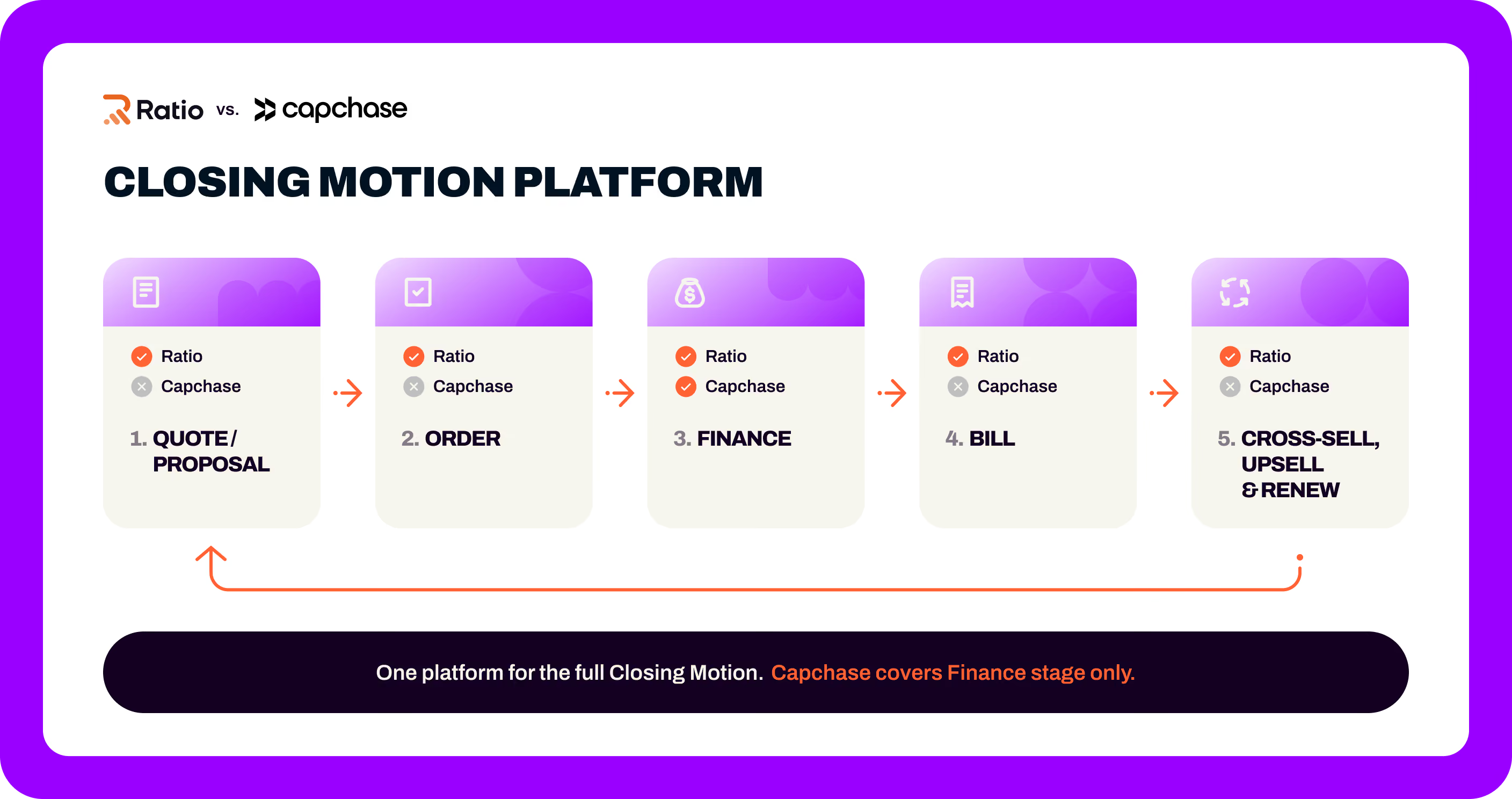
A Financing Tool Isn't a Closing Motion Platform.
Capchase is the closest thing to a direct competitor, so here's the direct answer. On new deals, Boost pays you upfront at the moment of yes while your buyer pays over time, with no document-chase because Ratio underwrites the buyer, not you. On the book you've already built, Trade advances a lump sum against your ARR on one company-level underwrite, repaid in fixed, predictable monthly payments. Both run on the same platform rails as your billing and collections, and Trade capacity can grow as more of your motion runs through Boost.
Capchase
Capchase activates after a deal is signed. It converts ARR into cash. Useful, but reactive.
RATIO
Ratio runs the close itself. Reps configure terms, route buyers through instant approval, send e-sign, collect upfront cash, and renew, all inside the CRM where the deal lives.
Capchase vs Ratio: Side-by-Side Comparison
If you're evaluating Capchase against Ratio, here's what each option actually covers on the same deal.
The table below breaks down exactly where the two platforms differ—and why top revenue teams choose Ratio when growth is the goal.
DIMENSION


Industry fit
Ratio supports software, robotics, hardware / equipment, value added resellers (VARs), and digital services.
Capchase is SaaS-focused.
International availability
Ratio supports 12 countries and growing.
Capchase supports 9.
Capital availability
Both offer access to >$500M in non-dilutive funding.
Both offer access to >$500M in non-dilutive funding.
Multi year deals
Ratio supports up to 60-month terms with custom schedules.
Capchase generally caps at 24 months on a fixed schedule.
Custom payment terms
Ratio supports milestone, deferred, and usage-based plans.
Capchase only offers standard terms.
Recourse flexibility
Ratio offers various recourse models.
Capchase always requires the seller to take the risk.
Control over who pays financing fee
Ratio lets sellers shift cost to buyer or split.
Capchase charges the seller 100%.
Pricing optimization
Ratio uses risk-based pricing (4–20%).
Capchase uses flat 10% fees.
Data-light underwriting
Ratio doesn't require any information from the buyer in most cases. Underwriting is fully automated.
Capchase often requires financial statements from buyers, with manual processing.
Instant buyer approval
Ratio's credit algorithm determines buyer eligibility instantly.
Capchase often involves manual steps.
Inside the deal
CRM integrations (Salesforce & HubSpot)
Both integrate, but Ratio embeds deeper into the sales stack.
Both integrate, but Ratio embeds deeper into the sales stack.
Embedded inside sales workflow
Ratio is built into Salesforce and HubSpot.
Capchase sits outside the quote process.
Built-in quote & proposal tools
Native quoting, proposal, e-sign, and subscription management. Optional integrations with Salesforce CPQ, DocuSign, Chargebee, and Recurly.
Capchase has no quoting, proposal, or modern billing. Limited integrations.
Buyer Activity Tracking & Automated Followup
Ratio tracks every buyer action in the proposal, with automated follow-ups.
Capchase has no buyer-side visibility because it sits outside the sales motion.
Channel & reseller support
Ratio supports VAR, marketplaces, and indirect sales.
Capchase does not.
Seamless vendor workflow
Ratio reduces manual handoffs.
Capchase requires coordination across tools and teams.
After signature
Collections Module
Ratio includes collections for free.
Capchase charges extra or requires seller involvement.
Upsells, Cross-sell & renewals support
Ratio automates expansion and renewal workflows and allows for co-termination with the original contract.
Capchase does not support them.
Across the program
Real-time reporting & analytics
Real-time, finance-grade dashboards across pipeline, cash, and program performance.
Capchase provides basic reporting.
Role based access controls and reporting
Ratio is built for the enterprise and supports role based access controls to features and realtime program data and analytics
Limited controls.
Enterprise grade security
Both Ratio and Capchase are SOC 2 compliant. Ratio adds bank-level security with row-level access controls.
Both Ratio and Capchase are SOC 2 compliant.
Integrations
Ratio: 19+ integrations across CRM, accounting, billing, e-signature, and tax. Salesforce, HubSpot, DocuSign, Stripe, Chargebee, and more.
Limited integrations.
Sometimes a Slice Is All You Need. Usually It Isn't.
If cash collections is your only bottleneck, AR automation will help. If you need one infusion of capital and nothing about your close needs to change, a financing tool will do it. But watch out for the most common false positive: "our buyers already prepay annually, so we just need a proposal tool." If every buyer you win prepays, that isn't proof you don't need payment terms. It's proof your market has been filtered down to the buyers who can.
The prospects who needed monthly terms stalled, demanded a discount, or never entered your pipeline at all: 80.2% of SaaS leaders saw payment terms block deals in the last 90 days. Offering terms doesn't just smooth the close for the buyers you already win. It expands the market to the ones you're currently locked out of. That's not a slice problem. That's the motion.
80.2%
of SaaS leaders saw payment terms block deals in the last 90 days.
What Changes on Ratio
+30%
Higher close rates when payment-term friction comes out of the deal.
+25%
ACV growth when discounting for annual prepay stops.
87%
Of deals priced and approved automatically in under one second.
FAQS
Whether you lead sales, run operations, or own the numbers.
Why Ratio Outperforms Capchase
Capchase is a financing tool. Ratio is a Closing Motion platform. That distinction is the whole point of this page. A Closing Motion is the operational sequence your team runs to convert an opportunity into recognized revenue: pricing the offer, structuring terms, approving the buyer, capturing signature, collecting cash, and setting up renewal. Most companies stitch this together across CPQ, e-sign, payments, billing, and a financing add-on. The result is brittle, expensive, and slow. Ratio collapses the whole sequence into one workflow inside the CRM where the deal already lives. Capchase doesn't do any of this. It activates after the deal is signed, converts ARR into cash, and exits. That's a useful instrument. It is not a way to win deals.
Ratio takes a fundamentally different approach. It embeds financing into the sales motion itself, giving your reps a way to offer buyer-friendly terms, like deferred payments, milestone-based billing, or usage-based structures, at the exact moment a deal is on the line. This flexibility helps you close faster and more often, without defaulting to heavy discounting.
Unlike Capchase, which sits outside your GTM workflow, Ratio lives inside your CRM and CPQ. Your sales team can generate quotes, configure terms, and send proposals with e-signature, all in one place. There's no need to coordinate across tools, teams, or timelines. It's the difference between bolting on financing after the deal and making it part of how the deal gets done.
Where Capchase locks you into fixed repayment terms and forces the seller to absorb a flat 10% fee (deducted upfront), Ratio gives you complete control. Pricing is dynamic, typically between 4% and 20% depending on risk, and you decide who pays the fee: the buyer, the seller, or a custom split. The result is more strategic control over margin without needing blanket discount approvals.
Capchase also creates friction for buyers, requiring document uploads and manual underwriting. Ratio simplifies this entirely. With just an EIN, buyers can be instantly approved. There's no back-and-forth or deal drag, just a seamless checkout experience built for modern B2B sales.
Beyond the deal itself, Capchase stops short. Collections, renewals, and subscription management remain your team's responsibility, or require additional paid services. Ratio, by contrast, automates collections and renewals as part of the platform. Finance teams gain full visibility into cash flow, payment health, and contract performance through customizable reporting dashboards, tax-handling, and real-time insights.
And while Capchase doesn't support reseller, channel, or marketplace sales, Ratio does. Whether you're selling directly, through partners, or using complex deal structures, Ratio can handle it, backed by integrations with 19+ systems including Salesforce, Stripe, HubSpot, Chargebee, and more.
In short, Capchase is a simple financial instrument. Ratio is a revenue engine. It doesn't just help you fund what you've already sold, it helps you sell more in the first place, close with confidence, and control every lever that affects revenue performance.
If you're trying to fund deals, Capchase will do that. If you're trying to close more of them, you need a Closing Motion platform. That's Ratio.


