How Does B2B BNPL Work? A Practical Guide for SaaS Sales Leaders
Challenge: Why Do SaaS Deals Keep Slipping Late in the Cycle? Procurement slowdowns. Budget objections. Delayed approvals. Even great SaaS sales teams lose high-intent deals to timing friction and payment constraints. The business impact is real: delayed revenue recognition, missed quarterly targets, forecast volatility and uneven cash flow, pipeline bloat from deals stuck in limbo Flexible payment terms help, but most solutions still leave sellers waiting to get paid and exposed to collection risk.

Table of contents

B2B BNPL helps SaaS sales leaders close faster, collect full contract value upfront, and avoid deep discounting. This guide breaks down how it works, how to embed it into your sales stack, and what to look for in a provider who understands SaaS sales.
Challenge: Why Do SaaS Deals Keep Slipping Late in the Cycle?
Procurement slowdowns. Budget objections. Delayed approvals. Even great SaaS sales teams lose high-intent deals to timing friction and payment constraints.
The business impact is real:
- Delayed revenue recognition
- Missed quarterly targets
- Forecast volatility and uneven cash flow
- Pipeline bloat from deals stuck in limbo
Flexible payment terms help, but most solutions still leave sellers waiting to get paid and exposed to collection risk.
This is where B2B Buy Now, Pay Later (BNPL) comes in. It offers a way to close faster, collect cash up front, and remove friction caused by broken quote-to-cash processes without changing how you price or sell.
This guide breaks down how B2B BNPL works, what makes it different from consumer tools, and how it can drive real revenue outcomes for SaaS businesses; for a deeper dive tailored to software companies, see our overview of B2B BNPL for SaaS.
Let's get started.
Step-by-Step Guide: How B2B BNPL Actually Works
"Startups aren't just software providers. They're banks, and they don't even know it." So writes Gustavo Guida, CMO of Ratio, in The Cash Flow Dilemma.
Most SaaS companies extend payment terms, effectively financing their buyers and absorbing the risk. But when they partner with a purpose-built solution like Ratio Boost, that burden is lifted. They get upfront cash, buyers pay over time, and the financier handles the risk.
As not all B2B BNPL solutions are created equal, we'll show you what B2B BNPL with Ratio looks like in practice.
Here's how B2B BNPL with Ratio works:
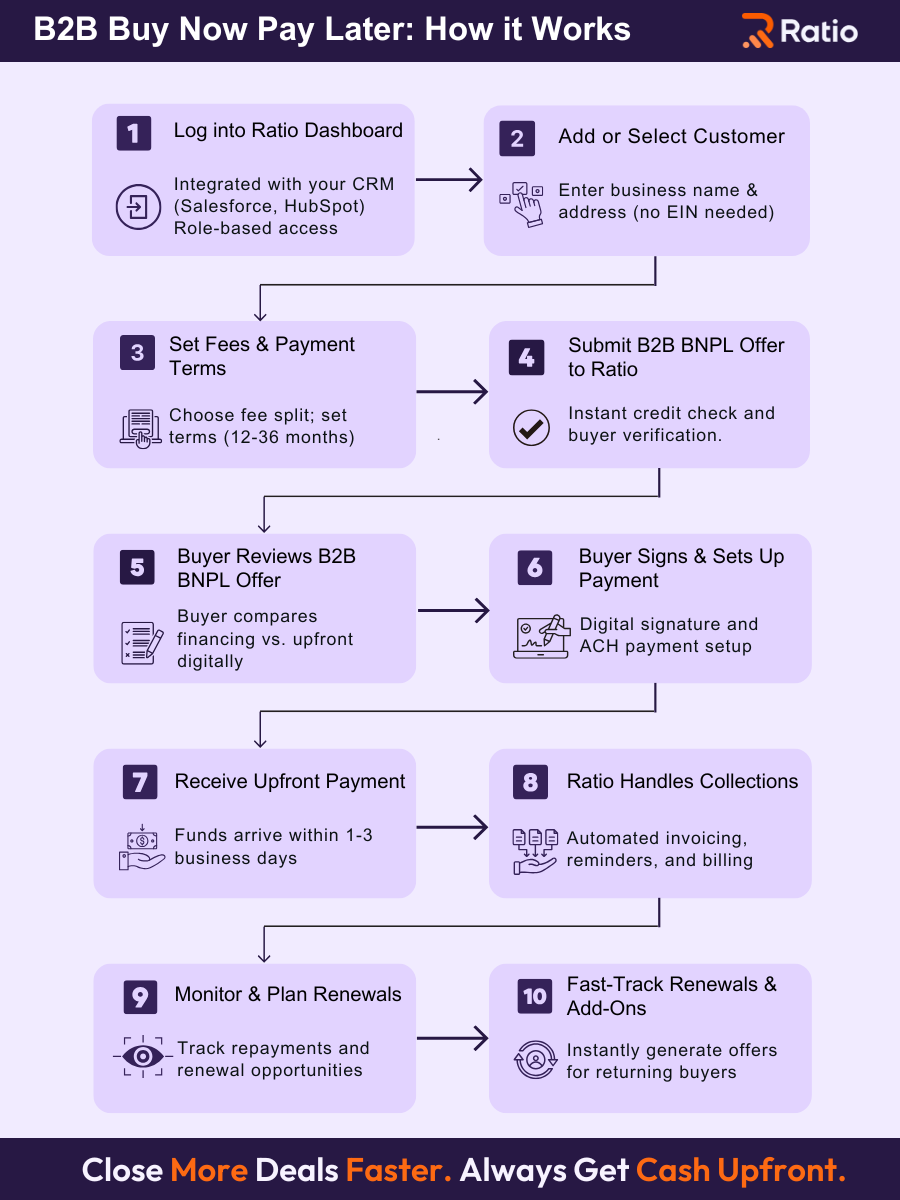
Step 1- Log into the Ratio Dashboard via Your CRM
After integrating Ratio Boost into your CRM, such as Salesforce or HubSpot, your sales reps can access the Ratio dashboard directly from within your sales stack.
Once inside the dashboard, each team member sees a view based on their role:
- Account executives see only the offers they’ve created.
- Managers and admins can view every offer across the team.
Admins can export offers to a CSV file, filter deals by status, such as closed, in progress, or abandoned, and identify stalled offers that need follow-up.
The dashboard also has a built-in search bar, which allows your reps to locate any offer or buyer by name quickly.
Step 2- Add or Select a Buyer to Begin the Offer
From the dashboard, your sales rep clicks “Create Offer” to begin setting up the buyer for a B2B BNPL offer.
For a new buyer, the rep enters key business details: legal name, registered address, buyer’s first and last name, email, and phone number. Ratio uses the name and address to identify the Employer Identification Number (EIN) to gauge business health; the reps don’t need to request this information from the buyer explicitly.
If the buyer already exists, the rep selects them from a searchable list. No information needs to be re-entered.
At this point, the buyer hasn’t received anything. Ratio stays behind the scenes until the rep sends the offer link.
Note: Ratio does not use buyer information for marketing or outreach.
Step 3- Set Financing Fees and Payment Schedule
With the buyer added, the rep configures the payment plan.
The rep selects who covers the financing fee, depending on how the account is set up. The cost can be paid entirely by the buyer, absorbed by your company, or split between both.
For example, on a $100,000 contract with a 10 percent fee, if your company pays, Ratio advances you $90,000, and the buyer repays $100,000. If the buyer pays, you receive the full $100,000 while the buyer repays $110,000 over time. A custom split is also possible, such as 25% buyer and 75% seller.

The rep then sets the payment schedule options, choosing from 12, 24, or 36 months. Plans can be monthly, quarterly, or biannually.
As terms are selected, a live preview displays what the buyer will see, including payment frequency, total repayment cost, and a comparison to the upfront price. Everything is transparent and fully customizable before the offer is sent.
Want to See What Your Next Contract Is Worth Upfront? Use the Ratio Cash Flow Simulator.
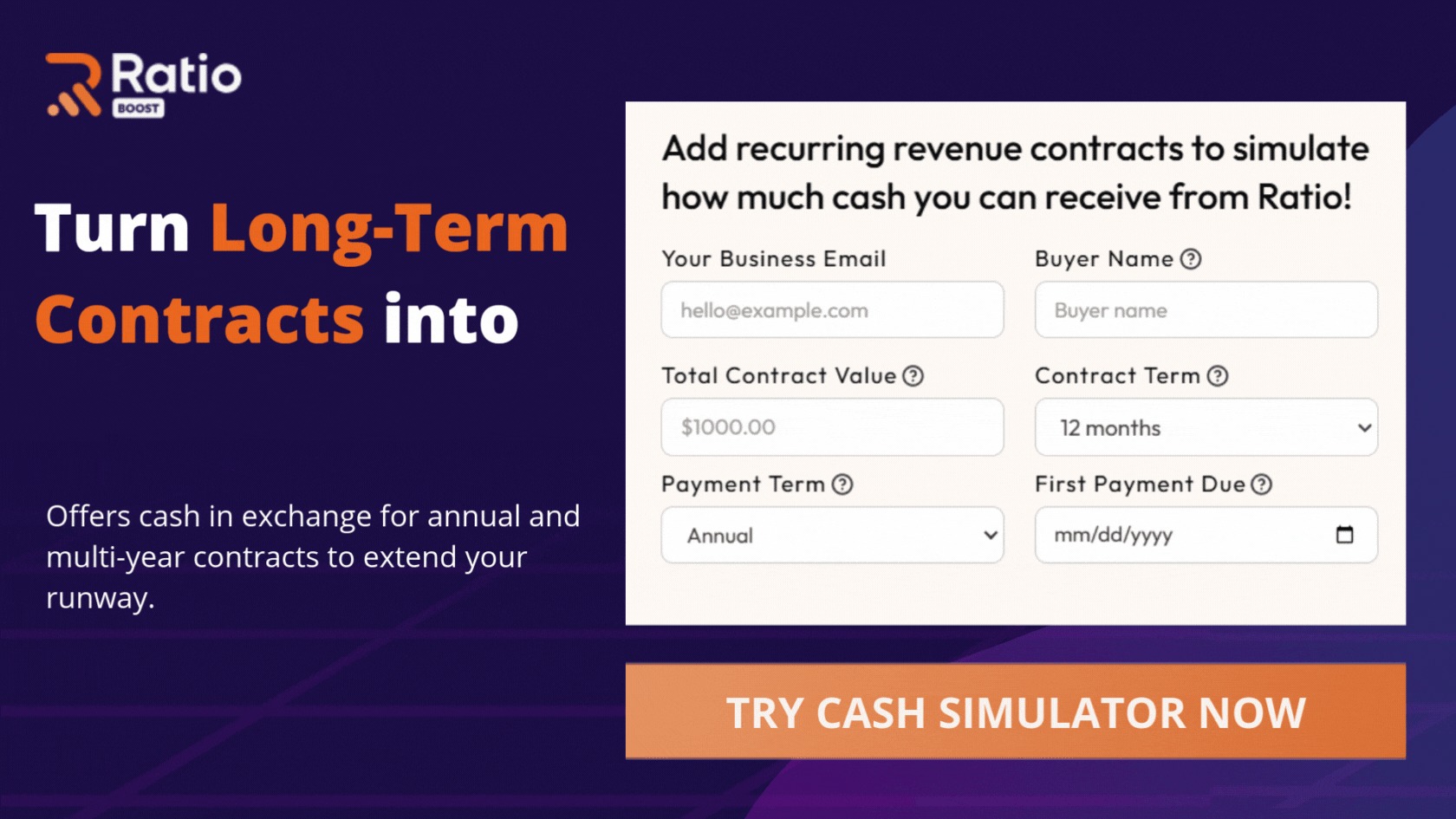
Step 4- Submit the B2B BNPL Offer to Ratio
Once the payment terms are configured, the rep clicks submit to send the offer to Ratio for underwriting. The platform evaluates the buyer instantly in the background. It automatically adjusts the available options based on deal size and buyer profile.
Credit decisions are returned in seconds for most deals, thanks to Ratio’s proprietary underwriting system that analyzes real-time business data.
Want a closer look at how that works?
This short video explains how Ratio qualifies each buyer and enables flexible payment terms with zero manual paperwork.
Large contracts may require a brief manual review. If the buyer qualifies, the status updates to Qualified. If the buyer needs additional review, Ratio updates the offer status to ‘Ready with review. The buyer is then prompted to connect their bank account using Plaid for secure instant verification.
Your sales rep can track buyer progress in real time, including when they view the offer, log in, accept terms, and sign. The event timeline appears directly inside the dashboard.
There’s no paperwork, no back-and-forth, and no manual follow-up. Ratio handles the entire review and verification process while your rep stays focused on closing the deal.
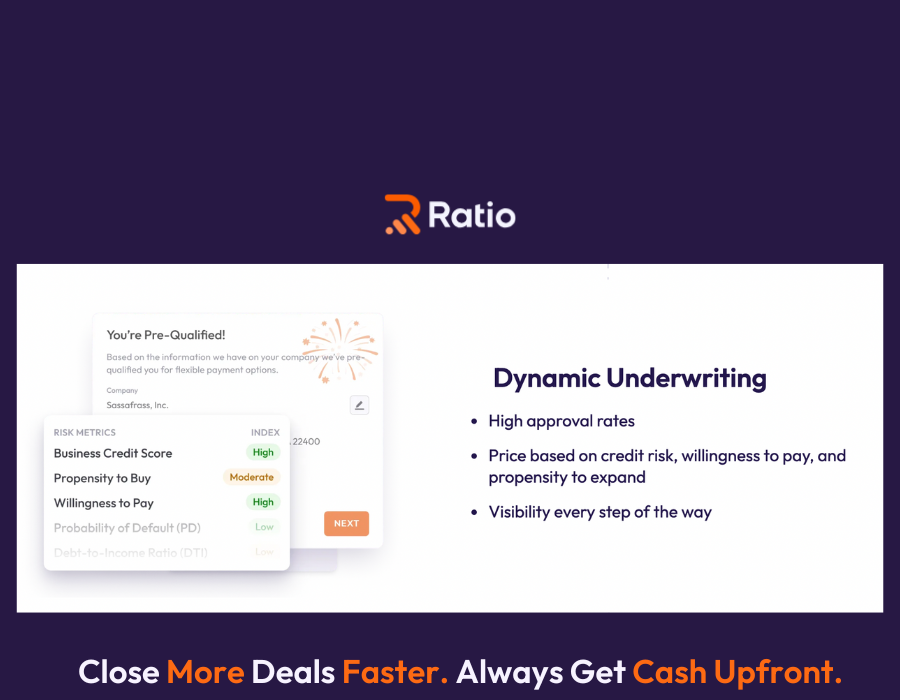
Step 5- Buyer Reviews Personalized B2B BNPL Offer
Once the buyer is approved by Ratio, they receive a personalized offer link. After authenticating with their email, they can view their financing options and compare plans.
The offer displays the exact terms configured by your sales rep, including monthly, quarterly, or biannual schedules for varying durations like one year, two years, etc. Buyers can toggle between options to see how each impacts their installment amount and total repayment.
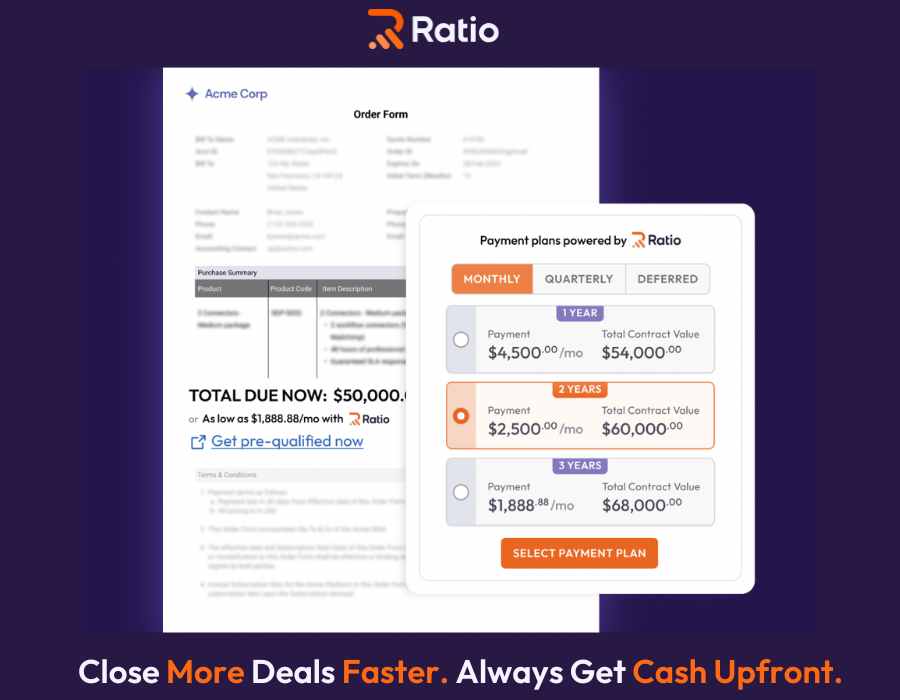
The offer also shows a clear comparison between financing and paying upfront, helping buyers understand the tradeoff. If needed, your team can turn this feature off to match your sales strategy.
The offer can include an expiration date to drive urgency or be extended for longer deal cycles. Buyers can forward the offer to internal stakeholders or message the rep directly from the offer screen.
The entire experience is digital, transparent, and designed to help buyers move forward with clarity and confidence.
“BNPL is a game-changer for both buyers and sellers; it opens possibilities for price-sensitive customers and brings down immediate barriers for sellers.”
— Karim Nurani, Chief Strategy Officer @ Linqto
Step 6- Buyer Selects a Plan, Signs the Agreement, and Sets Up Payment
The buyer selects a financing plan and signs electronically using Ratio’s built-in e-signature flow.
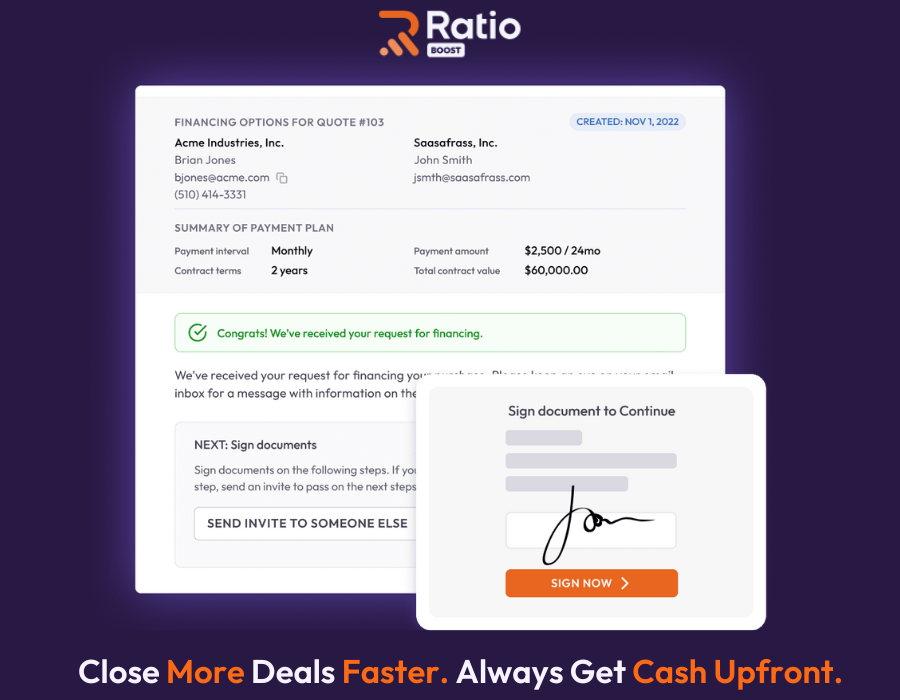
After signing, they enter their bank account and routing number to set up ACH payments. If they’ve used Ratio before, this step is skipped.
The seller can either upload a signed contract separately or display the full agreement inside Ratio for embedded signing. When this option is enabled, a completed copy is automatically shared with your team.
Once everything is confirmed, the buyer receives an email with their payment schedule. Ratio also sends automated invoices and reminders for each billing cycle.
All activities stay tracked in one place, and no extra coordination is required from your team.
Step 7- You Receive the Full Upfront Payment
Ratio disburses the full cash advance to your business within one to three business days after the first ACH payment clears.
Depending on whether the financing fee is covered by your business or passed to the buyer, the amount disbursed may be slightly reduced or paid in full.
You can track payout status directly in the Ratio dashboard, including when the buyer’s payment clears and when funds hit your account.
Step 8- Ratio Handles Invoicing, Reminders, and Collections
Ratio takes full responsibility for managing the buyer’s repayment process after the deal is funded.
It sends automated invoices and payment reminders each month. If a payment method fails or needs to be updated, Ratio works directly with the buyer to resolve it.
Collections and account-level support are fully managed within the platform, so your team doesn’t need to track due dates, chase payments, or manage accounts receivable.
This keeps your revenue on track without adding operational overhead.
Step 9- Monitor Repayments and Plan Strategic Follow-Up
Your team can see exactly what plan the buyer selected, when each payment is made, and whether repayment is on schedule.
These insights help you time renewals, prioritize upsells, and follow up confidently. Sales and RevOps stay aligned on account health without needing to request updates or coordinate manually.
This keeps your revenue on track without adding operational overhead.
Step 10 - Fast-Track Renewals and Add-Ons
Ratio automatically saves buyer information, payment methods, and financing preferences after the first deal is complete.
When the buyer returns for a renewal or add-on, your rep can generate a new offer in seconds without re-entering any details.
This speeds up follow-on deals and eliminates friction for both buyers and reps. There’s no need to requalify the buyer or repeat the onboarding process.
Whether you’re extending a contract or adding more seats, Ratio helps you close repeat business quickly and confidently.
We’ve shown you how Ratio works. But don’t just take it from us; hear directly from SaaS leaders who’ve used it to close faster, sell smarter, and collect upfront. Their outcomes speak louder than our claims.
Ratio Boost: Beyond the Classic B2B Buy-Now Pay Later
Ratio Boost is built to meet the realities of SaaS sales as advocated by its users.
"Ratio is helping us transform the purchasing experience. We see many ways to sell more deals faster. We do it by speeding up the procurement process for our customers. And we collect upfront no matter how the customer pays."
— David Keane, Founder & CEO @ Bigtincan
Ratio Boost enables SaaS sales teams to offer flexible payment terms without changing their pricing models or quoting workflows. It's embedded in your existing sales stack and improves deal outcomes from proposal to payment.
Works with SaaS pricing models out of the box
Ratio supports usage-based billing, ramp contracts, milestone-linked terms, and multi-year agreements. You don’t need to flatten your pricing or simplify how you sell.
Integrated into your CRM and quoting stack
Reps can offer B2B BNPL terms directly from Salesforce, HubSpot, or CPQ workflows. No new tools or off-platform approvals are required.
See Supported Integrations
Fast, AI-based underwriting for high-value contracts
Ratio evaluates business credit tied to your buyer’s EIN and delivers approvals in minutes. Its risk models are tuned for SaaS sales, supporting larger deals, faster motion, and scalable volume.
Full payment upfront, with no payment default risk
You receive the total contract value upon approval. Ratio takes full responsibility for collections and buyer repayment.
One unified flow from quote to cash
Reps send a single link for the buyer to select terms, sign the agreement, and initiate payment. No handoffs. No friction.
Backed by $411 million in capital
Ratio offers reliable, fast funding at scale. You can confidently apply B2B BNPL to large contracts and entire segments of your pipeline.
DearDoc, a healthcare SaaS company, saw this firsthand. Before using Ratio Boost, their sales team regularly lost momentum due to upfront payment hurdles. After rollout, close rates rose by 35%, average deal size increased by 25%, and they began collecting full payment at the time of signature. Collections work was eliminated, and deal velocity improved across the board.
“Ratio Boost isn’t just another BNPL tool. It’s transformed how we sell. The results have been extraordinary and we’re just getting started.”
— Joe Brown, CEO @ DearDoc
If you're ready to unlock faster closes, stronger pricing, and steady cash flow without changing how you sell, Ratio Boost is ready for you.
Request a demo
B2B BNPL FAQs: What SaaS Sellers Still Want to Know
- What are the Key Differences Between B2B and B2C BNPL?
While both models offer delayed payments, they are built for very different contexts. These differences become critical when applying BNPL to high-value, recurring software contracts.
| Aspect | B2C BNPL | B2B BNPL | Why does it matter? |
|---|---|---|---|
| Underwriting | Based on personal credit scores and ID checks | Assesses business financials, payment history, and contract risk | B2B underwriting protects against missed payments in long-term contracts. |
| Payment terms | Fixed short-term installments | Net-30, Net-60, or multi-month schedules | B2B BNPL aligns terms with procurement timelines to avoid billing friction. |
| Deal type | One-time, low-value purchases | Multi-year contracts, usage billing, ramp pricing | B2B BNPL supports complex SaaS pricing and payment structures. |
| Sales motion | Instant, self-serve checkout | Sales-led, embedded in CRM and quoting tools | B2B BNPL must be offered at quoting to avoid delays in deal approval. |
| Risk exposure | Spread across many small transactions | Concentrated in fewer, high-value contracts | B2B BNPL helps sellers offload large-deal risk while securing upfront revenue. |
- Will Adding B2B BNPL Slow Down Our Sales Motion?
No, when embedded at the quoting stage, B2B BNPL can actually speed up deal cycles. With Ratio Boost, reps offer payment terms directly within Salesforce, HubSpot, or CPQ workflows, so there’s no context-switching, approval delay, or new tools to learn.
Most teams can activate B2B BNPL in under a week, and buyers close faster because upfront payment barriers are removed. It’s a sales accelerant, not a slowdown.
- What Should You Look for in the Right B2B BNPL Solution?
More B2B companies are turning to BNPL to manage working capital, speed up deal cycles, and meet rising buyer expectations around flexible terms.
But for SaaS businesses, not every BNPL solution fits. Many fall short on supporting recurring revenue models like multi-year contracts, usage-based pricing, or embedded quoting in CRM and CPQ tools.
When evaluating B2B BNPL solutions, it’s important to choose one that aligns with how your team sells, not just how your buyers want to pay.
Here’s what to look for:
Deal Structure Flexibility
Can it support multi-year contracts, usage-based pricing, and staged payments?
Workflow Integration
Does it plug into your CRM, CPQ, or billing platform at the quoting stage?
Underwriting Quality
Does it assess your buyer’s business credit profile using their Employer Identification Number (EIN) or rely on outdated financials and manual checks?
Cash Flow and Risk Transfer
Do you get paid upfront? Does the B2B BNPL provider fully absorb repayment risk?
Buyer Experience
Is it seamless for your buyer, or does it feel like applying for a loan?
- Who Are the Top B2B BNPL Providers for SaaS and Enterprise Sales?
Several companies offer B2B BNPL, but their models vary by use case:
- Ratio Boost is purpose-built for SaaS and recurring revenue models. It supports usage-based, ramp, and multi-year contracts, integrates with CRMs like Salesforce and HubSpot, and pays the full contract value upfront.
- Hokodo and TreviPay specialize in trade credit for e-commerce and manufacturing.
- Mondu and Biller focus on B2B checkouts, offering real-time approvals and buyer-friendly terms but limited contract complexity.
If your sales motion involves flexible pricing, embedded quoting, or RevOps-led approvals, Ratio Boost will likely be a better fit.
Want to break through your ARR ceiling like the fastest-growing SaaS teams? Talk to the Ratio Boost team. An expert will reach out within 24 hours.
↗
The Closing Motion Platform
Sellers on Ratio see up to 30% higher close rates and 25% higher ACV.


