The B2B SaaS Sales Cycle Explained: Stages, Benchmarks, and Where Deals Go to Die
The average B2B SaaS sales cycle is 84 days and getting longer. Most teams are measuring to the wrong finish line. This post breaks down every stage, where deals really stall, why discounting makes it worse, and what the fastest-closing teams do differently with a Closing Motion Platform that turns a buyer's yes into cash upfront.

Table of contents

The average B2B SaaS sales cycle is 84 days and getting longer. Most teams are measuring to the wrong finish line. This post breaks down every stage, where deals really stall, why discounting makes it worse, and what the fastest-closing teams do differently with a Closing Motion Platform that turns a buyer's yes into cash upfront.
The Challenge: your rep hit every stage right but the deal still died after the yes.
Your rep worked the deal for 90 days. Hit every stage. And then, silence.
According to Optifai’s 2025 benchmark across 939 B2B SaaS companies, the median sales cycle is 84 days. For mid-market deals, it is 22% longer than 2022. That is not just a rough patch. That is a broken system.
Here is what nobody says out loud: most deals don't die at demo. They die after the yes, in the gap between commitment and cash, where proposals, payments, and collections live in four different systems owned by four different teams.
In this post, I'll show you exactly where that gap opens in the B2B SaaS sales cycle, why discounting makes it worse, and what the fastest-closing teams do differently. The evidence will make the answer obvious.
What the B2B SaaS Sales Cycle Actually Is
Let's fix a definition most teams get wrong from day one.
The B2B SaaS sales cycle is not the time from first contact to contract signature. It's the time from first contact to cash collected. A deal that closes on paper in 60 days but doesn't generate a dollar for another 45, because of monthly billing, slow invoicing, or a payment link nobody followed up on, is a 105-day deal. Period.
Most teams don't see it that way. And that's precisely where the trouble begins.
The Seven Stages (The Real Version)
Here's how the cycle actually plays out, not the clean version in your CRM:
- Prospecting: Finding the right people and getting a meeting. Harder than it sounds when your SDR's sequence looks exactly like everyone else's.
- Qualification: Confirming real budget, real authority, real timeline. This is where bad-fit deals should die. Most of the time, they don't, and you pay for it later.
- Discovery: Understanding the actual problem. The most consistently rushed stage in the cycle, and it shows in every stalled deal downstream.
- Demo: Showing the product. Here's the counterintuitive part: the demo is not where most deals die. More on that in a moment.
- Proposal: The numbers hit the buyer's inbox. This is where things start getting complicated, and not in a good way.
- Negotiation: The dance. Discounts get floated. Payment terms get argued. Finance walks in. Timelines slip.
- Close to Cash: Signature is not the finish line. The real close is when payment arrives.
How Long Each Stage Takes, by Deal Size
Optifai’s benchmark data gives a clean look at how cycle length varies by ACV (Annual Contract Value):
- SMB (under $15K ACV): 14-30 days
- Mid-Market ($15K–$100K ACV): 30-90 days
- Enterprise (over $100K ACV): 90-180+ days
For teams selling in the $20K–$80K range, right where most of Ratio's customers operate, you're realistically looking at 45-90 days minimum. That's assuming nothing gets stuck. And things almost always get stuck.
Knowing where your deal falls on that spectrum is step one. But benchmarks only tell you how long cycles are. They don't tell you why they're getting longer. That's what the next section is about.
The Four Forces Making B2B SaaS Sales Cycles Longer Right Now
This isn't your reps' fault. The buying environment itself has changed in ways that are genuinely hostile to fast closes. Here's what's driving it.
Force 1: More Stakeholders, More Sign-Offs
The average B2B deal now involves 6.8 stakeholders, up from 5.4 in 2020. CFO involvement in software purchases has jumped 40% (Optifai, 2025). What used to be a champion-plus-IT decision is now a committee spanning Finance, Legal, Procurement, Operations, and whoever the CFO brought in last Tuesday.
More stakeholders don't just mean more opinions. They mean more meeting cycles, more internal alignment steps, and more chances for someone to pump the brakes.
Gartner’s B2B buying journey research makes this painfully clear: larger buying groups directly increase deal stalls, repeated restarts, and late-stage collapses. The winning vendors aren't necessarily the ones with the best product. They're the ones who make it easiest for six people to align and say yes at the same time.
The pain shows up everywhere. On Reddit's r/sales and r/b2bsales, threads like this one surface constantly:
We had full buy-in from the VP of Sales and the champion. Then their new CFO came in and froze all software purchases. Six months of work, gone.
That's not a bad rep. That's a structural reality of the 2024–2025 buying environment. And the stakeholder problem doesn't stand alone. It gets worse when budget scrutiny enters the picture at the same time.
Force 2: Budget Scrutiny -- Let's Revisit Next Quarter Is the New No
SaaS sector revenue growth slipped to 12% in 2024, down from 21% just a few years prior, per BDO’s analysis of 115 publicly traded SaaS companies. CFOs are in triage mode: rationalizing software stacks, demanding stronger ROI justification, and in many cases, freezing new spend entirely.
Forrester’s 2024 State of Business Buying found that 86% of B2B purchases stall at some point in the process. Nearly nine out of ten deals hit a wall. And most of those walls sound exactly like this:
- "Can you send more information?"
- "We need Finance to sign off."
- "Let’s pick this up after Q2 planning."
That last phrase deserves its own warning label. It's not a soft yes. It's a soft no that hasn't made up its mind yet, and it will stretch your cycle by 30, 60, sometimes 90 days while you keep following up into the void.
I keep seeing this on LinkedIn. A VP of Sales at a SaaS company summed it up perfectly: "Budget cycles used to be predictable. Now every deal has a second approval cycle that nobody told you about." The comment thread had 200+ reactions. This is not an edge case.
But even when the budget eventually unlocks, the deal isn't safe yet because the next force hits right at the moment a buyer is ready to say yes.
Force 3: The Payment Terms Standoff
Here's the deal killer nobody talks about until it's already killed the deal: the stall that happens after the buyer says yes.
Buyers want monthly payments. Sellers want annual upfront. And instead of solving this creatively, most teams end up in a standoff that adds weeks to the close, or quietly lets the deal die.
Capchase’s benchmark data shows that 50% of SaaS companies have seen payment delays increase and 40% have seen collection times get longer. The mismatch is structural: buyers are managing cash flow and want predictable monthly commitments; sellers are managing ARR and want big upfront numbers. Without a mechanism to bridge that gap, the negotiation drags.
I hear this constantly on sales calls: "We lose at least two deals a month not because the buyer doesn't want the product, but because they can't do annual upfront. Our finance team won't budge. Their finance team won't budge. Deal dies." This is just one example — many SaaS founders have the exact same story.
This standoff has a name and a fix, which I'll cover in the next section. But first, there is a fourth force that quietly adds time even after the standoff gets resolved.
Force 4: Fragmentation After Yes
This is the one that almost never comes up in pipeline reviews, because by the time it matters, the rep has already moved on.
A signed deal still has to travel through invoicing, billing setup, payment collection, and, if things go wrong, collections. That journey typically runs through four different systems, owned by four different teams. Proposal in one tool. Contract in another. Payment in a third. Collections elsewhere.
Every handoff adds time. Every system adds friction. And since nobody owns the last mile, cash doesn't hit your account for weeks, sometimes months. That's not a closed deal. That's a deal in transit.
This is the enemy that Ratio's Closing Motion Platform is built to defeat: fragmentation. It connects proposals, payment, renewals, and collections in one flow so the gap between yes and cash simply doesn't exist. I'll get into exactly how in a moment.
Now that we've named the four forces making cycles longer, let's zoom in on where, specifically, the deals are dying inside them.
Where Most B2B SaaS Deals Actually Stall (and Why)
Here's the counterintuitive part: the demo is not where most deals die. The real drop zones are earlier and later than most teams think, and they're far more fixable.
The Proposal-to-Close Gap
Deals that make it to the proposal are qualified. The buyer has said yes in principle. And yet a surprising percentage of them never fully close, or close much later than the rep projected.
Why? Payment terms, internal approvals, and budget timing all colliding at once. The buyer's champion loves the product. But the CFO wants to model it against three other priorities. Procurement wants to run vendor risk. And the payment structure on the proposal doesn't match how their budget is actually structured.
Gartner research shows that buyers spend 15% of the entire buying cycle just conflicting information within their own organization, not evaluating your product, not comparing competitors, just sorting out internal noise. Pile payment friction on top of that and you can see exactly why proposals go dark.
And note: 25% of total buyer decision time is pure delay, not active evaluation. That's a quarter of your cycle that has nothing to do with your product quality or rep performance. It's structural. And it's fixable with the right closing motion.
The Discount Trap
Now for the stat that should make every sales leader put down their coffee: the correlation between discounting and quota attainment is 0.04. Statistically zero.
That finding comes from a study of over 40,000 deals across nearly 400 B2B SaaS companies. The average SaaS discount is 17%. Teams are giving away nearly a fifth of contract value on the working assumption that it closes deals faster. The data says it doesn't.
And then there's the second-order damage: once a buyer earns a discount, they expect it at renewal. The discount becomes the floor, not the ceiling. You've successfully trained your buyer to hold out, while shrinking your ACV, raising your CAC payback, and doing nothing for your close rate.
Quick Look: Have we all just accepted discounting as a normal part of the process? Because the numbers suggest we've been conditioning ourselves into a worse outcome for years. The better move isn't a lower price. It's a more flexible payment structure, and a platform designed to deliver it without sacrificing your ARR.
Post-Signature Delay: The Finish Line Nobody Sees
Let's say you got the signature. Great. You're not done.
If your buyer is on monthly billing, the first payment might land 30 days from now. If invoicing runs through their AP process, add another 2–4 weeks. If the billing contact changed, or someone left the company, or the payment link went to spam, add more.
Teams that measure their cycle to signature are consistently underestimating how long it actually takes to generate revenue from a "closed" deal. The gap between signature and cash is real, it's measurable, and it compounds at scale.
A deal is not closed at signature. A deal is closed when cash hits your bank account upfront. The teams that operate on this definition, and have a platform built around it, are the ones winning.
So what exactly are those teams doing? Let's get into the five moves.
What You Can Actually Do to Accelerate Stalled B2B SaaS Deals
Five moves. Most teams are doing none of them.
Fix #1: Bring Payment Into the Sales Conversation Earlier
The single most common mistake in B2B SaaS sales is treating payment structure as a post-signature admin task. It's not. How a buyer plans to pay is just as deal-critical as whether they plan to buy, and if you're not surfacing that in discovery, you're building toward a stall you could have seen coming 40 days earlier.
Start asking directly: "When it comes to structuring a purchase like this, annual upfront, monthly, or somewhere in between, what does your Finance team typically prefer?" The answer tells you immediately whether you have an alignment problem. Knowing early means you can solve it early, instead of watching it kill your deal at proposal.
Fix #2: Replace Discounts with Payment Flexibility
The buyer who says "can you do better on price?" often doesn't need a lower number. They need a different structure. This is one of the core things Ratio is built to solve — giving your reps the ability to offer payment flexibility without touching the ACV. Monthly payments versus one annual lump sum can feel like a $50,000 difference to a buyer, even when the total contract value is identical.
Instead of dropping your price by 17%, offer to accommodate their preferred payment cadence. The buyer gets the cash flow flexibility they actually need. You keep the full ACV. And you stop training buyers to expect a discount at every renewal. Lightspeed's research found that pricing flexibility is a deciding factor in 38% of deals won. Nearly four in ten deals, won or lost on structure, not price. As Ratio's CEO Ashish Srimal explored in a Forbes Council piece on flexible payments and sustainable SaaS growth, the subscription model alone no longer guarantees growth. The payment structure behind it does.
Fix #3: Add Embedded Financing
Payment flexibility is the goal. Embedded financing is the mechanism that makes it possible without giving anything away — and it's the engine at the center of Ratio's Closing Motion Platform.
B2B BNPL solutions let you offer buyers monthly or quarterly payment options while you collect the full contract value upfront. The financing partner carries the collection risk. The result: shorter cycles, no discount pressure, and cash that arrives at close instead of on the first of next month. Ashish's other Forbes post highlighted embedded financing as one of the top five working capital methods for tech leaders navigating exactly this cash-timing challenge.
Ratio embeds B2B BNPL directly into your quoting and proposal workflow, so your reps can offer monthly payment terms to buyers while you get paid upfront. No discounts. No payment delays. No chasing invoices.
DearDoc, a healthcare SaaS company serving 4,500+ medical practices, deployed Ratio Boost and collapsed their sales calls from multi-day processes down to 30–45 minutes. Close rates jumped 35%. Average deal size went up 25%. Full contract value arrived at signature. Collections work: eliminated. Read the full DearDoc case study here.
That's not a product story. That's what happens when you remove payment friction from the moment of close. But payment isn't the only place friction lives.
Fix #4: Reduce Fragmentation Across the Close
If your close process runs through four different tools, a CPQ, DocuSign, Stripe, and something Finance built in a spreadsheet, you have a fragmentation problem that's quietly adding days or weeks to every deal. Ratio was built specifically to collapse those four systems into one.
Every handoff between systems is a place where something can fall through: a payment link that doesn't work, a contract that went to the wrong email, a billing setup that's waiting on IT. The rep who closed the deal has usually moved on by now. Nobody owns the last mile. Consolidating proposal, contract, payment, and billing into a single closing motion workflow removes the error points that kill deals that should already be done.
Ratio connects proposals, BNPL payments, renewals, and collections in one unified flow. No handoffs. No gaps. Close equals cash, every time.
And even with the right platform in place, there is still one more lever most sales leaders never pull.
Fix #5: Replicate What Your Top Reps Do
In most SaaS sales teams, there are reps whose deals close faster, not because of luck or territory, but because of specific repeatable habits that were never systematized:
- Multi-threaded relationships built across the full buying committee, not just the champion
- Mutual action plans that create shared accountability on next steps, so deals don't drift
- Same-day proposal delivery after discovery calls, because momentum dies over a weekend
The Optifai benchmark specifically identifies these three behaviors as the shared traits of fastest-closing teams. The gap between your median rep and your top rep almost certainly isn't about pipeline volume. It's a handful of execution habits that were never turned into a process. That's fixable.
Now you've seen the problem from every angle and the five levers that move it. There is one platform that runs all five as one connected motion.
Ratio: The Closing Motion Platform That Turns Your Yes Into Cash Upfront
Everything in this post, the stakeholder sprawl, the budget standoffs, the payment term friction, the post-signature delay, has the same root cause: the close is broken. And it's broken because most teams treat signatures as the finish line, then wait on cash through fragmented handoffs.
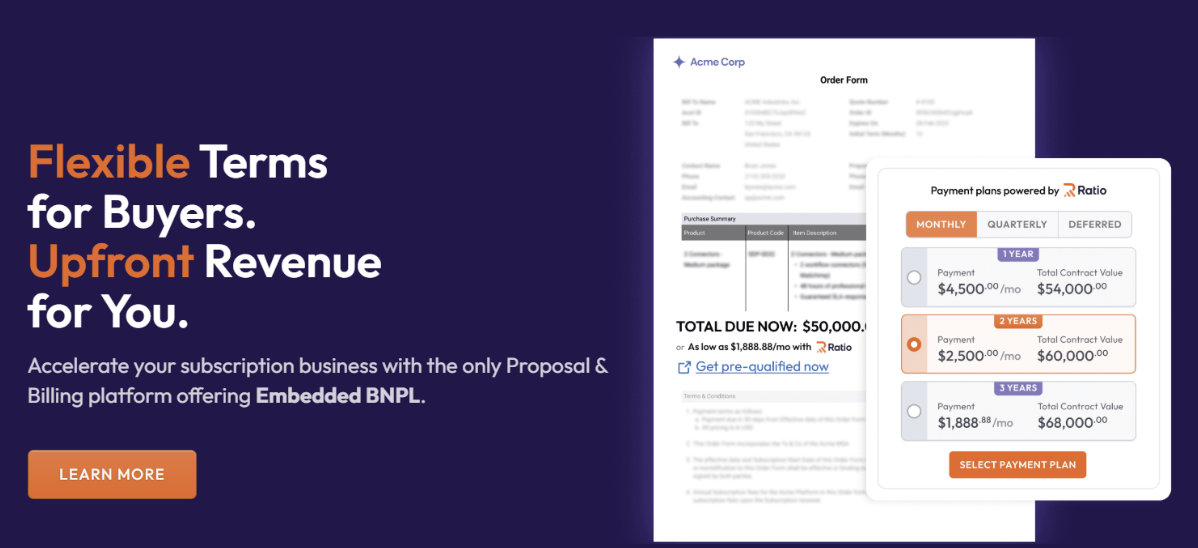
The teams that are outperforming right now have a different definition: close equals cash upfront, not signature. They treat payment as a sales conversation, not a Finance handoff. And they run their entire closing motion, proposals, payment, renewals, collections, through one unified platform instead of four disconnected systems.
That's exactly what Ratio is built to do. The market has taken notice too: in April 2026, Ratio raised $15.8M and secured $100M in lending capacity, specifically to pay B2B sellers upfront while their buyers pay over time. The company reached GAAP profitability in August 2025 and closed 2025 with 349% year-over-year ARR growth. That's not hype. That's the market voting on which model works. As the Closing Motion Platform for B2B technology scale-ups, Ratio runs the full sequence in one flow:
- Proposals: built and sent from the same platform where payment is handled
- BNPL Payments: buyers pay over time, you collect full contract value upfront. Ratio handles the financing
- Renewals: connected to the original commercial truth, no cleanup required
- Collections: built into the same system, not bolted on later
Hear it from one of our customers:
Sales cycles from days down to 30–45 minutes, close rates up 35%, deal size up 25%. This is what happens when you remove payment friction from the conversation and give reps a mechanism to say yes to how the buyer wants to pay, without losing anything on your end.
It's a different definition of what "closed" actually means. And Ratio is a platform built around it.
I'd genuinely like to know: where does your cycle break down? Is it the payment terms standoff, the post-signature gap, or something further upstream? Drop it in the comments.
↗
The Closing Motion Platform
Sellers on Ratio see up to 30% higher close rates and 25% higher ACV.


