
Nothing Else Runs the Whole Motion. Here's the Honest Map.
Ratio is a Closing Motion platform: proposals, buyer payment terms, instant approval, e-sign, upfront cash, billing, collections, and renewals in one flow inside your CRM. Everything else you're evaluating solves one slice. This page shows you which slice, and what the seams cost.
Trusted by B2B technology scale-ups





Three Kinds of Point Solutions. One Connected Motion.

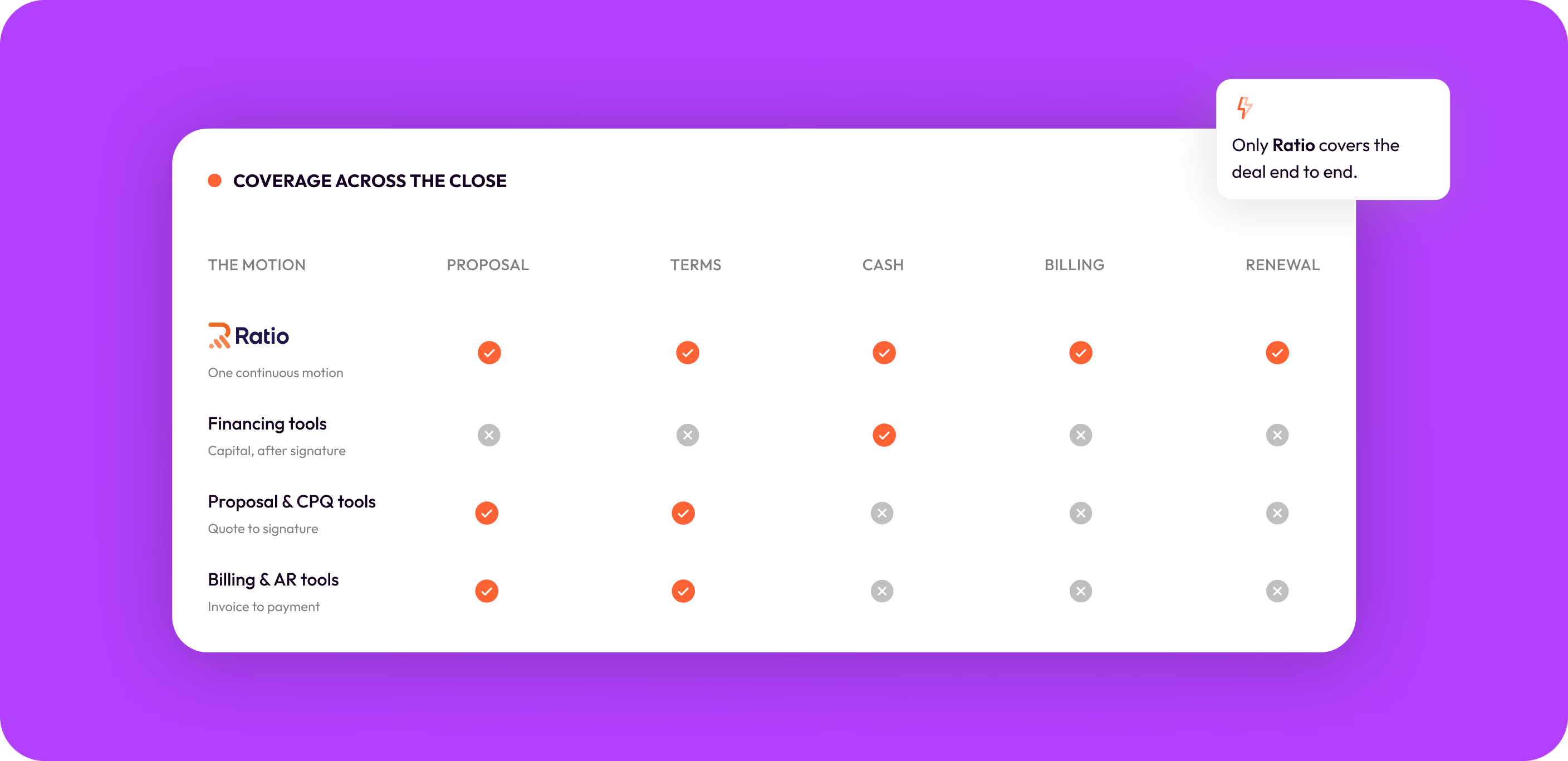
Financing tools
Revenue-based financing and ARR-financing providers give you capital after the deal is signed. Useful, but they never touch the close itself: no proposals, no buyer terms, no billing, no renewals. The capital arrives with flat fees the seller absorbs, and document-heavy underwriting on you.

Proposal and CPQ tools
Quoting and e-sign tools carry the deal to signature, then stop. The buyer still can't pick payment terms inside the proposal, you still wait on billing cycles for cash, and the deal still gets handed off four times after yes.

Billing and AR automation
These tools chase cash faster after the fact. They don't change when you get paid, who carries the buyer's terms, or how much of your finance team's life is spent on collections.
One Deal, Four Ways to Run It
Same deal, same buyer, same contract value. Here's what each option actually covers.
DIMENSION

FINANCING TOOLS
Proposal/CPQ tools
Billing & AR tools
What it owns
The whole motion: proposal to cash to renewal
Capital, after signature
Quote to signature
Invoice to payment
When you get paid
Upfront at close through Boost, while your buyer pays over time
After signature, on a draw against signed revenue
Unchanged: you wait on billing cycles
Unchanged: you chase slightly faster
Buyer payment flexibility
Monthly, quarterly, or custom terms inside the proposal, with instant approval
None: it's seller-side capital
Static terms on a PDF
None
Capital for your existing book
Trade: a lump sum on one company-level underwrite, repaid in fixed monthly payments
Yes: the core product, with flat fees and document-heavy underwriting
No
No
Who gets underwritten
Ratio underwrites your buyer (Boost) and your company (Trade); 87% of deals priced and approved in under one second
You, manually, with document requests
Nobody
Nobody
Billing and collections
Included, automated, connected to the original deal
Yours to run, or a paid add-on
Yours to run
Partially automated, still your team
Renewals
Connected to the original close, co-termination supported
Not supported
Basic at best
Not supported
Fees
Risk-based (4-20%), and you choose who pays: buyer, seller, or split
Flat fee, seller pays
Per-seat SaaS
Per-seat SaaS
Cap table and covenants
No dilution, no warrants, no financial maintenance covenants
Covenants and negative pledges are common
n/a
n/a
Where it lives
Inside Salesforce or HubSpot, where the deal already lives
Outside your GTM stack
A separate app
The finance stack only
Financing Tools Stop at Capital. For Ratio, Capital Is One Feature of the Motion.
The closest thing to a direct competitor is the financing-tool category, so here's the direct answer. On new deals, Boost pays you upfront at the moment of yes while your buyer pays over time, with no document-chase because Ratio underwrites the buyer, not you. On the book you've already built, Trade advances a lump sum against your ARR on one company-level underwrite, repaid in fixed, predictable monthly payments. Both run on the same platform rails as your billing and collections, and Trade capacity can grow as more of your motion runs through Boost.

Boost — new deals
Pays you upfront at the moment of yes. Your buyer pays over time. Ratio underwrites the buyer, not you.

Trade — existing book
A lump sum against your ARR on one company-level underwrite, repaid in fixed monthly payments.
Sometimes a Slice Is All You Need. Usually It Isn't.
If cash collections is your only bottleneck, AR automation will help. If you need one infusion of capital and nothing about your close needs to change, a financing tool will do it. But watch out for the most common false positive: "our buyers already prepay annually, so we just need a proposal tool." If every buyer you win prepays, that isn't proof you don't need payment terms. It's proof your market has been filtered down to the buyers who can.
The prospects who needed monthly terms stalled, demanded a discount, or never entered your pipeline at all: 80.2% of SaaS leaders saw payment terms block deals in the last 90 days. Offering terms doesn't just smooth the close for the buyers you already win. It expands the market to the ones you're currently locked out of. That's not a slice problem. That's the motion.

80.2%
of SaaS leaders saw payment terms block deals in the last 90 days.
What Changes on Ratio
+30%
Higher close rates when payment-term friction comes out of the deal.
+25%
ACV growth when discounting for annual prepay stops.
87%
Of deals priced and approved automatically in under one second.
here’s what they think of us



FAQS
Whether you lead sales, run operations, or own the numbers.