How to Accelerate Sales in B2B SaaS Without Discounting Your Way to the Bottom
Most B2B sales acceleration advice targets rep effort, so it never moves the bottleneck on the buyer's side. The deals that stall are stalling on urgency the buyer never feels, on handoffs that lose cash after the yes, and on losses nobody went back to study. This post covers the three structural levers that remove each one, the three metrics that replace win rate and days to signature, and the audits that tell you which lever to pull first.


Table of contents

To accelerate sales in B2B SaaS without discounting, fix the structure, not the rep. Most deals stall because of urgency buyers never feel, handoffs that lose cash after the yes, and losses nobody ever studied. This post covers the three structural levers that fix all three, the metrics that show whether they are working, and how Ratio Boost collects full ACV at signature while renewals and collections stay in the same flow.
The Challenge: The Usual Playbook Is Making Teams Work Harder on Deals That Are Stalling for the Wrong Reasons.
Sales acceleration efforts tend to stall in the same place. The reps are doing everything right on paper. Qualifying tightly, following up quickly, demo-ing well. The deals are still stalling. Not because of bad selling. Because of structural friction the standard playbook was never built to fix.
We already covered the payment flexibility side of this in depth, including how B2B BNPL, embedded financing, and trust-based selling change the close, in our guide to accelerating B2B SaaS sales cycles. If you have not read it, start there.
This post goes further. It covers the 3 structural levers beyond payment that the fastest-closing B2B SaaS teams use, the metrics that tell you whether your closing motion is working, and exactly how to apply them this quarter. Each one connects to Ratio's Closing Motion platform, the system that makes all three run faster.
Why the Usual Sales Acceleration Tactics Do Not Work
Most B2B SaaS sales acceleration advice targets rep effort. The actual bottleneck is structural friction on the buyer's side. Here is why the three most common tactics fail:
- Better ICP and tighter qualification improves pipeline quality but not velocity. A perfectly qualified deal still stalls at payment terms, internal approvals, or a buying committee that has not aligned.
- More follow-ups and faster demos add volume to a broken process. Speed on the rep's side does not move a bottleneck on the buyer's side.
- Discounting has near-zero correlation with quota attainment. Per Bridge Group's 2024 SaaS AE Metrics Report, only 51% of AEs hit quota in 2024, down from 66% in 2022. Reps are discounting more and hitting quota less. The damage compounds: once a buyer earns a discount, it becomes their reference price at renewal. You have not closed a deal. You have permanently lowered your price ceiling, set a floor expectation for every future negotiation, and trained that buyer to hold out next time.
So if the standard playbook is not the answer, what is? The three levers below each remove a different structural friction point. None of them require changing your product, your pricing, or your headcount.
How to Accelerate B2B SaaS Sales: 3 Structural Levers That Actually Work
To accelerate B2B SaaS sales without discounting, remove the structural friction causing deals to stall, not add more rep effort to a broken process. The three levers below each address a different stall point:
- Lever 1: Engineer urgency buyers actually feel by surfacing real buyer-side constraints: implementation timelines and the quantified cost of staying where they are.
- Lever 2: Collapse the handoffs from proposal to cash by running proposals, payment, renewals, and collections in one unified flow instead of four separate systems.
- Lever 3: Run win-loss analysis as a systematic close rate lever by turning every lost deal into a specific process fix rather than a general coaching initiative.
Lever 1: Engineer Urgency That Buyers Actually Feel
Most urgency in B2B sales is fake. End-of-quarter deadlines the buyer does not care about. Discounts that expire and then mysteriously reappear. It's artificial scarcity everyone sees through and buyers have been trained to ignore all of it.
Real urgency has nothing to do with the seller's calendar. It comes from three sources that are true, verifiable, and specific to the buyer:
Implementation and Onboarding Lead Times
If your product requires onboarding, data migration, or implementation, use that timeline as urgency. "If you want to be live before Q3 planning season, we need to start onboarding in three weeks" is not manufactured pressure. It is logistics. And it gives the buyer a concrete cost to waiting that a pricing deadline never creates.
With Ratio Boost embedded in the proposal, the buyer who decides to move during that onboarding window can commit and pay in one motion. No separate payment approval. No billing setup that needs IT. The decision and the action happen together, which means the urgency converts instead of drifting into the next quarter.
But implementation timelines only work if the buyer already sees a cost to waiting. Most do not. That is where the second urgency source comes in.
The Cost of Inaction, Built Into Discovery
The most common reason B2B SaaS deals stall is not no. It is not yet. And not yet almost always comes from the same cognitive gap: the cost of change feels visible, budgeted, and scary. The cost of staying where they are feels invisible.
Research by Matthew Dixon and Ted McKenna, authors of The Jolt Effect, found 44% of no-decision outcomes are status quo deals: the buyer understood the solution and validated the business case, but still did not move because the cost of waiting was never made concrete.
The fix is a discovery question, not a closing tactic. Ask the buyer: "What does your team spend per week on the process this would replace?" Then do the math together. Eight hours per person across four people at $60 per hour is $1,920 a week. $100,000 a year. Every quarter they wait is $25,000 they are paying to stay where they are.
That number creates urgency because it is real and specific to them. It reframes the conversation from "is this worth X?" to "is staying where you are worth $100,000 a year?" No discount required.
The best proposal does not demonstrate product value. It makes the cost of the status quo indefensible. Buyers do not move when the upside becomes attractive. They move when the current state becomes something they can no longer justify.
A buyer who just calculated that staying where they are costs $100,000 a year is not going to ask for a discount. They are going to ask how fast they can start. That is the difference between urgency that is real and a pricing conversation that was never necessary.
Once urgency is real, the next problem is what happens after the buyer says yes. Because that is where most deals quietly die without anyone noticing.
Lever 2: Collapse the Handoffs from Proposal to Cash
Here is the deal killer that never shows up in pipeline reviews: the buyer said yes. The rep marked it closed-won. And then the deal spent six weeks traveling through invoicing, billing setup, payment collection, and collections, each owned by a different team, each running in a different system.
Four teams. Four tools. Four places where something can fall through. The rep has moved on. Nobody owns the last mile. Cash arrives weeks or months after it should, if it arrives at all.
AeolusGTM's 2026 State of B2B Revenue report found that 20 to 40% of SaaS churn is involuntary, caused not by buyer decisions but by payment failures and billing gaps that opened up after signature. That is not a sales problem. It is a systems problem. And it compounds because every one of those failed payments is ARR that was won and then lost in the handoff.
PYMNTS Intelligence's 2025 analysis found embedded B2B payments inside unified proposal-to-payment workflows consistently reduced friction and accelerated cash flow. The variable that mattered most was not the speed of any individual step. It was the number of handoffs between them.
The teams accelerating sales fastest are the ones where the proposal is the payment flow is the contract, running in one motion through one platform. When proposal, payment, renewal, and collections live in the same system, the gap between yes and cash closes to near-zero. This is exactly what Ratio is built to run: one unified Closing Motion that starts at the proposal and does not stop until cash is in your account and renewal is set.
And when the payment standoff is gone, so is the reason most reps reach for a discount in the first place. The discount was never solving a price problem. It was masking a payment structure problem. Remove the structure problem and the discount conversation never starts.
But even a deal that closes and pays has a question attached to it: why did the ones that did not close actually die? That gap is where the third lever lives.
Lever 3: Use Win-Loss Analysis as a Systematic Close Rate Lever
Most B2B SaaS teams know their win rate. Very few know why it is what it is. Almost none have a systematic process for turning that information into faster closes on future deals.
The average B2B SaaS win rate is 21% across all opportunities per HubSpot's 2024 Sales Trends Report. Four out of five deals are lost. Salesmotion's 2026 benchmark research shows 63% of those losses happen before the needs assessment stage. The problem most teams try to fix at the proposal starts in discovery. Win-loss analysis is what makes that visible.
IcebergIQ's 500+ buyer interviews found that buyers repeatedly cited sales execution quality, specifically responsiveness, deep discovery, and feeling understood, as the primary differentiator in deals they chose to close. Not price. Not features. Execution. That is not something a discount fixes. It is something only systematic analysis of lost deals surfaces.
The Two-Question Process That Costs Nothing
Send two questions to every closed-lost deal within 48 hours: "What was the primary reason you chose another path?" and "Was there anything we could have done differently?" Thirty percent of buyers respond. Across ten responses, patterns emerge that no amount of CRM analysis reveals.
Track two numbers: which stage deals drop most frequently, and which objection appears most often in lost deals. If 60% of deals die at proposal, you have a proposal problem. If 70% of losses cite timing, you have a cost-of-waiting problem. Each insight becomes a specific fix, not a general coaching initiative.
Win-loss analysis consistently surfaces one pattern for B2B SaaS teams specifically: payment structure and billing flexibility show up in both win reasons and loss reasons. Deals that closed fast had payment terms that matched what the buyer needed. Deals that died at proposal had a standoff nobody resolved. That insight alone tells you exactly where Ratio Boost belongs in your standard proposal, not as an optional add-on, but as the default structure that removes the most common late-stage stall before it starts.
The teams with a 35% win rate are not smarter than the teams at 21%. They have a feedback loop. And when that feedback loop consistently tells them discounting did not save the deals that died, they stop discounting. They fix the structure instead.
Now that you have the three levers, you need a way to know whether they are actually working. The next section covers the three metrics that replace win rate and days to signature as your closing motion scoreboard.
How to Measure Sales Acceleration: 3 Metrics That Replace Win Rate and Days to Signature
Win rate and days to signature measure events. These three metrics measure whether your closing motion is structurally sound:
- Closing Velocity: time from buyer yes to cash upfront. Replaces days to signature.
- Cash Acceleration: percentage of deals where full ACV lands at signature regardless of how the buyer pays.
- Handoff Reduction: number of systems and teams from proposal to cash. Target is 1, not 4.
Closing Velocity: Time from Buyer Yes to Cash Upfront
This replaces days to signature. Signature is an event. Cash is the outcome. If your close process consistently produces a 30 to 45-day gap between those two events, you are not measuring your real sales cycle. You are measuring the first half of it.
Closing velocity is also the number that makes urgency engineering visible in the data. A rep who surfaces cost of inaction in discovery and embeds payment flexibility in the proposal will show a shorter closing velocity than a rep who does neither. The difference is not luck or territory. It is the structural friction each rep is removing, or leaving in place, in the proposal-to-cash window.
Cash Acceleration: Percentage of Deals Where Full ACV Lands at Signature
This tells you whether your payment structure is working. A team with 80% cash acceleration collects full contract value at close on 80% of deals regardless of how the buyer is billing. A team with 10% cash acceleration is effectively offering monthly billing and hoping every invoice lands.
When Ratio Boost is embedded in the closing motion, buyers pay on their preferred schedule while you collect full annual contract value upfront at signature. DearDoc moved from multi-day sales calls to 30 to 45 minutes, close rates up 35%, deal size up 25%, full ACV at signature. Read the full case study. That outcome is what high cash acceleration looks like in practice.
Handoff Reduction: Number of Systems from Proposal to Cash
The target is one, not four. If your close process runs through a CPQ, DocuSign, Stripe, and a billing function, you have four handoffs. Kondo's 2025 State of B2B Sales found the average sales team uses 10 different tools to close deals, with 66% of reps feeling overwhelmed by the complexity. Every handoff is a place where a deal can stall, a payment can fail, or ownership falls into a gap.
These three metrics, closing velocity, cash acceleration, and handoff reduction, replace win rate and days to signature as the scoreboard for a closing motion that is actually accelerating. They measure the outcome that matters: full contract value, at close, through one connected flow.
Knowing the metrics is one thing. Knowing where to start is another. Here is how to audit your current motion and identify which lever to pull first.
How to Apply These Sales Acceleration Tactics This Quarter
Three audits reveal exactly where your closing motion is losing speed and which lever to pull first:
- Audit 1: Map your proposal-to-cash flow: count every system, team, and handoff between signed proposal and cash received.
- Audit 2: Identify your stall point: tag every closed-lost deal by the stage where it died to see which lever moves first.
- Audit 3: Embed payment flexibility before the objection: build annual, quarterly, and monthly options into every proposal before the buyer asks.
Audit 1: Map Your Proposal-to-Cash Flow
Map every step from buyer yes to cash received. Count the tools, the teams, the handoffs, the days. For most B2B SaaS companies, this exercise reveals a process nobody designed. It grew organically and became the structural reason deals take longer than they should.
- How many systems does a closed deal touch between signed proposal and first payment received?
- How many people own a step in that process outside the sales team?
- What is the average gap between signed contract and cash in account?
If your answer to the first question is more than two, you have a fragmentation problem that no amount of rep coaching will fix. The solution is connecting proposal, payment, renewal, and collections in one platform. That is the Closing Motion.
Audit 2: Identify Your Stall Point
Pull your last quarter of closed-lost deals and tag each one by the stage where it died. The distribution tells you exactly which lever to pull first.
- Deals dying at proposal: urgency and cost-of-inaction were not surfaced in discovery. Start with Lever 1.
- Deals dying after the yes: payment standoff or post-signature fragmentation. Run Audit 1 first, then embed Ratio Boost to collapse the handoffs in one motion.
- Deals stalling between proposal and payment: no unified closing flow. The proposal, payment, and collections are living in separate systems. That is a Lever 2 problem.
- Recurring objections at late stage: win-loss analysis is not running. Start with Lever 3.
Each stall point has a different root cause and a different specific fix. The audit makes the fix visible.
Audit 3: Embed Payment Flexibility Before the Objection
Reps who include annual, quarterly, and monthly payment options in the proposal before the buyer asks close faster and discount less. The standoff never starts because the buyer's actual friction, payment structure, not price, is already addressed.
This is the behavioral change that ties all three levers together. The urgency conversation in discovery is more credible when the rep can immediately follow it with a proposal that removes every structural barrier to acting now. The win-loss pattern that consistently shows payment standoffs as a top loss reason becomes a data-backed argument for making Ratio Boost the default structure in every proposal, not a special option for difficult deals.
Three audits, three levers, three metrics. One platform connects them all.
Ratio: The Closing Motion Platform That Runs All Three Levers at Full Speed
Urgency engineering, handoff collapse, and win-loss analysis each accelerate sales independently. They compound when the payment infrastructure underneath them removes the last structural reason deals stall after the yes.
Ratio's Closing Motion Platform is built to do just that.
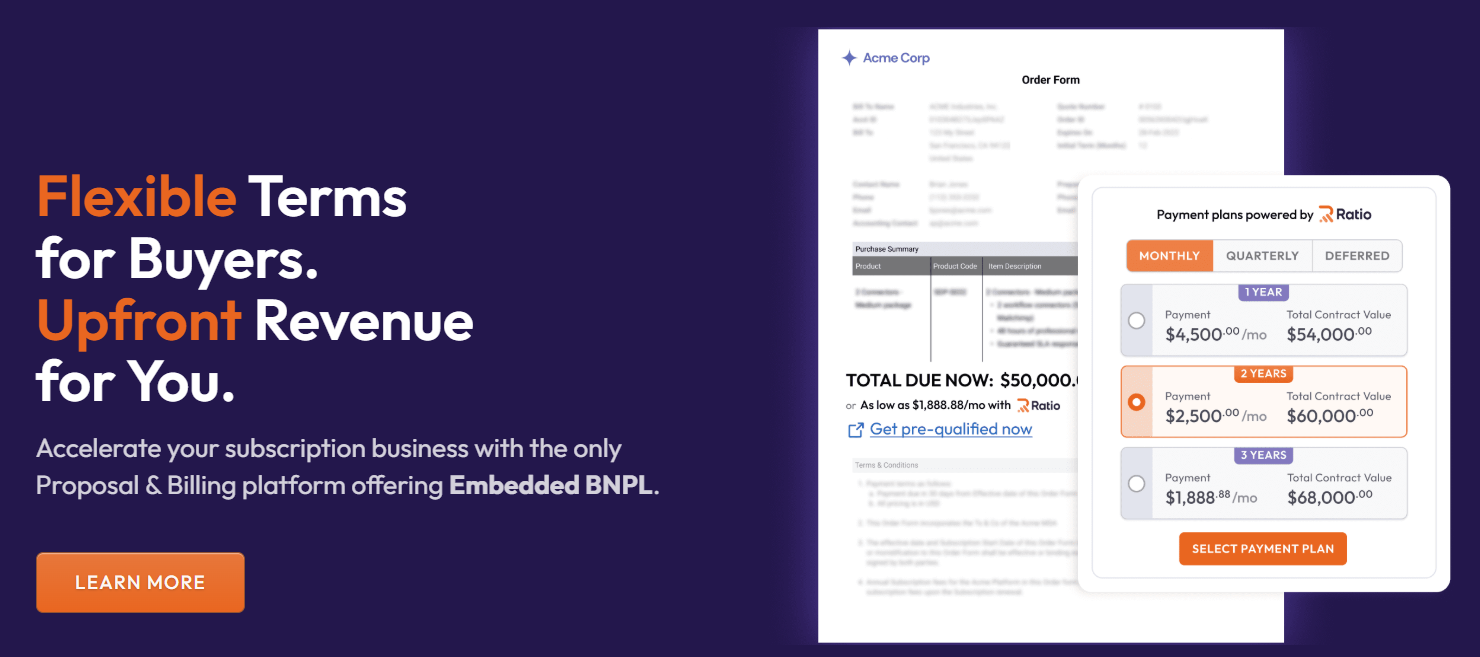
Proposals go out with payment options already embedded. Buyers pay on their preferred schedule. You collect full annual contract value at signature. Renewals stay connected to the original commercial terms. Collections are part of the same system, not a reactive downstream function. No discount. No payment standoff. No handoffs that lose cash between teams.
DearDoc, a healthcare SaaS serving 4,500+ medical practices, is the clearest proof of what removing the payment standoff actually does. Here is what DearDoc’s founder has to say about Ratio Boost:
In April 2026, Ratio raised $15.8M and secured $100M in lending capacity specifically to pay B2B sellers upfront while buyers pay over time. GAAP profitable since August 2025. 349% year-over-year ARR growth in 2025. The model works because the problem it solves is structural, and structural problems do not go away with better rep training or deeper discounts.
Accelerating sales is not about working faster. It is about removing the structural reasons deals slow down. Three levers, three metrics, one platform.
Book a Demo to See How Ratio Boost Works.
Frequently Asked Questions
What Is the Difference Between Sales Velocity and Closing Velocity?
Sales velocity is a pipeline metric: (number of opportunities x average deal value x win rate) divided by average sales cycle length. It tells you how much revenue your pipeline generates per day. Closing velocity is narrower and more specific: time from buyer yes to cash upfront. Sales velocity measures the health of your entire funnel. Closing velocity measures the health of your closing motion, specifically what happens after a buyer commits. A team can have strong sales velocity and terrible closing velocity if deals consistently take 45 days to convert from signature to payment. Ratio Boost directly improves closing velocity by collecting full contract value at signature, which means the gap between buyer yes and cash received collapses to near-zero rather than stretching across billing cycles.
What Is Involuntary Churn and Why Does It Show Up in Sales Metrics?
Involuntary churn is ARR lost not because a buyer decided to leave, but because payment failed, an invoice went unpaid, a billing contact changed, or a collections process was never triggered. AeolusGTM’s 2026 research puts involuntary churn at 20 to 40% of total SaaS churn. It shows up in sales metrics because the rep counts the deal as closed, the CRM counts it as won, and then the revenue quietly disappears in the handoff. It is never attributed to a sales failure so it never gets fixed. The structural fix is connecting collections to the original close rather than treating it as a separate downstream function. When collections is part of the same Closing Motion platform as the proposal and payment, involuntary churn gets caught before it becomes churn.
How Do You Know If Your Closing Motion Has a Fragmentation Problem?
Ask four questions about your current proposal-to-cash process. How many systems does a closed deal touch between the signed proposal and first payment received? How many teams own a step in that process outside the sales team? What is the average time between signed contract and cash in account? What percentage of monthly billing customers pay their first invoice on time and on the correct amount? If the answer to question one is more than two, question three is more than 10 days, or question four is below 90%, you have a fragmentation problem. The fix is not better tools at each handoff. It is eliminating the handoffs entirely by running proposals, payment, renewals, and collections through one unified flow. That is what Ratio, as the Closing Motion Platform, is specifically built to do.
Can You Accelerate Sales Without Changing Your Product, Pricing, or Team?
Yes, and that is the point. The three levers in this post, engineering real urgency, collapsing post-yes handoffs, and running systematic win-loss analysis, require no product changes, no pricing model changes, and no new hires. Urgency engineering is a discovery conversation change. Handoff collapse is a platform decision. Win-loss analysis is a 48-hour email and a monthly review. Each one removes a structural friction point that was stalling qualified deals without touching anything that requires a board approval or a planning cycle. The compounding effect across all three is why the teams at 35% win rate are not better resourced than the teams at 21%. They have removed the friction the other team is still paying for on every deal they run.
↗
The Closing Motion Platform
Sellers on Ratio see up to 30% higher close rates and 25% higher ACV.


