Top 4 SaaS Finance Software Options to Speed Up Sales and Simplify Finance Operations in 2026
SaaS deals are stalling as buyers push for flexible terms, forcing Sales to discount and Finance to chase cash.Traditional SaaS finance software helps after a deal is signed by automating billing and improving cash visibility, but it doesn’t resolve friction at the moment of closing. In this post, we compare four leading SaaS finance platforms and explain what they do well. Then, we show how Ratio fills the critical gap they leave: enabling Sales to offer flexible terms during negotiations while allowing Finance to secure upfront cash the moment a buyer commits.


Table of contents

SaaS deals are stalling as buyers push for flexible terms, forcing Sales to discount and Finance to chase cash.Traditional SaaS finance software helps after a deal is signed by automating billing and improving cash visibility, but it doesn’t resolve friction at the moment of closing. In this post, we compare four leading SaaS finance platforms and explain what they do well. Then, we show how Ratio fills the critical gap they leave: enabling Sales to offer flexible terms during negotiations while allowing Finance to secure upfront cash the moment a buyer commits.
🚨 The Challenge: SaaS revenue growth is slowing; not because demand is disappearing, but because deals are stalling at the moment of close.
Across the industry, YoY growth has dropped from ~21% to ~12%. Deals are taking longer, buyers are asking for flexible terms, and budgets are under more scrutiny than ever.
This pressure shows up inside your org:
️ Sales turns to discounts to remove friction
⏳ Finance gets involved late, concerned about cash flow and risk
💬 Payment terms are negotiated before Finance has visibility
The result? Deals stall at the moment of close, cash arrives later than expected, and tension grows between Sales and Finance.
This is where traditional SaaS finance software plays an important (but limited) role. These tools automate billing, manage payments, and improve visibility after a deal is signed. They help Finance operate efficiently, but they don’t resolve friction when buyers push for flexible terms during negotiations.
In this guide, we break down four leading SaaS finance platforms, what they do well, and where their impact stops. Then, we look at one critical extension you shouldn’t miss: Ratio Boost, a Closing Motion layer that enables Sales to offer flexible terms at the point of close while allowing Finance to secure upfront cash.
👇So, let’s start with the basics.
💡 What Is Considered SaaS Finance Software Today?
SaaS finance software is a category of digital tools designed to help subscription-based businesses manage and optimize financial operations after commercial terms are set.
Rather than being a single platform, it's an umbrella term that covers a range of specialized solutions used for:
- Automating billing and invoicing
- Managing revenue recognition and compliance
- Forecasting cash flow and financial performance
- Handling payments, collections, and Account Receivable(AR) processes
These tools are tailored to SaaS business models, where revenue is often recurring, usage-based, or contract-driven. Also where finance teams must work closely with Sales, RevOps, and Customer Success to ensure accuracy, once a deal is closed.
Most companies build their SaaS finance stack by combining multiple tools; each focused on a specific part of the post-signature financial workflow.
And, when choosing a mix of platforms, it’s important to understand not just what these tools do well, but also what they were never designed to handle, especially during deal negotiation and close.
🧰 Core Features of SaaS Finance Software (By Category)
Once you recognize that SaaS finance software spans multiple functions, the next step is knowing what to look for, because not all tools are built the same.
Some are designed for high-volume billing logic, while others focus on financial controls, compliance, or forward-looking visibility. The risk is choosing based on brand or UI; it’s choosing a platform that optimizes the wrong stage of the revenue lifecycle.
Instead of guessing, break it down.
👉 Below, we map the key categories of SaaS finance software, the core features each one should provide, and where their impact typically begins and ends; along with examples of tools that lead in each category.
💳 1. Billing & Invoicing Automation
These tools ensure that complex billing logic is handled without manual intervention once a deal is signed and payment terms are finalized.
Key features to look for:
- Recurring and usage-based billing
- Subscription management (upgrades, downgrades, proration)
- Multi-currency and tax compliance (e.g., VAT, GST)
- Customer self-service portals
- Payment reminders and auto-charging
Popular tools: Chargebee, Maxio, Stripe Billing
📜 2. Revenue Recognition & Compliance
Critical for finance and audit teams to remain compliant with ASC 606 / IFRS 15.
Key features:
- Automated rev rec schedules
- Deferred revenue tracking
- Audit trail and reporting
- Support for contract modifications and multi-element arrangements
- Integration with billing and GL systems
Popular tools: Zuora Revenue, NetSuite ARM
📈 3. FP&A and Cash Flow Forecasting
These platforms support real-time planning and help Finance teams model different growth, retention, and cash-flow scenarios based on deals that have already closed.
Key features:
- Driver-based forecasting (bookings, churn, cash timing)
- Scenario modeling
- Integration with CRM, billing, and accounting data
- Custom dashboards and board reporting
- Collaboration tools for Finance & GTM teams
Popular tools: Mosaic, Cube, Pigment
🧾 4. Payments & Collections
Focused on managing incoming cash and reducing revenue leakage after invoices are issued and payment obligations already exist.
Key features:
- Payment processing and failed payment retries
- Dunning workflows and notifications
- Invoice aging reports
- Customer payment history and reconciliation tools
- Real-time AR dashboards
Popular tools: Bill.com, Stripe, Paddle
This breakdown helps teams understand what SaaS finance software covers, but also where its responsibility ends. Next, we’ll look at how to evaluate what your business actually needs based on maturity, deal structure, and where cash friction enters the revenue cycle.
🧭 How to Choose the Right SaaS Finance Software Category for Your Business
Not all SaaS finance software are equally relevant at every stage of your business, and picking the wrong ones too early (or too late) drains resources without solving your most pressing problems.
To make smarter choices, match your current business needs with the core capabilities of each finance category we just covered.
Below, we break this down by business scenario and explain why certain categories matter more in each context; helping you prioritize what to invest in now versus later.
1. Early‑Stage SaaS (Pre‑Product Market Fit)
Focus Areas: Billing & Invoicing Automation
Why:
At this stage, your priority is collecting recurring revenue cleanly, reducing manual work, and avoiding revenue leakage. A lightweight billing automation platform gives you visibility into core metrics like MRR and churn while minimizing admin load for small finance teams.
Manual billing or spreadsheets simply don’t scale with recurring models, and aren’t robust enough to support experimentation with pricing or bundles.
As the business evolves, subscription-native billing tools become essential. Accurate billing establishes reliable cash flow and creates the financial foundation investors and leadership rely on; even though most deals at this stage still close on simple, upfront terms.
2. Scaling SaaS (Growth / Series A-B)
Focus Areas: Revenue Recognition & Compliance + FP&A / Forecasting
Why:
As growth accelerates, contract complexity, deferred revenue, and compliance requirements increase. Revenue recognition becomes both a risk and a strategic capability.
Standards like ASC 606 require structured automation; without it, finance teams spend excessive time reconciling historical data instead of planning forward. Automated rev-rec tools ensure reporting accuracy and support growth modeling during fundraising, audits, and strategic planning.
At the same time, cash flow forecasting and FP&A tools become essential as booking volumes rise. These tools help leadership understand runway, budgets, and cash timing; even though they still rely on inputs defined earlier in the sales process.
3. Enterprise‑Focused / Complex Billing SaaS
Focus Areas: Payments & Collections + Advanced Forecasting
Why:
As contract sizes grow and terms become negotiated, payments and collections platforms become more strategic. Basic invoicing tools often struggle with multi-year contracts, partial payments, disputes, and exception handling.
These tools help reduce DSO (days sales outstanding), manage dunning workflows, and improve AR visibility; strengthening unit economics after invoices are issued.
However, as payment flexibility becomes common, these platforms increasingly operate downstream of the real problem: cash timing and risk decisions made during deal negotiations. Advanced forecasting tools help finance leaders model renewals, expansion, and cash risk; but they cannot change how or when cash is secured at close.
Must Read: 5 Best Accounts Receivable Management Software Options (2025)
🧠 What This Means in Practice
Not every company needs every category right away. Priorities should evolve with your business stage, and with where cash friction enters your revenue cycle:
- Early stage: Start with billing automation and basic subscription management
- Growth stage: Add revenue recognition and forecasting capabilities
- Complex / enterprise stage: Invest in payments and collections to optimize recovery and reduce leakage after invoices are issued.
Each phase builds on the last, and getting clear on these priorities avoids tool overload and wasted spend.
Now that you know which capabilities matter at each stage, we’ll move into what benefits SaaS teams gain overall using these software stack.
🎯What are the Benefits of Using SaaS Finance Software to SaaS Enterprises?
When implemented well, SaaS finance software improves how teams operate after a deal is signed. By centralizing billing, revenue tracking, collections, and forecasting, it reduces back-office friction and creates financial clarity across the organization.
Here’s what SaaS teams gain in practice 👇
🚀 More Predictable Deal Execution
Standardized billing logic, approval workflows, and payment processing reduce internal coordination once terms are finalized. Sales moves forward with clearer expectations, while Finance ensures deals are structured correctly.
Outcome: fewer downstream delays after close.
🔍 Clearer Financial Visibility
Finance teams gain real-time insight into invoiced revenue, collections, and outstanding balances; replacing spreadsheets and lagging reports with live data.
Outcome: stronger visibility into cash position and revenue health.
🧮 Accurate Revenue Tracking Over Time
As customers upgrade, downgrade, or change usage, revenue calculations adjust automatically. This reduces manual reconciliation and ensures revenue is tracked correctly across the customer lifecycle.
Outcome: cleaner books and more reliable reporting.
💰 More Consistent Cash Collection
Automated invoicing, reminders, and collections workflows help teams stay on top of payments without constant follow-ups. Overdue invoices are easier to track and address.
Outcome: lower DSO and fewer surprises.
🤝 Stronger Alignment Across Internal Teams
By connecting contracts, billing, and financial reporting, SaaS finance software creates a shared source of truth for Finance, RevOps, and Customer Success.
Outcome: fewer handoffs, fewer errors, and better collaboration.
📈 More Confident Planning and Forecasting
With accurate revenue and cash data, leadership teams can plan with greater confidence and plan growth using real performance inputs.
Outcome: smarter decisions backed by trustworthy data.
🎯 Now that we’ve seen what benefits SaaS finance software offers..
The next question is practical: Which platforms actually deliver these capabilities in the real world?🤔
We have done that leg work for you and found that one best option in each category you can choose. Let’s break them down in the next section.
🏆 Four Most Trusted B2B SaaS Finance Software Options (One for Each Key Category)
According to the 2025 SaaS CFO Finance & Accounting Tech Stack Report, finance leaders are actively assembling diversified software stacks across more than 20 distinct tool categories; signaling a clear shift away from monolithic solutions and toward a layered, purpose-built approach.
Below are four widely trusted platforms, each leading one core category of SaaS finance software: from billing and compliance to forecasting and collections. Together they form the operational foundation most SaaS teams rely on after a deal is signed.
1st Category - Billing & Invoicing Automation
Chargebee
Chargebee is a SaaS finance platform built to streamline subscription billing, invoicing, and revenue recognition for growing businesses. Designed for SaaS and e-commerce firms, it automates recurring billing, manages complex pricing models, and ensures compliance with standards like ASC 606. Its flexibility and ease of integration make it ideal for businesses scaling recurring revenue models across regions.
🧩Key Features of Chargebee
- 🔁 Recurring billing and subscription management (including upgrades, downgrades, cancellations, trials).
- 🧾 Automated invoicing and billing workflows.
- 📊 Usage-based billing and hybrid pricing support.
- 💳 Compliance with tax rules and multi-currency/global invoicing.
- 📈Integrations with many payment gateways (Stripe, PayPal, etc.) and financial systems.
- 🌍 Revenue recognition capabilities via Chargebee RevRec that help manage ASC 606/IFRS 15 compliance.
- 🔗 Analytics and reporting for recurring revenue metrics (MRR, churn, lifetime value).
💵 Chargebee Pricing
Chargebee pricing scales with your billing volume and complexity so you pay more only as your revenue model grows.
- Starter: Free for the first $250K in billing, then 0.75%
For early-stage teams running subscriptions, usage-based, or hybrid billing. - Performance: From $599/month for businesses up to $100K/month in billing Advanced invoicing, RevRec, smart dunning, CPQ Lite.
- Enterprise: Custom pricing for high-volume, global, multi-entity operations Advanced CPQ, contract controls, and enterprise support.
🗣️Chargebee User Review
4.4/5 on G2
Chargebee is consistently rated as a reliable subscription billing platform, especially for SaaS companies managing recurring revenue at scale.
✅ What users like
- 🧾 Strong billing automation for subscriptions, upgrades, proration, renewals, and cancellations
- ️ Flexible pricing models, including usage-based and hybrid plans
- 💸 Effective dunning and revenue recovery that reduces failed payments
- 🖥️ Easy-to-use interface with fast onboarding for new team members
- 🔌 Solid integrations and APIs across CRM, accounting, and payments
️ Where users see limits
- 🎨 Limited customization for invoices, checkout, and communications
- 📊 Reporting depth can fall short, often requiring external tools
- 🏢 B2B payment edge cases (bulk allocations, linked accounts) feel clunky
- 🤖 Support quality varies, especially for complex or technical issues
2nd Category - Revenue Recognition & Compliance
Zuora Revenue
Zuora Revenue (formerly RevPro) is an enterprise‑grade revenue automation and compliance platform. It is designed to help finance teams automate complex revenue recognition and reporting across subscriptions, usage, hybrid pricing, and one‑time charges.
And all while ensuring compliance with ASC 606 and IFRS 15.

🧩 Key Features of Zuora Revenue
- 📊 Automates full ASC 606/IFRS 15 revenue recognition lifecycle (SSP allocation, deferrals, revenue release, journal entries)
- 📈 Real‑time revenue waterfalls, roll‑forwards & analytics (built‑in reports & dashboards)
- 🔄 Continuous accounting and automated reconciliation to reduce month‑end crunch times
- 📋 Finance‑owned sub‑ledger that integrates with ERP systems (NetSuite, Workday, SAP, Oracle)
- ️ Configurable recognition rules to handle contract modifications, usage, hybrid pricing & complex models
- 🧾 Automated journal entry creation and audit‑ready trails with SOX controls
- 🔍 Real‑time reconciliation across subscriptions, usage records, and non‑subscription products
💵 Zuora Revenue Pricing
Zuora Revenue does not publish transparent self‑serve pricing on its site (typical of enterprise financial systems).
Annual commitment pricing generally starts in the high‑five‑figure to six‑figure range depending on contract size, transaction volume, and integration scope.
🗣️ Zuora Revenue User Reviews
3.9/5 (Zuora overall rating on G2)
✅ What users like
- ⏱️ Faster month-end close with automated rev rec and journal entries
- 📊 Real-time revenue waterfalls and granular visibility into contract data
- 🔄 Strong ERP integrations (NetSuite, SAP, Workday)
- 🧾 Audit-readiness and SOX-compliant reporting structure
- 📈 Handles complex models like usage-based pricing, bundling, and modifications
️ Where users see limits
- 🧠 Steep learning curve and technical onboarding requirements
- 💰 Higher cost and heavier implementation
3rd Category - FP&A and Cash Flow Forecasting
Cube
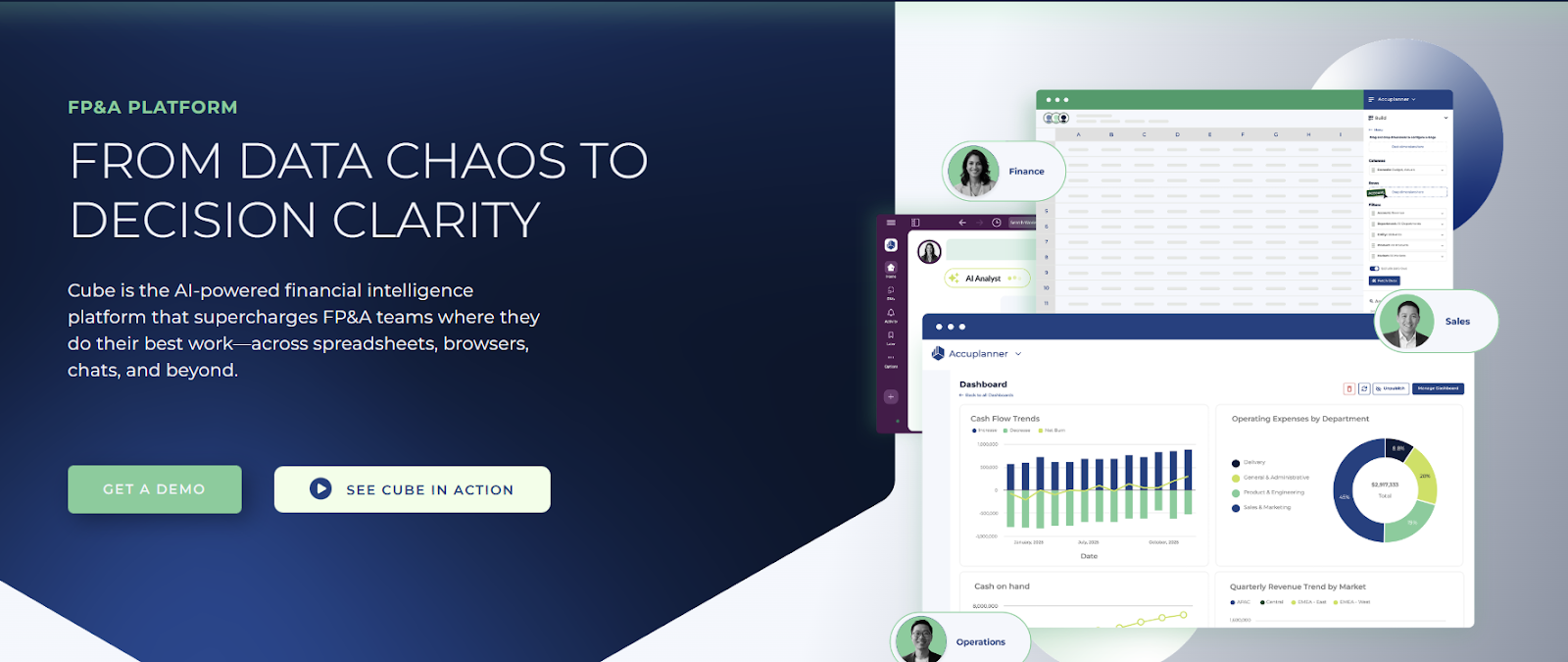
Cube is an AI-powered FP&A and financial intelligence platform designed to help finance teams move from manual reporting to strategic decision-making. Built by former CFOs, Cube works directly inside Excel and Google Sheets; layering AI-driven planning, forecasting, and analysis on top of existing workflows without forcing teams to abandon spreadsheets.
🧩 Key Features of Cube
- 📊 Financial planning, budgeting, and rolling forecasts
- 🔁 Scenario planning and what-if analysis
- 🧮 Workforce, revenue, and strategic planning
- 🧠 Plain-English queries for finance insights
- 🔗 Embedded directly in Excel & Google Sheets (no workflow disruption)
- 🔐 Enterprise-grade security (SOC 2 Type II, HIPAA compliant)
💵 Cube Pricing
Cube does not publish fixed pricing. Plans are customized based on company size, data complexity, and FP&A requirements.
🗣️ Cube User Reviews
4.5/5 on G2 (120+ reviews)
Cube is well regarded by FP&A and finance leaders for modernizing planning, forecasting, and reporting—especially for teams that live in Excel or Google Sheets.
✅ What users like
- 📊 Powerful FP&A capabilities for budgeting, forecasting, and variance analysis
- 🧮 Native Excel & Google Sheets workflows (no forced tool switch)
- ⏱️ Major time savings in reporting and planning cycles
- 🤝 Strong customer support and hands-on implementation help
- 🔄 Flexible modeling for fast-changing business scenarios
️ Where users see limits
- 🎨 Dashboards and visualizations feel limited compared to BI tools
- 🧩 Initial implementation can be time-consuming for complex models
- 📈 Advanced customization sometimes requires deeper setup effort
4th Category - Payments & Collections
Bill.com
Bill.com is a cloud-based financial operations platform designed to help businesses automate accounts payable, accounts receivable, payments, and spend management. Designed to centralize back-office workflows, it streamlines bill creation, approvals, invoicing, and payment processes; and integrates closely with leading accounting systems.
For SaaS teams, Bill.com is typically used to optimize financial operations after deals are signed, reducing manual work in payables, receivables, and expense tracking rather than handling subscription billing or revenue recognition.
️Key Features of Bill.com
- 🧾 Accounts Payable (AP) automation for bill creation, approvals, and payment workflows
- 💸 Accounts Receivable (AR) for sending invoices and managing incoming payments
- 💳 Payments management (ACH, card, international payment support)
- 🧠 AI-assisted automation to reduce manual entry and errors
- 📊 Spend & expense management with budgets, controls, and virtual/corporate cards
- 🏦 Business Credit & Tools with offers like via BILL Spend & Expense (Divvy)
- 🔗 Deep integrations with accounting systems like QuickBooks, NetSuite, Xero, and Sage Intacct
- 📱 Mobile access for approvals, payments, and expense tracking
- 🔐 Permissions & Controls for audit trails, role-based access, and approval workflows
💵 Bill.com Pricing
Bill.com uses per-user, monthly pricing based on the level of control, automation, and scale required:
- Essentials ($49/user/month): Core AP & AR automation for bill payments and invoicing.
- Team ($65/user/month): Adds more granular controls and two-way sync with leading accounting systems.
- Corporate ($89/user/month): Includes advanced customization and unified management of AP, AR, and procurement.
- Enterprise (Custom pricing): Designed for larger organizations needing enhanced security, premium support, and multi-entity capabilities.
🗣️Bill.com User Reviews
4.4/5 on G2 (1,500+ reviews)
Users consistently describe it as a major time-saver for finance teams handling high volumes of invoices and payments.
✅ What users like
- 💡 Significant time savings through automated invoice capture, approvals, and payments
- 🔄 Seamless integrations with accounting systems like QuickBooks, NetSuite, Xero, and Sage Intacct
- 🧾 Clear approval workflows and audit trails, helpful for compliance and audits
- 📊 Good visibility into payables, payments, and spend
- 🧠 Easy to use, even for non-finance stakeholders involved in approvals
️ Where users feel friction
- 🧩 Reporting flexibility can be limited for complex or custom needs
- 💰 Costs can add up as users and features scale
- 🖥️ UI can feel cluttered when managing large volumes of data
- 🌐 Vendor network issues, such as duplicates or onboarding confusion
- 📱 Mobile app is less robust than the desktop experience
While each of these tools plays a vital role in managing revenue operations, they still cover only part of the revenue lifecycle.
They help you execute and report after a deal is signed: automating billing, tracking revenue, and keeping the back office running smoothly. But they don’t help you actually win the deal when buyers are pushing for flexible terms, finance needs to protect cash, and your growth depends on faster conversion.
That’s the gap traditional SaaS finance stacks leave open (a moment in the revenue cycle where negotiation, payment structure, and cash timing collide) and where a new layer of capability is now emerging.
🚧 Why SaaS Finance Software Alone Can’t Unlock Faster Deals or Healthier Cash Flow
As SaaS companies move upmarket and deals become larger, more negotiated, and more flexible, a different set of requirements emerges. The ones that most finance platforms weren’t built to solve.
The issue isn’t that these tools are ineffective. It’s that they stop short of the closing moment, where buyer commitment must turn into cash.
Here’s where that gap shows up most clearly 👇
💸 1. No Built-In Upfront Financing for Flexible Deals
When buyers ask for monthly or quarterly payments, most SaaS finance software simply documents the terms after the fact.
What it doesn’t do is:
- 💰 Deliver cash upfront at close
- 🛡️ Protect the seller’s liquidity
- 🔄 Separate buyer flexibility from seller cash timing
As a result, SaaS companies end up funding customer payment plans themselves, often unintentionally. Over time, flexible terms quietly become a working capital drain, especially as deal volume grows.
️ 2. Risk Assessment Is Static, or Completely Absent
Traditional SaaS finance platforms excel at reporting on what’s already happened.
They struggle to inform us about what should happen next.
Most tools:
- 📉 Do not assess buyer risk in real time
- 🧮 Do not price flexibility based on behavior
- 🕒 Do not adapt terms dynamically during negotiations
The result? Every buyer is treated the same, regardless of risk. Without real-time risk assessment at close, teams absorb avoidable defaults, write-offs, and delayed cash.
🧾 3. BNPL Exists: But Only in Its Simplest Form
Some SaaS finance platforms support basic installment billing or net terms. But these options are usually rigid and operational, not strategic.
What’s missing is:
- 🛍️ Buy Now, Pay Later structures designed for B2B subscriptions
- 📆 Payment plans tied to deal value and buyer risk
- 📈 Flexibility without sacrificing price or cash timing
Without that, Sales defaults to discounting to close. Long-term value is traded for short-term wins; not because it’s smart, but because there’s no better option. BNPL treated billing logic, not financing, and can't move the needle.
🧩 4. Deal Workflows Remain Fragmented Across Tools
Even with modern SaaS finance software, the deal still fragments across tools:
- 🧑💼 Sales negotiates in the CRM
- 🧑💻 Finance reviews risk later
- 💳 Billing and collections happen downstream
- ❓ Risk decisions live outside the workflow, or nowhere at all
This fragmentation introduces friction exactly where speed and clarity matter most. Instead of one closing motion governing pricing, financing, and approval, teams rely on handoffs and workarounds, slowing closes and degrading deal quality.
Without upfront financing, real-time risk pricing, and embedded flexibility at the moment of close, SaaS finance software remains reactive, not strategic.
🎯 The answer isn’t more tools. It’s a closing layer, one that protects cash, prices risk, and converts buyer commitment into certainty at the exact moment a deal is won.
That’s exactly what Ratio Boost delivers. Read on!
🔥 Ratio Boost: The Closing Layer That Protects Cash in Modern SaaS Deals
Ratio Boost is an embedded closing and financing platform built for B2B SaaS and subscription businesses that want to offer buyer payment flexibility without slowing deals.
Importantly, Ratio Boost is designed to sit alongside your existing accounting, billing, and finance systems (not replace them) addressing the gap those tools weren’t built to solve: how deals with flexible terms are financed and approved at the moment of close.
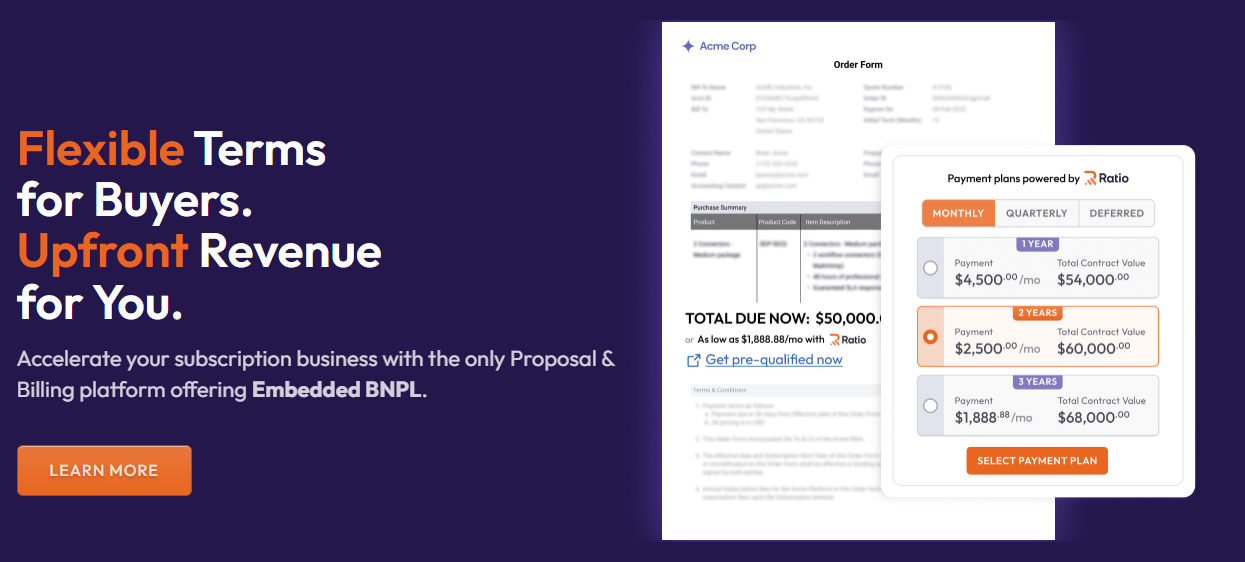
Embedded directly into the sales workflow, Ratio Boost delivers upfront cash to the seller, flexible payment terms to the buyer, and real-time underwriting and risk evaluation in a single flow.
🛠️Here's a Detailed Look at Ratio Boost’s Core Capabilities.
Each capability addresses a critical gap traditional SaaS finance software leaves at the moment of close.
💰 Paid Upfront, Buyer Pays Over Time
Ratio Boost enables sellers to be paid upfront for deals while buyers pay according to flexible terms selected during purchase; all through an embedded financing experience that doesn’t delay the deal.
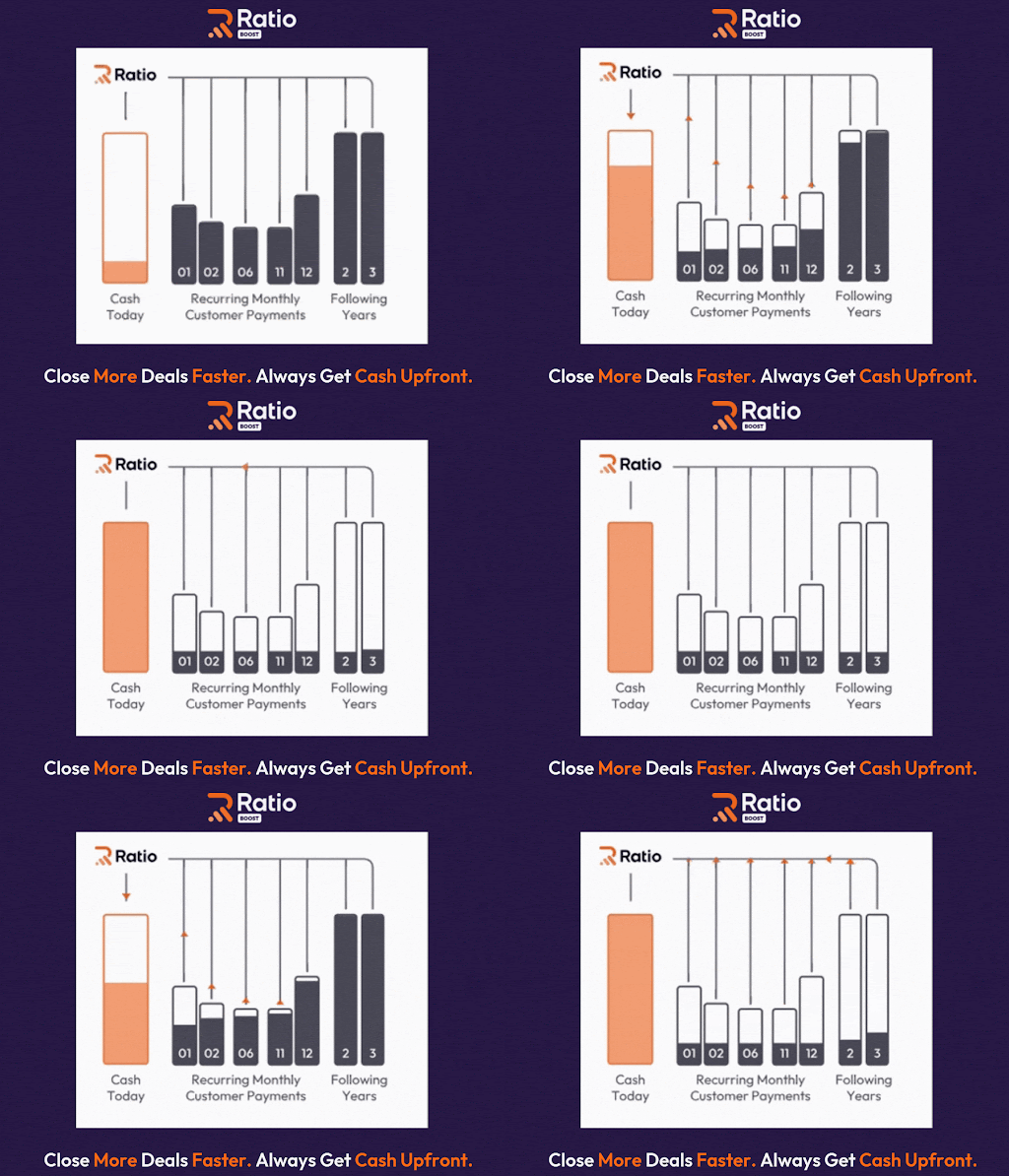
Why it matters: Flexible terms paired with upfront cash remove one of the biggest blockers in SaaS sales. You protect cash flow, reduce back-and-forth during negotiations, and close deals that would otherwise stall due to budget timing or payment objections.
Close High-Quality Deals Fast
Buyers see flexible payment options embedded directly in the buying flow, choose terms, sign, and complete the purchase in one motion. This eliminates procurement delays and reduces negotiation friction, helping deals move forward faster; without sacrificing deal quality.

Why it matters: Removing internal handoffs and external delays shortens sales cycles, improves conversion rates, and reduces lost opportunities caused by payment timing or budget constraints.
⚖️ Price Risk in Real Time
Ratio Boost evaluates each buyer in real time using contract data, company-level risk signals, and underwriting models. Enabling payment terms to be aligned with risk at the moment of close.

Why it matters: Sales maintains momentum while finance stays protected; minimizing no back-and-forth approvals and last-minute deal friction.
🔁 Replace 4+ Tools with One Layer
Ratio Boost connects directly to your CRM, billing system, and AR stack, acting as a single closing layer: no-code, no rebuild, and no disruption to existing workflows.
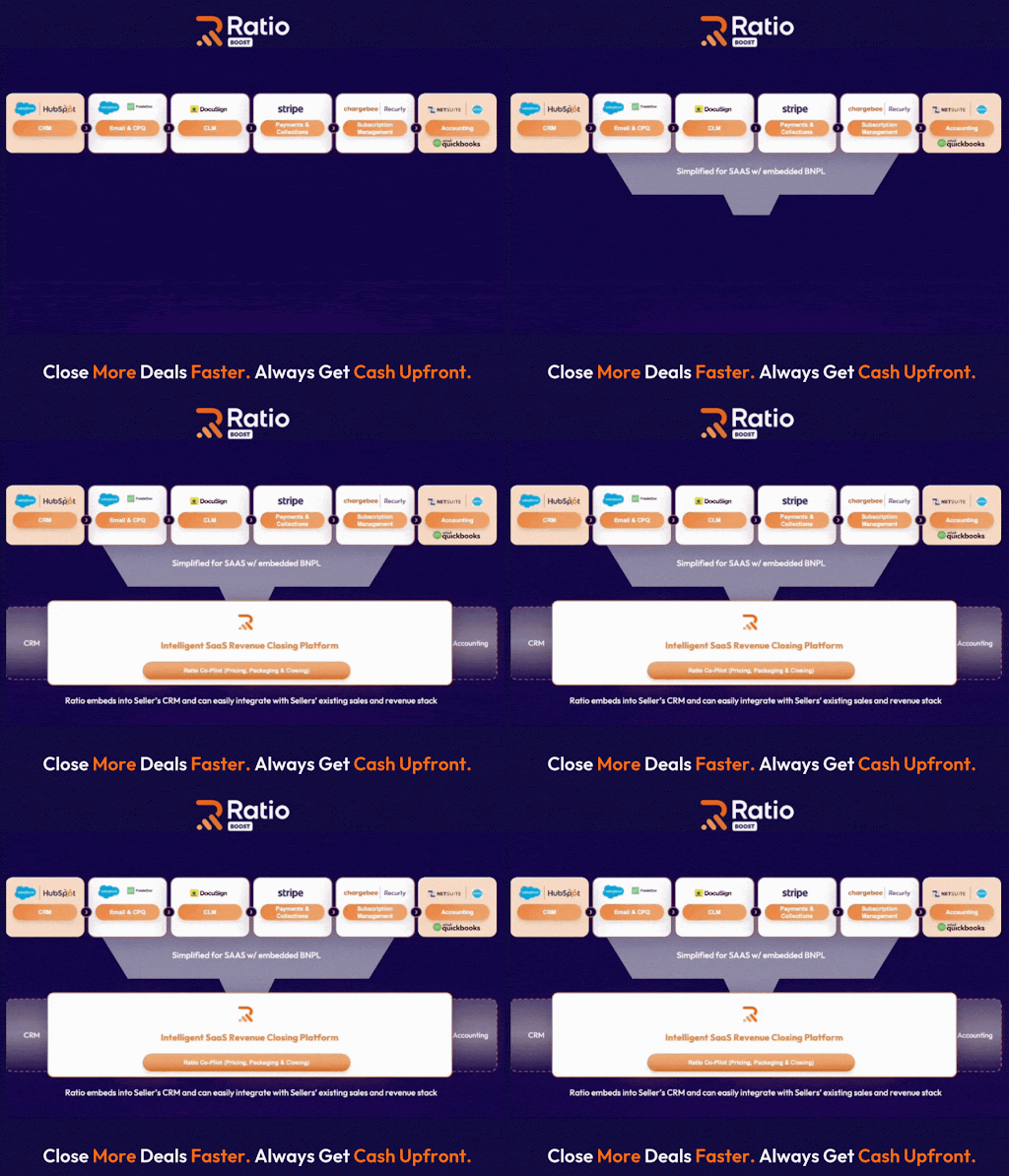
Why it matters: Keeps workflows clean and lets your team scale without adding unnecessary tools or operational sprawl.
🤝 Align Sales and Finance from Day One
Sales offers flexibility, finance stays in control, and both see the same version of truth—directly inside your CRM.
Why it matters: Deals move forward without the internal tug-of-war.
🔧 How Ratio Boost Fits Into Your SaaS Finance Workflow
Ratio Boost connects into your CRM and finance stack to add a closing layer: buyer flexibility, real-time underwriting, and cash certainty; without forcing your team to rebuild workflows.
Here’s how it fits in, step by step:
- Launch from your CRM: Reps access Ratio Boost from Salesforce or HubSpot within the existing workflow. Supports role-based access controls to keep everyone focused and aligned.
- Create an offer in the deal flow: Reps configure payment terms through a guided flow. Financing costs can be buyer-paid, seller-paid, or shared — without spreadsheets.
- Get credit decisions: Ratio runs real-time underwriting in the background. Finance gets visibility and control, while reps keep momentum.
- Send a buyer-ready link: Buyers receive a branded, self-serve experience to review payment options, share internally, sign, and complete the purchase in one motion.
- Get paid upfront: After signature, Ratio pays the seller upfront (typically within a few business days) while the buyer pays over time.
- Keep repayment automated: Ratio manages invoicing, reminders, collections, and repayment tracking so teams aren’t chasing payments manually.
To truly understand what Ratio Boost enables in practice, it helps to see what users are saying about it. For example, DearDoc, a bootstrapped healthcare SaaS company, fundamentally changed how deals moved forward after implementing Ratio Boost.
See what was the case:
🚫 Before Ratio Boost
Payment terms created friction in a bootstrapped, high-velocity sales environment.
- 💳 Annual upfront payment was required to protect cash flow
- ⏳ Deals delayed due to misaligned buyer budgets
- 📉 Steep discounts used to close deals needing flexibility
- 🧑💼 Sales cycles stretched across multiple days
- 🔧 Sales process was fragmented across Stripe, Braintree, DocuSign, PandaDoc
✅ After Ratio Boost
Payment flexibility became a growth driver; without sacrificing control or cash.
- 💰 Full contract value collected upfront from Ratio
- 📈 25% increase in average selling price (ASP)
- 🚀 20-30% lift in overall close rates
- 🔁 All-in-one workflow replaced 4+ tools (no-code, no heavy integration)
- ✅ 10% additional increase in closes from streamlined buyer experience
Don't just take our word for it.
🎥 Hear directly from the Founder.
So it is what it is.
If you’re planning on investing in SaaS finance tools, the next step isn’t replacing them; it’s adding the layer that connects them and unlocks values they can’t reach on their own.
No pressure. Let’s start with 👉a 25-minute strategy call. We’ll show you how it fits into your stack, and you decide if it’s worth it.
❓Frequently Asked Questions
1. What Is the Difference Between SaaS Finance Software and SaaS Financing Solutions?
SaaS finance software helps manage revenue after a deal is signed—billing, invoicing, revenue recognition, collections, and forecasting. It's operational and essential for accuracy and reporting.
SaaS financing solutions, on the other hand, operate at the moment of sale. They help offer payment flexibility, manage risk, and advance cash to the seller; without waiting for collections.
Both are essential, but they solve different problems at different stages of the revenue cycle.
2. Why Do SaaS Companies Need a Layer Beyond Billing and Rev Rec?
Tools like Chargebee, Zuora, and NetSuite are critical for back-office accuracy. But they don’t influence how deals are structured, how fast deals close, or how quickly cash is collected.
SaaS growth today depends on deal structure, speed, and liquidity—which traditional finance software wasn’t built to optimize. A flexible layer that lives between Sales and Finance is increasingly becoming a necessity, not a nice-to-have.
3. Can Offering Flexible Terms Hurt Cash Flow?
Yes, if you’re funding them from your own balance sheet.
Offering monthly or quarterly terms without protection means you delay cash collection and take on risk. This can quietly drain working capital, especially as deal volume increases.
That’s why many SaaS companies are now decoupling buyer flexibility from seller liquidity through embedded financing solutions.
4. What’s the Smartest Way to Add Payment Flexibility Without Slowing Down Sales?
Build it into the deal flow, not after the fact.
When Sales can offer terms during pricing and Finance can assess risk in real time, deals move forward without handoffs, delays, or internal friction.
The most effective teams are embedding flexibility and financing into their CRM and quoting workflows, rather than treating it as a downstream workaround.
↗
The Closing Motion Platform
Sellers on Ratio see up to 30% higher close rates and 25% higher ACV.


