5 Best Equipment Financing Companies for 2026 (Traditional, Fintech & Embedded BNPL Compared)
Selling high-ticket hardware is hard because buyers hesitate at large upfront costs. They want flexible payments, fast approvals, and simple checkouts—just like they get elsewhere. This blog explains how equipment financing helps vendors close more deals without giving up cash flow, and breaks down the top 5 equipment financing companies in 2026. One of them, Ratio Boost, stands out by helping hardware sellers offer flexible payment plans while still getting paid upfront.

Table of contents

Selling high-ticket hardware is hard because buyers hesitate at large upfront costs. They want flexible payments, fast approvals, and simple checkouts—just like they get elsewhere. This blog explains how equipment financing helps vendors close more deals without giving up cash flow, and breaks down the top 5 equipment financing companies in 2026. One of them, Ratio Boost, stands out by helping hardware sellers offer flexible payment plans while still getting paid upfront.
The Challenge: Selling high-ticket hardware is hard, especially when buyers hesitate over price.
You’re selling robotics, medtech, or infrastructure systems that deliver real ROI. But let’s be honest, when it comes time to close, six-figure price tags scare buyers off.
- They want monthly payments
- Instant approvals
- Frictionless checkout, just like they get elsewhere
So what happens? You either lose the deal or offer terms yourself. That slows down cash flow, drags out the sales cycle, and adds credit risk you weren’t built to carry.
It’s no surprise the global equipment finance market is projected to hit $3.1 trillion by 2032 as buyers need flexibility, and vendors need a better way to offer it.
To help, we’ll explore four top equipment financing companies and why Ratio stands apart.
But first, let’s cover the basics.
What Is Equipment Financing (for Vendors)?
When you sell high‑ticket equipment like med‑tech devices, infrastructure hardware, or robotics systems, the real hurdle isn’t just building the product, it’s closing the deal. And often what stands in the way is how your buyer pays. That’s where equipment financing steps in.
Equipment financing traditionally means that the buyer takes out a loan or enters a lease to acquire business equipment instead of paying the full cost upfront.
But from your point of view (as the vendor), the interesting version is vendor‑financing or embedded financing: you partner with a financing provider so that your customer pays over time but you still get paid up front or much sooner.
What does that mean in practice for you?
- You don’t need to wait months while your buyer figures out funding.
- You don’t have to discount or absorb extra risk because you let the financing partner handle that.
- You align the buyer’s payment experience (monthly installments, quick approval) with your business goals (cash flow today, predictable revenue).
In short: equipment financing for vendors is a sales‑enablement strategy wrapped in a finance offering. It makes your offer more appealing payment options and hence you are solving a buyer’s pain. And simultaneously, it protects you by keeping your revenue, margin, and cash flow healthy with financing upfront.
Now that we’ve unpacked what equipment financing actually is, the next question is: who is it for?
Because while any B2B seller can technically offer payment terms, the benefits aren’t equal. For some vendors, equipment financing is a nice-to-have.
For others, it’s a deal-closing, cash-flow-saving game changer.
Who Is Equipment Financing Really For?
Equipment Financing is for vendors selling capital‑intensive, high‑ticket hardware and whose growth is hindered by traditional payment models. Think about it like this:
Vendors Selling Complex Equipment with Long Cycles
Machine manufacturers, industrial automation firms, med‑tech suppliers. These companies sell hardware where a cash‑out sale is often the default, but the buyer can’t deploy cash outright. According to industry data, nearly 8 in 10 U.S. companies use some form of equipment financing when acquiring equipment, reflecting how critical it is for high‑ticket sales.
Vendors Whose Buyers Expect Financing
Buyers in manufacturing, healthcare, and infrastructure increasingly demand payment models that mirror consumer finance (monthly, low‑friction). One specialist lender states that equipment and vendor financing helps maintain margins, grow market share, and make complex hardware acquisition affordable.
Vendors Who Can’t Afford to Float Long Payment Terms
If you, as a seller, absorb payment risk or wait for full payment, you hurt your cash flow. As per a PNC insights: equipment financing allows firms to free up cash, improve budgeting, and standardize replacement cycles.
Vendors Competing in Industries Where Rapid Technology Turnover or Upgrade Cycles Exist
In markets like robotics, AI hardware, and med-tech, tech turnover is constant. Buyers need payment flexibility to keep up.
And as the global market for equipment‑finance services is projected to grow from ~$1.2 trillion in 2022 to ~$3.1 trillion by 2032, illustrating demand across tech‑intensive sectors.
So far, we’ve looked at who benefits most from equipment financing across industries. But one segment stands out: vendors selling robotics and high-performance hardware.
Why? Because their products sit at the intersection of complexity, cost, and innovation. Traditional sales models fall short, and financing becomes not just useful, but mission-critical.
Let’s break down why.
Why Robotics & Hardware Vendors Need Equipment Financing Now More Than Ever
When you’re selling advanced hardware like robotics, infrastructure, med‑tech systems, the deal isn’t just about the tech. It’s about how the buyer pays.
And right now, three major shifts make financing critical, not optional.
1. Rising Complexity Means Buyers Hesitate
Hardware today isn’t plug‑and‑play. Installations are lengthy, customization is high, and support/service commitments matter. As one expert put it:
“Robotic hardware is generally unknown to banks, which means they will not provide financing with the equipment as collateral.”
Vendor Takeaway: If your buyer can’t get traditional finance, the deal stalls, and you risk losing both the customer and revenue.
2. The Shift to “Pay‑as‑you‑Use” Models Demands Flexible Financing
Business models are evolving. Original Equipment Manufacturers (OEMs) now offer hardware as a service (HaaS), with subscriptions, and usage‑based pricing. According to a 2024 report:
“In 2024, more than half (54 %) of equipment acquisitions are forecast to be financed; eight out of 10 businesses will use leases, secured loans or lines of credit.”
Vendor Takeaway: To support monthly, subscription, or usage‑based models, you need a financing partner that aligns with that flow—not legacy one‑time payments.
3. Rapid Market Growth Creates Both Opportunity and Pressure
The robotics market is expanding fast—meaning hardware vendors are under pressure to scale deals and close quickly. For instance:
“The global robotics market size is nearly US $50 billion in 2025 and is projected to expand to US $111 billion by 2030 (CAGR ~14 %).”
Vendor Takeaway: With buyer demand increasing, you must be able to offer payment options or risk being bypassed by competitors who do.
4. Fintech & Embedded Financing Are Changing What’s Possible
Technology is reshaping how hardware vendors and finance providers partner. This leads to faster approvals, real‑time underwriting, and embedded checkout.
Tech commentary highlights how AI, IoT‑based asset monitoring, and automation are transforming equipment financing for tech‑hardware‑led deals.
Vendor Takeaway: If your sales process isn’t aligned with modern payment expectations, you’ll lose momentum—and your buyer’s interest.
5. Working Capital and Margin Risk Are Real
If you personally extend long payment terms or wait for large invoices to be paid, you tie up resources and expose margins.
According to BDC’s guide: equipment financing helps businesses avoid large upfront payments, preserve cash flow, and expand.
Vendor Takeaway: A financing partner lets you close without negative impact to your cash flow or profitability.
At the core of all the challenges covered above is the same issue: not just getting the buyer to say yes, but turning that yes into cash upfront without slowing the deal.
And here, equipment financing isn’t just helpful, but for robotics and hardware vendors, it’s become a go-to-market necessity.
But mind this: not all financing models are created equal.
Some shift the burden to the buyer. Others strain your balance sheet. And a few unlock real leverage, letting you close faster, get paid sooner, and reduce risk.
Let’s walk through the key financing models vendors can use.
Types of Equipment Financing Models Vendors Can Use
You tailor your hardware to the operational needs of your buyers.
Likewise, the financing model you choose should align with how you sell, and how your buyers prefer to pay.
Each model reshapes your deal structure differently, affecting risk exposure, cash flow timing, and sales velocity.
This isn’t just a financial detail, it’s a strategic lever.
And like any lever, the impact depends on the model you choose. Some help you get paid faster. Others protect your margins. A few even shift how buyers perceive your price.
No wonder 82% of equipment buyers in 2023 chose leasing or financing options because not all financing is created equal, and neither are the outcomes.
In this section, we’ll define the major equipment financing models vendors can use and break down the practical pros and cons of each.
1. Equipment Loan
What it is: Your buyer takes out a loan—usually from a bank or lender—to buy your equipment. You get paid once the loan is approved.
Pros for you:
- You get paid upfront
- The buyer owns the equipment, which can reduce service calls later
Cons:
- If the buyer’s credit isn’t great, the loan might get rejected
- The process can be slow and delay your deal
- You have little control over the buyer’s financing experience
Use when: You work with larger enterprises who prefer to own assets and already have lending relationships.
2. Equipment Lease
What it is: Instead of buying, the customer rents the equipment for a set time. A leasing company handles the financing.
Pros for you:
- Lower price point makes it easier for buyers to say yes
- Good for hardware that will be upgraded often
Cons:
- You may have to manage returns or upgrades
- Lease contracts can be complicated
Use when: You sell fast-evolving tech or buyers need flexibility over ownership.
3. Embedded Financing (a.k.a. Partner Financing)
What it is: You partner with a financing provider who is built into your sales flow—kind of like how Apple lets you pay monthly through your checkout. The buyer pays over time, but you get paid right away.
Pros for you:
- Instant approvals and smooth checkout = more deals closed
- You protect your cash flow and avoid credit risk
- Works well for high-ticket deals
Cons:
- You need to set up with the right provider (not all work well for hardware)
- There may be integration or onboarding time
Use when: You want to scale faster without offering terms yourself, and your buyers want a seamless buying experience.
4. Subscription or Hardware-as-a-Service (HaaS)
What it is: Buyers pay monthly to use your hardware…like a subscription. They don’t own it, you manage and support it.
Pros for you:
- Predictable monthly revenue
- Easier for buyers to budget
Cons:
- You still own and manage the hardware
- You need to handle maintenance, upgrades, and returns
Use when: You offer managed hardware, bundled services, or want recurring revenue.
5. Hybrid or Split-Payment Models
What it is: A mix of upfront and monthly payments. For example, the buyer pays 30% now and the rest over 6 months.
Pros for you:
- Flexible = good for custom deals
- Helps close price-sensitive buyers
Cons:
- Slightly more complex to manage
- Risk of buyer confusion if terms aren’t clear
Use when: You offer bundled hardware + services, or when buyers need flexible deal structures.
These are the types of equipment financing models. Now, let me be honest with you. Choosing the right model is only half the equation. The other half? Picking the right financing partner to actually make it work. Some providers are built for banks, some for SaaS and only a few truly understand the needs of hardware vendors.
Let’s break down how to evaluate third-party equipment financing companies so you don’t just pick a provider, you pick a partner.
How to Evaluate Equipment Financing Companies or Third-Party Financing Partners?
Different equipment financing companies bring different capabilities, risk profiles, speed, and alignment with your goals. Let’s dig into key criteria you should assess.
1. Do They Understand Hardware, Robotics, and Complex Assets?
Not every financing provider can underwrite or support advanced hardware. Many lenders are built for vehicles, construction tools, or generic commercial equipment, not robots, AI-powered devices, or multi-component systems.
What to look for:
- Have they financed intelligent equipment, robotic systems, or specialized hardware before?
- Do they understand installation, calibration, service cycles, and upgrade paths?
- Can they finance hardware + software + services in one contract? (Most banks can’t.)
Why this matters: Your product is complex. Your financing partner must know how to evaluate it, price risk, and support long-term performance.
2. Do They Pay You Upfront and Take on the Risk?
This is critical. You don’t want to wait months to get paid or take on buyer non-payment risk.
Ask directly:
- Will we get full payment upfront?
- Who carries the credit and default risk?
- Is payment tied to buyer approval, installation, or delivery?
Why this matters: You need cash flow to fund production, inventory, and GTM, not to be a bank.
3. Are They Fast? (Speed = Closed Deals)
In hardware sales, slow financing kills deals. If approvals take weeks, your buyer will lose urgency, or move to a competitor.
Evaluate:
- Average approval time (hours? days?)
- Is the process digital or manual?
- Do they support instant or near-instant underwriting?
- Can financing be offered during quoting—not after?
Why this matters: Your buyer expects a modern purchasing experience. Your financing partner should match that.
4. Can Their Solution Plug Into Your Sales Workflow?
Modern vendors need financing built into their quote-to-cash workflow, not bolted on after the sale.
Check for:
- CRM or CPQ integration
- Quote-level financing options
- Embedded checkout (like “pay over time” in the PDF/quote)
- Automated agreement generation
Why this matters: Sales teams shouldn’t manage financing manually. It should flow naturally inside your sales process.
5. Are Their Terms Clear, Transparent, and Buyer-Friendly?
Your buyers will judge you by the financing experience, even if a partner handles it.
Make sure:
- Rates, fees, and repayment terms are simple to explain
- No hidden charges or misleading teaser rates
- They provide clear dashboards or reporting for your team
- They support end-of-term options (renew, return, upgrade)
Why this matters: Confusing terms reduce trust and slow down closing.
6. Do They Support the Business Model You Sell?
Robotics and hardware vendors increasingly sell:
- Hardware + software + service bundles
- Annual contracts
- Multi-year service agreements
- Subscriptions / HaaS
- Hybrid models
Ask:
- Can your partner support subscriptions or hybrid financing?
- Can they handle deferred payments, seasonal schedules, or usage-based flows?
- Can they finance multi-line items in one contract?
Why this matters: Many banks don’t support bundled or flexible models—only modern providers do.
7. Do They Act Like a True Sales Partner?
The best financing providers help you sell—not just lend money.
Look for support such as:
- Training your reps
- Sales collateral
- Co-branded financing calculators
- Joint marketing support
- Buyer-prequalification tools
Why this matters: Financing should help your reps close deals, not add friction.
8. Can They Support Your Buyers (in the Regions You Sell In)?
If you sell across states or countries, your partner must be able to operate there.
Check:
- Licensing
- Local underwriting rules
- Regional tax considerations
- Ability to support cross-border deals
Why this matters: You don’t want to close deals in one region and get stuck in another.
Quick Checklist for Hardware Vendors
A strong financing partner should:
- Understand robotics & complex hardware
- Pay you upfront
- Take on buyer credit risk
- Approve deals fast
- Integrate with your quote-to-cash workflow
- Support hybrid and bundled models
- Provide transparent terms
- Help your sales team win deals
If they can’t do these, they aren’t the right partner for a hardware-first business.
Now that you know how to evaluate an equipment financing partner: their speed, risk model, integration, and industry fit, the next question is obvious: Which companies actually meet these standards?
Because the market is crowded. Some providers are built for banks. Some are built for fleets and construction equipment. Only a few truly understand the needs of high-ticket hardware vendors selling robotics, med-tech systems, and complex equipment bundles.
So let’s look at the top equipment financing companies in 2026.
Top Four Equipment Financing Companies for Robotics & Hardware Vendors
To help you shortlist the right options, we’ve evaluated the market through the lens of hardware and robotics vendors, not generic equipment sellers. Based on speed, risk management, integration strength, industry fit, and support for bundled or hybrid models, here are the four companies that stand out in 2026:
- Ratio Boost
- Crest Capital
- Taycor Financial
- National Funding
Let’s break down each one-by-one.
1. Ratio Boost
Ratio is an equipment financing company that helps hardware and robotics vendors make their products easier to afford without sacrificing cash flow. Instead of pushing buyers toward traditional leasing companies or banks, Boost lets vendors offer Custom payment plans at the point of sale, right inside their CRM.
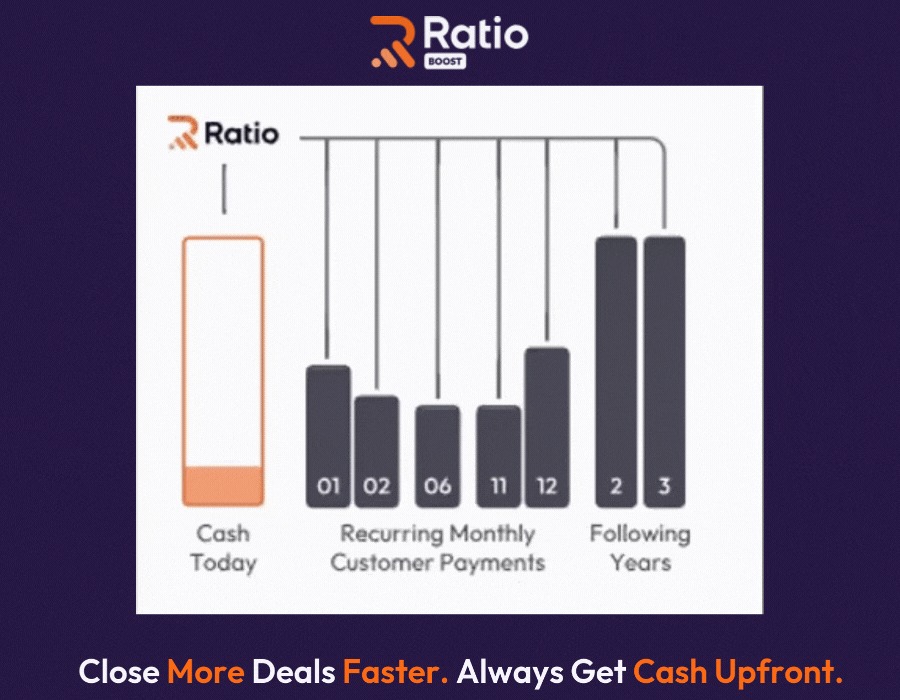
Your customer gets the equipment immediately and pays over time. You receive the full contract value upfront from Ratio, because Ratio purchases the contract through a true-sale structure. Ratio then manages billing, repayment, and collections with the buyer.
What makes Ratio different is that it does more than help finance the purchase. In hardware sales, a signed contract does not always mean the deal is truly closed if the seller still has to wait months to get paid. Ratio helps vendors move from signature to cash upfront, so payment does not become the point where deal momentum breaks.
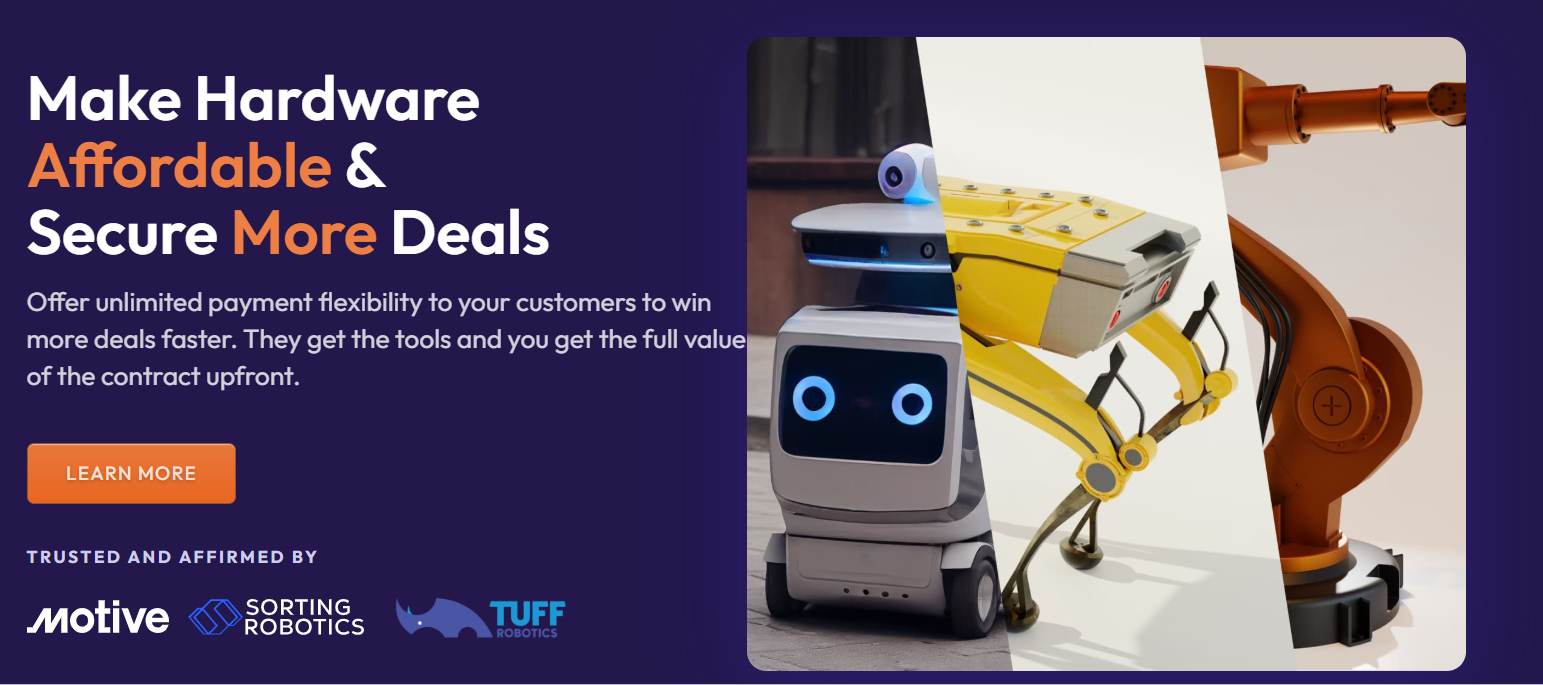
That is why Ratio is called a Closing Motion Platform. It helps ensure the deal does not stop at signature, but continues through to cash upfront for the seller. Many hardware and robotics vendors like Sorting Robotics, Bigtincan, and Tuff Robotics rely on Ratio. All they got is less procurement friction, less pressure on internal teams, and more support for deals that might otherwise slow down at the point of close.
Key Features & Benefits
- Embedded Payment Flexibility in Your CRM: Your sales reps can build monthly, or custom payment plans directly inside Salesforce or your CPQ. This removes friction, eliminates back-and-forth with lenders, and lets buyers see flexible pricing the moment they receive a quote.
- BNPL-Style Checkout for Hardware Buyers: Your customers can choose how they want to pay—pay now or pay over time—through a simple, modern financing flow. This mirrors the intuitive checkout experience buyers expect and reduces objections tied to large upfront costs.
- Full Upfront Payment to the Seller: Ratio purchases the contract from you, so you recognize revenue immediately. You’re not waiting through long repayment periods, and you’re not dependent on the customer’s monthly cash flow.
- Ratio-Managed Underwriting for Every Buyer: Ratio evaluates creditworthiness on your behalf. Your team doesn’t have to assess risk or review financial documents, which removes the burden of acting like a lender.
- Fast Buyer Onboarding & Approval Workflow: Your customers can complete the application online and receive decisions quickly. Faster approvals mean fewer stalled deals and smoother procurement.
- Financing for Hardware + Software + Services: Ratio can finance the entire offer—equipment, installation, training, software, and multi-year service agreements. This helps you sell full solutions instead of limiting financing to the hardware alone.
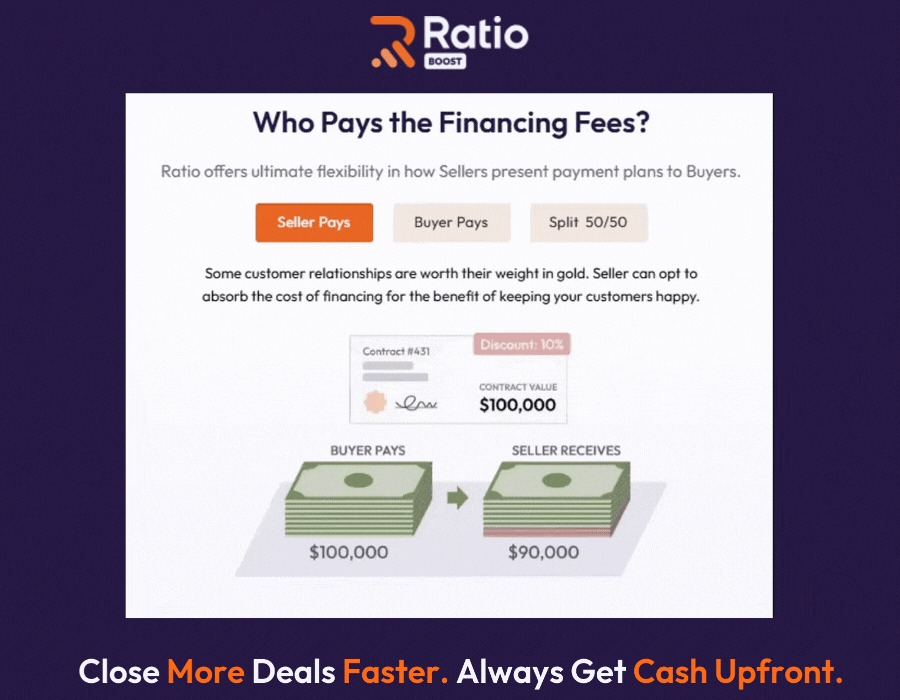
- Customizable Fee Responsibility (You, Buyer, or Split):You can decide who pays the financing fee based on the deal. This flexibility lets you stay competitive without automatically reducing margins.
- Support for “X-as-a-Service” Revenue Models: Ratio enables you to turn installs, support, and professional services into ARR. You can transition from one-time transactions to predictable recurring revenue.
Integration Capabilities
Ratio Boost plugs directly into the tools like:
- Accounting: QuickBooks, Xero, Oracle NetSuite, Sage, FreshBooks
- Banking & Verification: Plaid
- CRM: Salesforce, HubSpot
- Subscription Management: Chargebee, Recurly, Chargify
- Payments: Stripe, GoCardless, ACHQ
Limitations
- Ratio is not a fit for low-ticket or consumable hardware, where embedded financing adds unnecessary overhead.
- Ratio primarily operates in the U.S. market.
- Ratio carries the risk, so buyers must pass underwriting. Vendors with many subprime or distressed customers may see lower approval rates compared to collateral-based lenders.
Pricing
Ratio doesn’t publish fixed program fees. Instead, financing costs are built into each deal structure. Vendors can choose whether the buyer pays the fee, the seller absorbs it, or the cost is split.
Demo
You can book a personalized demo to see how Ratio Boost fits into your sales flow.
2. Crest Capital
Crest Capital is a privately held, national equipment financing company. Serving small and mid-sized businesses across the United States since 1989. Crest Capital specializes in providing fast, hassle-free loans and leases for new and used equipment, vehicles, and software, with minimal paperwork and highly competitive fixed rates.
Its approach is tailored to businesses seeking predictable payments, flexible terms, and quick approvals—often within the same day—for funding amounts ranging from $5,000 to $500,000.
Key Features & Benefits
- 100% Financing + Soft Costs Included: Buyers can finance the entire equipment cost plus up to 25% of related expenses (delivery, installation, training), reducing upfront cash requirements.
- Fast Digital Application Process: Most loans under $250K receive decisions within hours, helping buyers secure equipment quickly when timing is critical.
- No Down Payment on Most Loans: Qualified borrowers can obtain financing without upfront cash—ideal for companies preserving liquidity.
- Flexible Repayment Options: Monthly, quarterly, seasonal, deferred, and step-up schedules allow businesses to match payments with their cash flow cycles.
- Fixed Rates for Predictable Costs: Interest and payments remain constant throughout the term, protecting buyers from rate fluctuations.
- Minimal Collateral Requirements: Only the financed equipment is used as collateral—avoiding blanket liens on the buyer’s business, unlike many banks.
- Financing for New & Used Equipment: Buyers can finance pre-owned or refurbished equipment up to 10 years old, expanding options beyond new-only assets.
- Soft Credit Pull for Pre-qualification: Buyers can explore financing without impacting personal credit scores.
Integration Capabilities
Crest Capital does not offer deep CRM or workflow integrations. Applications are submitted through its online portal, and financing remains largely separate from a vendor’s internal quoting or sales systems.
Limitations
- Crest offers vendor financing tools and an online application portal, but its public site emphasizes lender-led financing rather than deeply embedded CRM or CPQ workflows.
- Crest’s streamlined process is emphasized for many standard deals up to around $250k, while larger or more complex deals may involve a longer review process.
- Crest pays vendor partners after delivery and acceptance in many programs; payout timing varies by deal structure and may not occur at signature.
- Crest indicates it generally does not focus on startups or businesses with credit issues, which may limit fit for some buyer profiles.
Pricing
Crest offers fixed-rate loans and leases, but specific rates depend on credit profile, equipment category, and loan structure. Costs are disclosed after application review, and vendors have no control over pricing or fees passed to their buyers.
Demo
Crest does not offer a live product demo like fintech platforms. Buyers typically engage through the online application, speak with a financing representative, and receive terms after underwriting review.
3. Taycor Financial
Taycor Financial is a nationwide equipment financing and leasing provider serving small and mid-sized businesses. With offices in Los Angeles, Boston, and Salt Lake City, Taycor focuses on fast approvals, flexible programs, and strong customer support. The company finances a wide range of assets (technology, medical, construction, software) and is known for simple applications and responsive service.

Recognized on the Inc. 5000 list, Taycor has built a reputation as a reliable partner for transactions under $1 million, balancing traditional lending stability with a more modern, technology-enabled experience.
Key Features & Benefits
- 100% Financing with No Down Payment: Businesses can finance the full cost of equipment without upfront cash, helping preserve liquidity.
- Flexible Financing Programs: Lease and loan options with fixed payments, deferrals, and term choices tailored to a company’s cash flow needs.
- Fast, Simple Application Process: Approvals often occur within hours with minimal documentation, and funding can be completed within one business day.
- Multiple Lending Products: Beyond equipment financing, Taycor offers working capital loans, SBA loans, lines of credit, and commercial mortgages.
- Concierge-Level Support: Dedicated finance specialists help buyers select the right product and guide them through the process.
- Competitive Equipment Financing Rates: Factor rates are reasonable for equipment transactions, with clear and predictable repayment terms.
- Section 179 Compatible: Supports IRS Section 179 deductions, allowing businesses to reduce taxable income on qualifying equipment.
Integration Capabilities
Taycor offers technology tools that partners can embed into sales workflows, enabling customers to apply directly during the buying process.
Limitations
- Documentation fees apply to all equipment financing and may not be fully disclosed upfront.
- Working capital loans and some non‑equipment products carry factor‑based pricing and may include origination fees, which reviews describe as relatively higher than some other financing options.
- Applicants with low credit, limited time in business, or low revenue may not qualify.
Pricing
Taycor tailors its pricing to factors like credit history, time in business, equipment cost, and term length, rather than advertising a fixed factor‑rate band on its site.
Demo
Taycor offers demos of its hosted finance tools, showing how financing can be embedded into vendor workflows. Businesses can also request personalized walkthroughs.
4. National Funding
National Funding is a long-established small business lender providing equipment financing and leasing up to $150,000 for new or used equipment. With over $4.5 billion funded to 75,000+ businesses, the company focuses on fast approvals, simple applications, and strong customer support.
Their model helps businesses preserve working capital while still accessing essential equipment, with many decisions delivered within 24 hours. National Funding’s dedicated Funding Specialists guide applicants through options, making the process straightforward for small and midsize firms across many industries.
Key Features & Benefits
- Up to $150,000 in Equipment Financing: Buyers can fund new or pre-owned equipment essential to operations without heavy documentation.
- No Down Payment Requirements: Businesses can acquire equipment while keeping cash on hand for other needs.
- Lowest Payment Guarantee: National Funding pledges to beat competitors’ payments or offer cash back, helping buyers secure competitive terms.
- Fast Application & Approvals: Simple online applications with decisions often within 24 hours make it easy for businesses needing quick access to equipment.
- Flexible Payment Structures: Payment schedules can be customized to match a business’s cash flow.
- Supports Many Equipment Types: From heavy machinery to medical devices and office technology, a wide range of assets qualify.
- Dedicated Funding Specialists: Buyers receive one-on-one guidance to choose the right financing program.
Integration Capabilities
- National Funding provides online tools and calculators that vendors or buyers can use for quick payment estimates.
- Although the company emphasizes a streamlined digital workflow, it does not publicly list CRM integrations or APIs.
- The process is designed to fit easily into vendor sales cycles through guided, personalized support.
Limitations
- Equipment financing is capped at $150,000, limiting support for larger purchases.
- Applicants typically need fair‑to‑good credit and at least six months in business to qualify for equipment‑leasing programs.
- Limited public information on prepayment policies or additional fees.
Pricing
Pricing details require a direct consultation. Rates and fees are not published upfront.
Demo
Does not offer public platform demos.
Now that we’ve reviewed the top equipment financing companies individually, it helps to see how they stack up side-by-side.
Comparison Table: Equipment Financing Companies for Hardware & Robotics Vendors
To make evaluation easier, here’s a comparison across the criteria that matter most for hardware and robotics vendors: speed, risk transfer, integration strength, deal size, asset support, and overall fit for complex equipment sales.
| Provider | Best For | Financing Model | Upfront Payout | Risk Transfer | Integration Strength | Deal Size Range | Supports Bundles (HW + SW + Services) |
Approval Speed |
|---|---|---|---|---|---|---|---|---|
| Ratio Boost | Hardware & robotics vendors that want buyers to pay over time while still getting paid upfront | Closing Motion workflow | ✅ Yes | ✅ Ratio-managed | Strong (CRM, CPQ) | $1,000 to $250,000 | ✅ Yes | ⚡ Fast, automated |
| Crest Capital | Buyers wanting traditional equipment loans or leases | Loan / Lease | ✅ Yes | ✅ Crest-managed in vendor program | Minimal | Up to ~$500K | ✅ Yes | ⚡ Fast for many standard deals |
| Taycor Financial | SMBs seeking flexible terms + concierge support | Lease / Lease + other products | 🟣 Varies | 🟣 Lender-managed | Medium (Hosted tools) | $5K–$5M | 🟣 Limited public detail | ⚡ Within hours for some deals |
| National Funding | Small businesses needing fast approvals | Loan / Lease | 🟣 Varies | 🟣 Lender-managed | Low (online tools) | Up to $150K | 🟣 Limited public detail | ⏱️ Around 24 hours |
Of the four providers, Ratio Boost is the only one built specifically for vendors, embedded in your sales workflow, with upfront payout at signature and true-sale risk transfer. The other three are strong buyer-facing lenders but operate outside vendor workflows.
The others are also strong buyer-facing lenders but do not integrate deeply into vendor workflows.
Lets go in more detail why you should choose Ratio Boost.
Ratio: The Best-Fit Equipment Financing Company for Hardware & Robotics Vendors
Before we tell you why Ratio Boost stands apart from other equipment financing companies, let’s pause, and listen to the people who use it every day.
Nohtal Partansky, CEO, of Sorting Robotics said:
“Ratio fills a need in the Robotics-as-a-Service industry that no one else does. By providing flexibility to our customers, we’ve landed deals we would have lost to budget constraints.”
Not just him but Kyle Dou, CEO, of Tuff Robotics also mentioned:
“With Ratio, our customers onboard online and get approved almost immediately. Boost was easy to implement and has helped us grow tremendously.”
Both outcomes point to the same mechanism: financing embedded at the point of quoting, upfront payout to the vendor, and Ratio managing collections downstream. Ratio Boost is not a traditional equipment financing company. It is a Closing Motion Platform that moves vendors from signature to cash upfront.
With Ratio, vendors selling high-ticket hardware are able to close deals faster, get upfront payouts, and offload underwriting and collections. And all of this is backed by Ratio’s dedicated $411M+ financing pool, built to support robotics, med-tech, and complex hardware transactions.
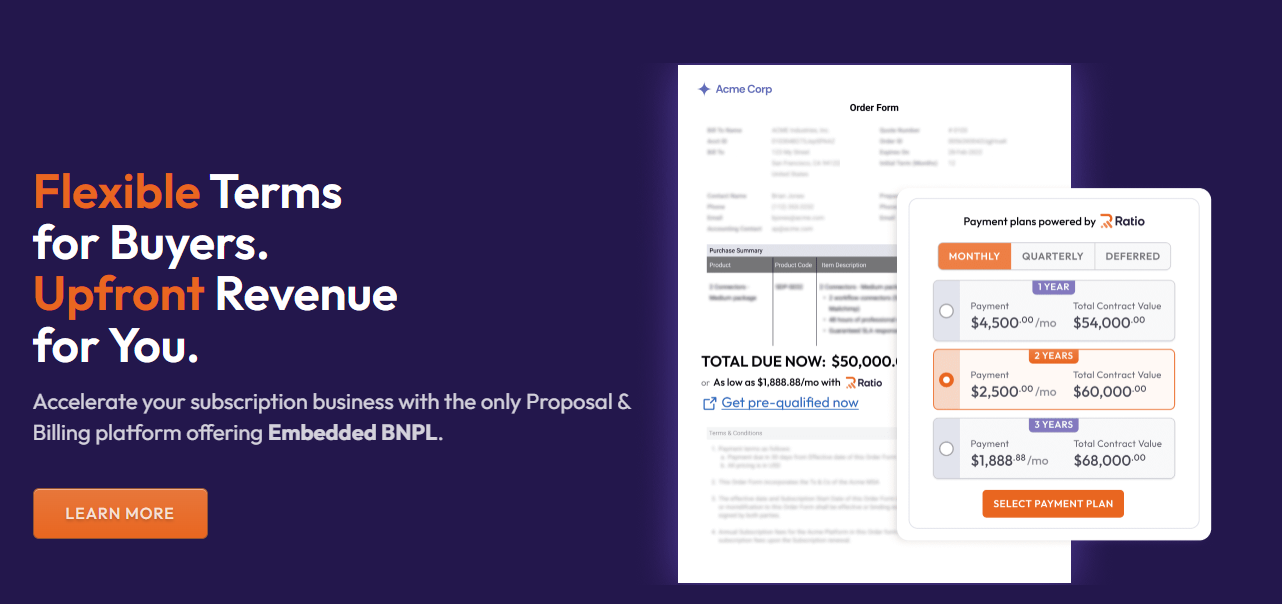
If you want your team (and your buyers) to experience this same momentum, the next step is simple.
[Request a 15 min strategy call →]
FAQs
1. What Is the Best Equipment Financing Company for Startups?
There’s no universal winner.
The right choice depends on your use case. Early-stage buyers often lean toward fintech lenders like Taycor Financial, which offer fast, application-only approvals. But if you’re a hardware or robotics startup selling equipment, an embedded BNPL platform like Ratio Boost is more strategic because it accelerates sales and improves cash flow without requiring you to act as the lender.
2. Can I Get Equipment Financing With Bad Credit?
Yes, depending on the provider and the strength of your business.
Traditional banks rarely approve subprime credit, but fintech lenders evaluate revenue stability, cash flow, and tenure more heavily than personal scores. Embedded BNPL platforms like Ratio focus on buyer credit, not yours. So vendors can still offer financing even if their own credit profile isn’t ideal.
3. What Is Embedded BNPL for Equipment?
Embedded BNPL places installment payment options directly inside the seller’s checkout or quoting flow.
The buyer pays over time, while the vendor receives the full payout upfront, and the BNPL provider handles underwriting, billing, and collections. For robotics, med-tech, and industrial hardware, this reduces procurement friction and shortens sales cycles dramatically.
4. How Fast Is Approval for Equipment Financing?
Approval speed varies by category:
- Traditional lenders: 1–3 weeks
- Fintech lenders: same day to ~48 hours for <$250K
- Embedded BNPL platforms (Ratio, Vartana, Credit Key): minutes to a few hours
If fast procurement is critical, embedded BNPL consistently delivers the shortest timelines.
5. Is Equipment Leasing Better Than Equipment Financing?
It depends on your usage and goals:
- Leasing works well for short-term use or fast-depreciating assets. Lower upfront costs, but no ownership.
- Financing / BNPL is ideal when the equipment generates multi-year ROI. You own the asset, and the total cost can be lower.
For robotics and high-ticket hardware, financing often delivers better long-term value because these assets typically remain productive for years.
↗
The Closing Motion Platform
Sellers on Ratio see up to 30% higher close rates and 25% higher ACV.


