If AI Is So Powerful, Why Isn't It Helping B2B SaaS Companies Close Faster?
AI has transformed the top of the funnel. Reps qualify, personalize, and follow up at machine speed, and pipeline looks healthier than it ever has. Then a buyer says yes and everything slows down: pricing by gut feel, a two-week billing thread, an ROI model finance wants in its own template. The close still runs on human judgment applied one deal at a time, which is exactly what an agent cannot execute. Here is why the bottleneck sits where it does.


Table of contents

AI has made the top of the funnel faster than it has ever been, and left the close exactly where it was. Everything between a buyer's yes and cash in your account, proposals, payment terms, financing, contracts, and collections, still runs on human judgment applied one deal at a time. Agents cannot execute judgment that lives in your best rep's head, because they need structured data and written rules instead. That gap is where revenue leaks and cash flow quietly breaks: discounts given to pull cash forward, renewals nobody chased, and the cost of capital on receivables that sit and age. Here is what a closing motion built for agents looks like, and how to tell whether yours is ready.
The bottleneck didn't get worse. It just got visible.
This is the expanded, in-depth version of the article our CEO Ashish Srimal originally published in Forbes. Read the original on Forbes.
AI Sped Up Selling. It Didn't Speed Up the Close.
Just a year ago, AI vendors were closing enterprise deals in a single demo. Today, those same deals can take six months or longer, according to a vendor cited by the Wall Street Journal.
The single-demo close was never normal. It was a brief window when enterprise buyers suspended their usual discipline because the technology felt unmissable. For a stretch of months, the fear of being left behind outran the instinct to scrutinize, and deals that would normally crawl through procurement sailed through on enthusiasm alone.
Now that window has closed. B2B tech companies are back to behaving like they always have: deliberately, skeptically, and with finance in the room for every significant decision. The urgency that compressed a six-month cycle into a single call has been replaced by the questions that were always going to come, about ROI, about budget, about what happens in year two. Buyers aren't less interested in AI. They're just back to buying it the way they buy everything else.
And here's the contradiction that should stop every founder cold. Even as the buying slows down, organizations believe AI is more capable than it has ever been. A 2026 Gartner survey found that 80% of CEOs believe AI will force operational overhauls in their organizations. As one Gartner analyst put it: "AI is not simply another layer of automation. It is a catalyst for rebuilding the enterprise itself."
So if AI is so powerful, powerful enough that four out of five CEOs expect it to rebuild how their companies operate, why isn't it helping those same companies close faster?
The Gap That's Breaking Your Sales Team
AI is almost certainly already inside your sales workflow. Your reps are using it to qualify leads, personalize outreach, draft follow-ups, and coach themselves on calls. The investment is real, and the results at the early stages of the funnel are genuine. Pipeline looks healthier. Reps spend less time on busywork and more time in front of buyers. By every top-of-funnel measure, the technology is doing its job.
But watch what happens the moment a deal crosses from conversation into closing. The intelligence that carried the deal this far simply… stops.
Pricing turns out not to be straightforward at all. Discount negotiations, internal ones with your own leadership and external ones with the buyer, have very little science behind them. They run on gut feel and precedent and whoever pushes hardest in the room. The billing question, annual or monthly, bounces between sales, finance, and the customer for two weeks before anyone lands it. For larger deals, finance needs an ROI model dropped into their template before they'll sign off. Procurement sends over a vendor-onboarding form nobody on your team has seen before, and the clock keeps running.
None of this is new. The friction between how sellers want to get paid and how buyers need to pay has been building for years, as I've written about before. What AI has done is change the stakes. When the top of your funnel moves at machine speed and the bottom still moves at the speed of a two-week email thread, the contrast becomes impossible to ignore. The bottleneck didn't get worse. It just got visible.
There are plenty of reasons deals slow down: budget pressure, skeptical CFOs, vendor fatigue, a macro environment that rewards caution. But those forces do not break deals on their own. They expose where deals were already fragile. And in company after company, the fragile part is the same: it's the closing motion. The forces outside your control find the weakness inside your control and press on it until the deal stalls.
The Closing Motion: Built For People, Broken For Agents

Let me define the term precisely, because it's the whole argument. The closing motion is everything that happens between a buyer's yes and cash in your account. Proposals. Payment terms. Financing. Contracts. Collections. It is the stretch of the deal where revenue either becomes money or quietly evaporates, and while AI has made real progress at the front of the sale, the closing motion on the seller's side is still overwhelmingly manual and fragmented.
For decades, that was fine, because the closing motion ran on human judgment and humans were good at it. The best sales reps weighed risk in real time, read buyer psychology, and structured payment terms on the fly. That judgment is precisely what moved money from a buyer's account into yours. And smart companies didn't leave it to chance, they codified that judgment constantly, through playbooks, training, deal reviews, and coaching. The knowledge existed. The problem is how it gets applied.
Because even when judgment is shared and written down, it still has to be executed by a person, one deal at a time. Your best rep's instinct for how to structure a hesitant enterprise buyer's payment schedule lives in that rep's head and gets applied manually, deal by deal, call by call. It doesn't scale, it doesn't transfer cleanly, and it walks out the door when the rep does.
Which brings us to the real problem, and it isn't effort or talent. It's architecture.
Humans and AI agents are built for fundamentally different environments. Human workflows are designed around intuitive interfaces, visual cues, and contextual understanding, the things a person is good at. AI agents need the opposite: structured data, API-first architecture, and high-throughput reliability. An agent can't "read the room" from a PDF proposal, a Slack thread, and a spreadsheet of hand-entered discount approvals. It needs the logic of your closing motion to exist as data and rules, not as tribal knowledge scattered across tools and people.
That is the deeper reason AI hasn't sped up your close. It's not that the technology isn't capable. It's that the closing motion was built for people, and you can't simply point an agent at a process designed for human improvisation and expect it to run. The problem isn't the intelligence. It's the plumbing underneath it.
Rethinking The Closing Motion With AI Agents
So imagine the closing motion rebuilt with that agentic architecture in mind, designed, from the ground up, for an agent to run.
When a buyer says yes, an AI agent can surface a proposal that already reflects that buyer's risk profile, willingness to pay, payment preferences, and contract history. It can connect pricing to payment terms in real time, so the discount and the billing structure aren't two separate negotiations happening on two separate timelines. It can flag the financing structure that works for both sides before anyone has to ask for it. And it can keep the deal moving after signature by ensuring collections and renewals are built into the same flow from the start, instead of bolted on months later when someone finally notices the invoice is overdue.
That is what "building for agents" actually means for a sales team. The exhausting coordination work, like the chasing, the re-keying, the two-week billing thread, gets handled by the system. The rep gets their energy back for the part only a human can do. And the money stops leaking out of the process.
It's worth being specific about where that leakage hides, because most teams never add it up. Leakage is three things at once: the discount you gave to win an annual upfront payment you could have financed instead; the renewal or upsell nobody chased because it wasn't anyone's job in the system; and the cost of capital you eat while your receivables sit and age.
And the scale is bigger than most teams assume. Across B2B technology partners, that's roughly 30% of deals lost or heavily discounted over payment terms alone, about half of a deal's value sitting in receivables on multi-year monthly terms, and around 40% of renewals and upsells that never happen.
None of these show up as a line item called "waste." They show up as a company that booked a great quarter and still had to raise money to cover the gap between revenue earned and cash collected.
This isn't a far-off prediction. McKinsey's April 2026 research on agentic AI in B2B pricing confirms the shift is already underway: pricing is moving from human-led processes toward AI-orchestrated systems, with humans remaining in oversight rather than in the loop for every decision. I believe the same transition is coming for the entire closing motion, not just the price, but the terms, the financing, the contract, and the collection that follow from it. Pricing is simply the first domino.
What It Looks Like When the Closing Motion Runs as One Flow
I'll be transparent about my vantage point here, because you should weigh it. I co-founded Ratio to run the closing motion as one connected flow instead of the disconnected tools most companies stitch together. So I'm not a neutral observer of where the bottleneck sits. I built a company on the conviction that it sits in the close. Take what follows as the argument of someone with a stake in it, and judge it on whether it matches what you see in your own pipeline.
Here's what we built, and why it maps to everything above. Ratio is a Closing Motion Platform: one flow that carries a deal from proposal to flexible payment and checkout, through renewals and collections, in a single connected system.
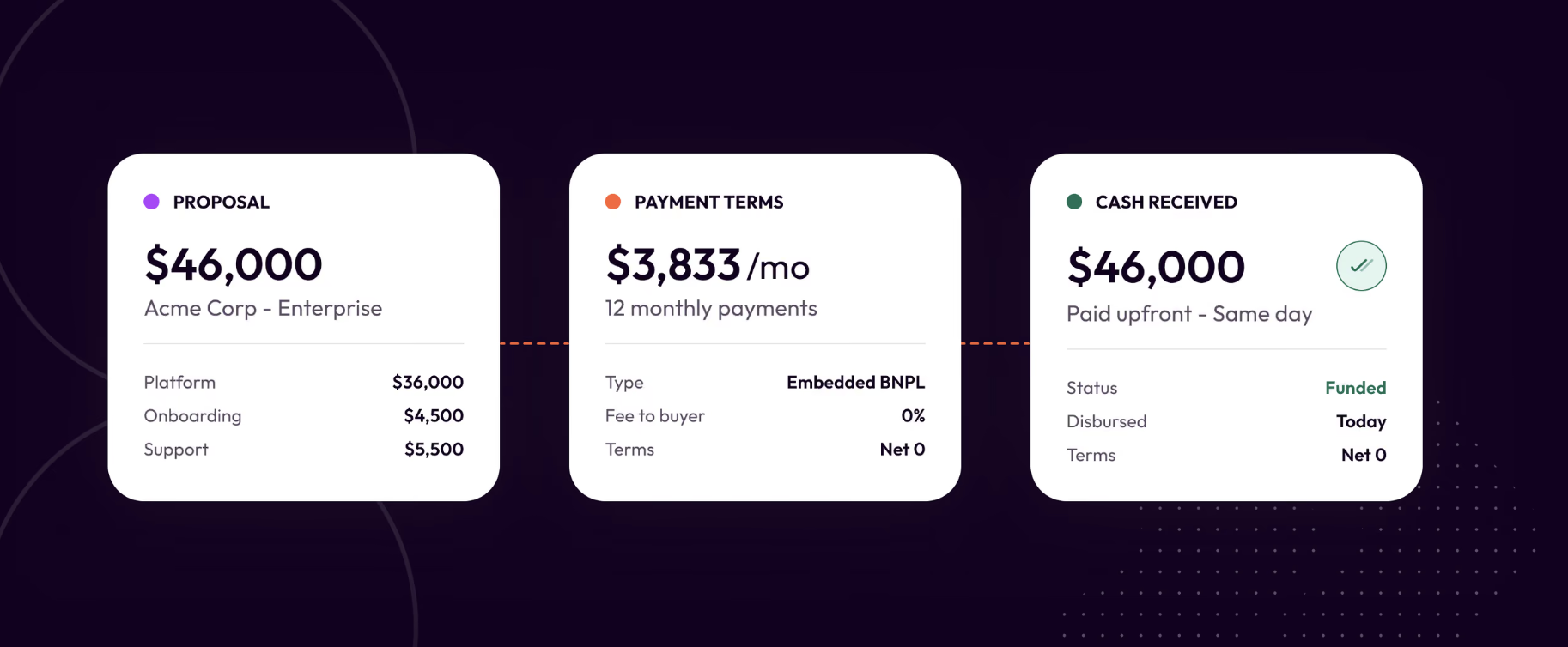
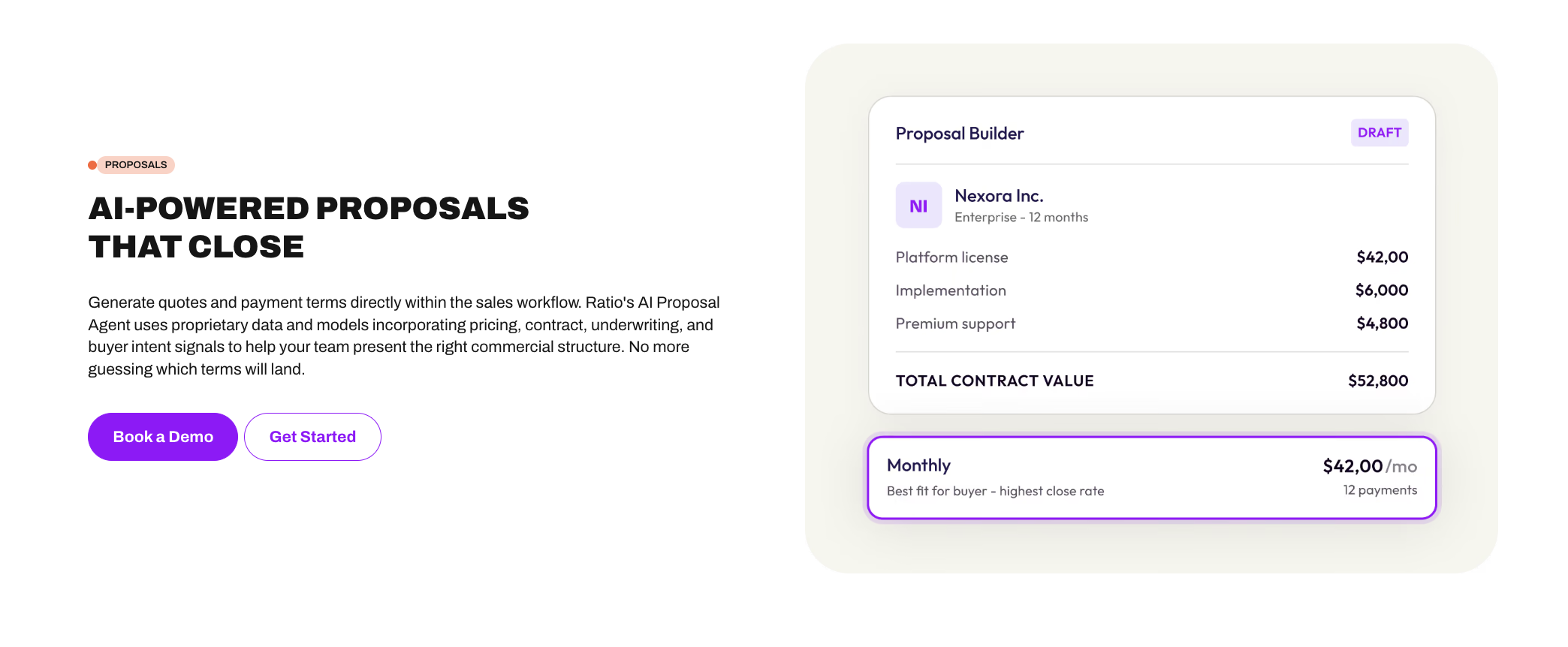
A rep sends one proposal link. Inside it are the terms, the payment options, and the checkout, with no separate documents, no signature chased across three tools, no billing thread bouncing between teams for two weeks. The buyer chooses how to pay, including flexible monthly terms approved in seconds. Ratio underwrites that buyer and pays you the contract value upfront. The buyer gets flexibility; you get the cash now.
Look at what that does to the three sources of leakage. The discount you'd have handed over to pull cash forward becomes unnecessary, because financing pulls the cash forward instead, you collect in full at close without cutting price. The renewal nobody chased is built into the same flow from the start, so it re-evaluates terms automatically instead of slipping. And the cost of capital on aging receivables disappears, because the receivable is funded at signature rather than sitting and aging for a year.
The risk intelligence that a good rep used to apply from instinct is wired into the proposal itself, assessing financial health, payment history, and firmographics before the deal is signed, the written-down judgment an agent can actually execute.
That last point is the one I'd underline. The reason this architecture matters isn't that it's modern for its own sake. It's that a connected, data-structured closing motion is the only kind an agent can run. When pricing, terms, financing, contracts, and collections live in one flow instead of scattered across a CPQ tool, an e-signature tool, a billing system, and a collections process, you've done the unglamorous work that makes agentic AI possible at the close, not someday, but with the tools you deploy now.
The companies already running this way aren't just closing cleaner; they're closing better. After moving its close onto Ratio, DearDoc raised its average selling price 25%, lifted its closing rate 20-30%, and compressed calls that used to take several days into a 30 to 45 minute flow, all while collecting cash upfront.
As founder and CEO Joe Brown put it, "With Ratio we will 2-3× ARR this year, while collecting the cash upfront." Those are top-line numbers from a system most people think of as back-office plumbing.
And to be clear, rebuilding from scratch isn't the only route. Some teams get most of the way there by consolidating the proposal, contract, and billing systems they already own into something that behaves like one flow. Whether you adopt a platform built for it or assemble it from what you have, the destination is the same: a closing motion that exists as structured data and rules, ready for an agent to run, rather than as judgment trapped in your best rep's head.
Either way, the hard problems that agents genuinely can't solve are still yours. Reading a room. Knowing when to push and when to wait. Building the trust that gets a skeptical CFO to lean in. Those problems are not going away, and they shouldn't. The point of handing the coordination work to the system is that these human problems finally get the attention they deserve, instead of being crowded out by the mechanical work of chasing a signature and reconciling an invoice.
Is Your Closing Motion Ready?
The shift is coming whether or not you're prepared for it. How well you ride it depends almost entirely on the architecture you have today, so it's worth assessing honestly.
Start with the unglamorous part. Your pricing and terms have to exist somewhere other than your best rep's judgment. This is the prerequisite for everything else, because an agent can only apply a rule that someone has actually written down, and most companies improvise discounting and payment terms deal by deal, with the real logic living in Slack threads and a senior rep's memory.
Until that logic is explicit, no amount of AI will speed up your close, because there's nothing structured for it to execute. Get the rules out of people's heads and into a system. Then you can decide who owns the motion end to end, because "everyone and no one" is how the leakage started in the first place.
Expect trade-offs, and go in with your eyes open about them. Standardizing terms buys you speed and consistency, but it can cost your best reps the improvisation that makes them effective on hard deals, so the goal is guardrails, not handcuffs. Finance will want those guardrails first anyway: approval thresholds, exposure caps, audit trails. That's not resistance; it's the price of letting a system move money faster, and it's a price worth paying. The companies that navigate this well don't choose between speed and control. They build the control in so the speed is safe.
Because here's what's actually at stake. In a growing B2B SaaS market, a broken closing motion is not a rounding error. It is revenue that exists on paper but not in the bank: bookings you've celebrated and cash you haven't seen. AI has made the top of your funnel faster than it's ever been.
The only question left is whether the bottom of your funnel can keep up, or whether every deal your smarter front end wins will keep stalling in the same manual, fragmented close.
So ask yourself the question that matters more than any pipeline metric on your dashboard: how much of your revenue is still waiting to arrive?
Frequently Asked Questions
What is the "closing motion," and how is it different from the sales process?
The sales process is everything up to the buyer's yes: prospecting, qualifying, demos, negotiation. The closing motion is everything after it: proposals, payment terms, financing, contracts, and collections. It's the stretch where a "yes" either becomes cash in your account or quietly leaks away. The distinction matters because AI has dramatically improved the sales process while leaving the closing motion largely manual, which is exactly why deals that start fast still finish slow.
If AI is already in our sales stack, why hasn't it sped up our close?
Because AI agents and the closing motion are built for different environments. Agents need structured data, API-first architecture, and clear rules; most closing motions run on human improvisation spread across disconnected tools: a PDF proposal here, a billing thread there, discount approvals in someone's inbox. An agent can't execute judgment that only exists in your best rep's head. Until pricing, terms, and financing are written down as data and rules, there's nothing structured for AI to accelerate, no matter how capable the model is.
How does running the closing motion as one flow actually recover revenue?
Revenue leaks in three places most teams never tally: discounts given to pull cash forward, renewals and upsells nobody chased, and the cost of capital while receivables age. A connected closing motion closes all three. Financing pulls the cash forward at the contract value, so you stop discounting to get paid early. Renewals are built into the same flow, so they don't slip. And because the contract is funded at signature, the receivable doesn't sit and age for a year. That's the difference between a great bookings quarter and cash actually in the bank.
Do we need to rip out our current tools to get ready for this?
Not necessarily. Rebuilding on a purpose-built Closing Motion Platform like Ratio is one route, but some teams get most of the way by consolidating the proposal, contract, and billing systems they already own so they behave like one flow. The real prerequisite isn't a specific vendor; it's getting your pricing and terms out of individual judgment and into structured rules, then deciding who owns the motion end to end. Do that, and you're ready for agents whether you buy the architecture or assemble it.
↗
The Closing Motion Platform
Sellers on Ratio see up to 30% higher close rates and 25% higher ACV.


