How a SaaS Provider expanded their market with innovative FinTech solution


Table of contents
Background
High-velocity SaaS Transactions products (HST) companies often face significant budget objections. Companies known for closing deals in just a few calls, demonstrate the need for solutions that address this issue.
For HST companies, they thrive on a high volume of customers to sustain their growth. They also do not offer monthly payment plans and require customers to pay the annual contract upfront.
Customer
The HST customer in this case provides a tool that allows their clients to identify and source contact information for their ideal customer profiles.
While the HST does offer a monthly subscription, the sales team is highly incentivized to negotiate annual contracts where the customers pay upfront. The companies discount their SaaS as high as 55% in order to get their customers to pay upfront.
The Challenge
The heavy discounts and the push to drive upfront annual contracts, sales become quickly unprofitable when it takes more than 6-weeks to close the transactions.
- Budget Constraints: Large upfront payments often deter their buyers, even those highly interested in a product.
- Lengthy Sales Cycles: Negotiating contracts, securing approvals, and managing paperwork prolong the sales process.
- Profit Erosion: To entice buyers facing budget limitations, companies often resort to discounts, eroding profit margins and potentially devaluing their product.
HST was able to entice certain customers to jump on annual subscription with very high discounts, however, the prolonged negotiation often resulted in losing upwards of 20% of the deals. Even worse, about 10% of these customers actually didn’t pay and the HST had to write off these accounts.
The cost of sales becomes prohibitively expensive! The company began to run into financial challenges and were in the process of a major restructuring.
The Solution
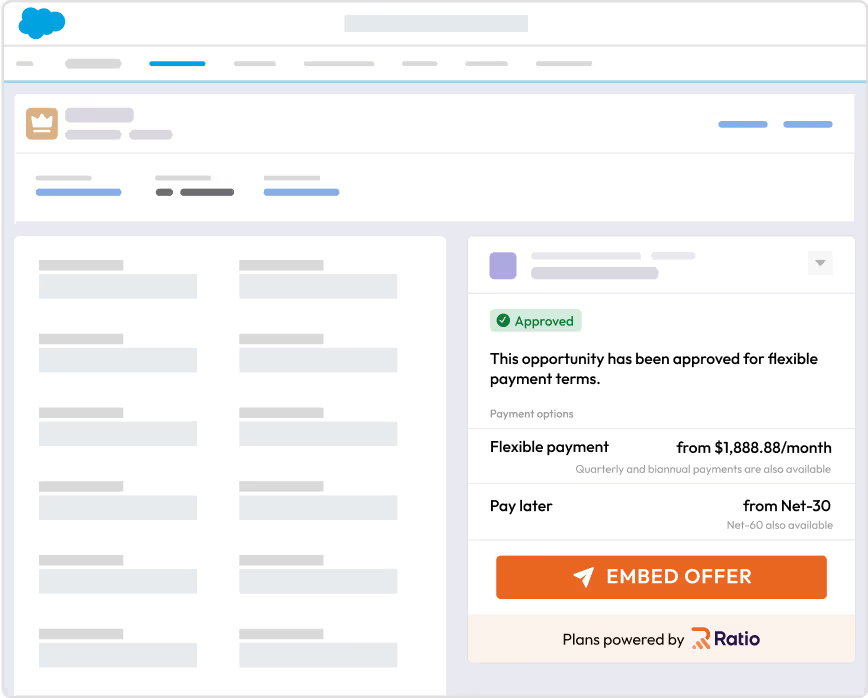
Ratio Boost offers a comprehensive suite of features to address these challenges:
- Increased Sales Velocity: A remarkable increase in sales velocity after implementing Ratio Boost, with sales representatives closing deals 60% faster during an initial test period.
- Higher Conversion Rates: By offering BNPL through Ratio Boost, they also experienced a 10% increase in closed deals, attributing this gain to the reduced friction and ease of payment provided by the platform.
- Reduced Discounting: Ratio Boost eliminates the need for aggressive discounting by offering payment flexibility, enabling the HST to maintain their pricing integrity and preserve profit margins.
The Results
The result is that HST experienced numerous benefits to their business. They also uncover additional benefits that they were not seeing before:
- Faster Revenue Recognition: Upfront payment by Ratio to HST accelerates revenue, enhancing cash flow and supporting strategic investments in growth.
- Reduced Customer Acquisition Costs: The streamlined sales process and increased conversion rates lower the overall cost of acquiring new customers.
- Enhanced Competitiveness: In a crowded market, offering BNPL can provide a significant competitive advantage, attracting budget-conscious buyers and driving market share growth.
The unexpected benefits were the improved customer satisfaction. By offering flexible payment options and a simplified purchasing experience through Ratio, their buyers' satisfaction increased significantly. The HST believes this also fosters stronger relationships and reduces churn.
Ratio is a game-changing solution for SaaS companies seeking to optimize their high-velocity sales processes. By addressing key customer pain points, streamlining operations, and providing financial flexibility, Ratio empowers companies to accelerate revenue growth, build stronger customer relationships, and achieve greater success in a competitive market.