B2B BNPL vs. Net 30/60/90 Terms: What Changes for Your Cash, Risk and Close Rate
Net terms leave your cash waiting weeks or months after the deal is won. This guide compares net 30, 60 and 90 with B2B BNPL on cash timing, DSO, collections and close rate, then walks through how to close the gap step by step.


Table of contents

Net 30, 60 and 90 terms are the default way B2B sellers give buyers time to pay, and they come with a built-in cost: cash arrives weeks or months after the deal is won. B2B BNPL keeps the flexibility buyers want and moves the cash to the moment of yes, so payment timing is less likely to be a reason to discount or lose a deal. This guide compares the two on cash timing, DSO, collections and close rate, then walks through how to fix the gap step by step. Ratio's Closing Motion Platform puts the payment schedule inside the proposal so cash lands upfront.
The Challenge: Net terms keep buyers comfortable and your cash waiting. Every extra day between "yes" and "paid" is a day your growth plan runs on a promise.
Net terms became the default for a simple reason: buyers expect time to pay, and a seller who refuses looks rigid. Net 30 means payment is due 30 days after the invoice date. Net 60 and net 90 stretch it further, usually because a larger buyer asks for it or a seller offers it to win the deal. On paper it is a small accommodation. In practice it is an interest-free short-term loan the seller extends to every buyer, usually without pricing it, underwriting it, or tracking what it costs.
The cost shows up in three places. First, cash timing: the sale is booked at signature, but the cash is spendable only after the invoice clears, which stretches DSO (days sales outstanding, the average number of days it takes to collect payment after a sale). Second, forecasting: finance plans against collections it does not control. Third, collections effort: someone has to chase the invoices that run late, and roughly 7 in 10 US companies are dealing with late payments, according to Atradius's 2026 payment practices report.
Payment terms also reach into the sale itself. When a buyer asks to pay over time and the only answers a seller has are "no" or "here's a discount," deals slow down, shrink, or walk. So the choice is not only a finance decision. It changes whether deals close, and at what price.
How Net 30, 60 and 90 Terms Work, and What They Cost
Under net terms, the seller delivers, sends an invoice, and waits. The buyer pays on or near the due date, or later. A few effects follow, whatever the industry:
- Cash lags revenue. The longer the term, the longer the seller finances the buyer's purchase out of its own working capital.
- DSO rises with the term. A seller with net 60 terms on most contracts will see DSO sit near 60 days when buyers pay on time, and climb past that when they pay late.
- Terms get applied uniformly. Many sellers extend the same terms to every buyer, whether the buyer is strong or stretched. Ratio CEO Ashish Srimal makes the point in his Forbes piece on aligning subscription sales and finance teams to avoid cash flow leaks: one-size-fits-all terms leave finance forecasting collections it cannot control.
- Discounts get traded for speed. When cash is tight, the usual lever is a discount for early or upfront payment, which permanently lowers price to fix a timing problem.
None of this makes net terms wrong. For large buyers with strong credit and short cycles, they are simple and familiar. The trouble starts when net terms become the answer to every deal, including the ones where the buyer wants more flexibility than 30 days and the seller needs the cash sooner than 90.
B2B BNPL vs. Net Terms, Side by Side
B2B BNPL (buy now, pay later) splits the two sides of the deal. The buyer pays over time on a schedule that fits their budget, such as monthly or quarterly, and the seller is paid upfront. Consumer BNPL works in a similar spirit, but the B2B version is built around business buyers and larger contract values. For a walkthrough of the mechanics, see how B2B BNPL works.
Risk is where the two differ most. Under net terms, the seller extends credit to the buyer and holds the non-payment exposure until the invoice is collected. Under B2B BNPL, a financing partner underwrites the buyer on the specific contract before the offer goes out, so approval, not a blanket policy, decides who gets payment flexibility. Not every buyer will qualify, which is why most sellers keep both options.
The cost is a risk-based financing fee, set by underwriting the buyer on the contract. The seller can absorb it, build it into the buyer's payment plan, or split it. Compare that with what net terms already cost: working capital tied up in receivables, collections effort, and any discount offered to speed up payment. Terms vary by deal.
One caveat: BNPL does not replace the conversation about value. If a buyer asks for a discount because they do not see the benefit, payment terms will not fix that.
How to Fix the Cash Gap, Step by Step
Whatever you use, the fix follows the same sequence.
- Measure the gap before you change anything. Track DSO, and track the time from signature to cash separately. DSO tells you how long invoices take to collect once they are issued. Signature-to-cash is the full gap, and it includes the time before the invoice goes out, which DSO does not capture.
- Segment buyers by risk instead of applying one set of terms to everyone. Strong-credit buyers can keep net terms. Buyers who want more time, or whose payment history is thin, need a different structure.
- Separate the buyer's payment schedule from your cash timing. The buyer's budget and your working capital are two different problems. Solving them with the same lever, usually a discount or a long net term, is why the trade feels so expensive.
- Stop using discount as the cash lever. If a prepayment discount is the only way to get paid early, you are spending price to buy cash. See how to accelerate sales in B2B SaaS without discounting.
- Put the terms in the proposal. Payment options shown with the price are part of the offer. Payment options negotiated after the buyer says yes are a negotiation, and that is where deals slow down. The pros and cons of upfront payments lay out why a flat demand for upfront cash often backfires.
- Keep billing and collections connected to the terms you agreed. When the schedule lives in one tool and billing lives in another, the handoff is where cash slips. For more on tightening the whole cycle, see how to improve cash flow in B2B SaaS sales.
Each step is worth doing on its own. The trouble is that steps three through six cross sales, finance and billing, and most companies run them across separate tools and owners.
Where Ratio Fits: The Closing Motion Platform
We call the stretch between a buyer's yes and cash in your account the closing motion. It covers the proposal, the payment terms, the signature, the cash upfront, billing, collections and renewals, and in most companies it runs through disconnected tools and handoffs. That fragmentation is part of why net terms hurt: the delay is not only the buyer's due date, it is also everything that happens between the yes and the invoice.
Ratio is the Closing Motion Platform that starts with proposals, adds B2B BNPL so buyers can pay over time while you get paid upfront, and keeps renewals and collections connected.
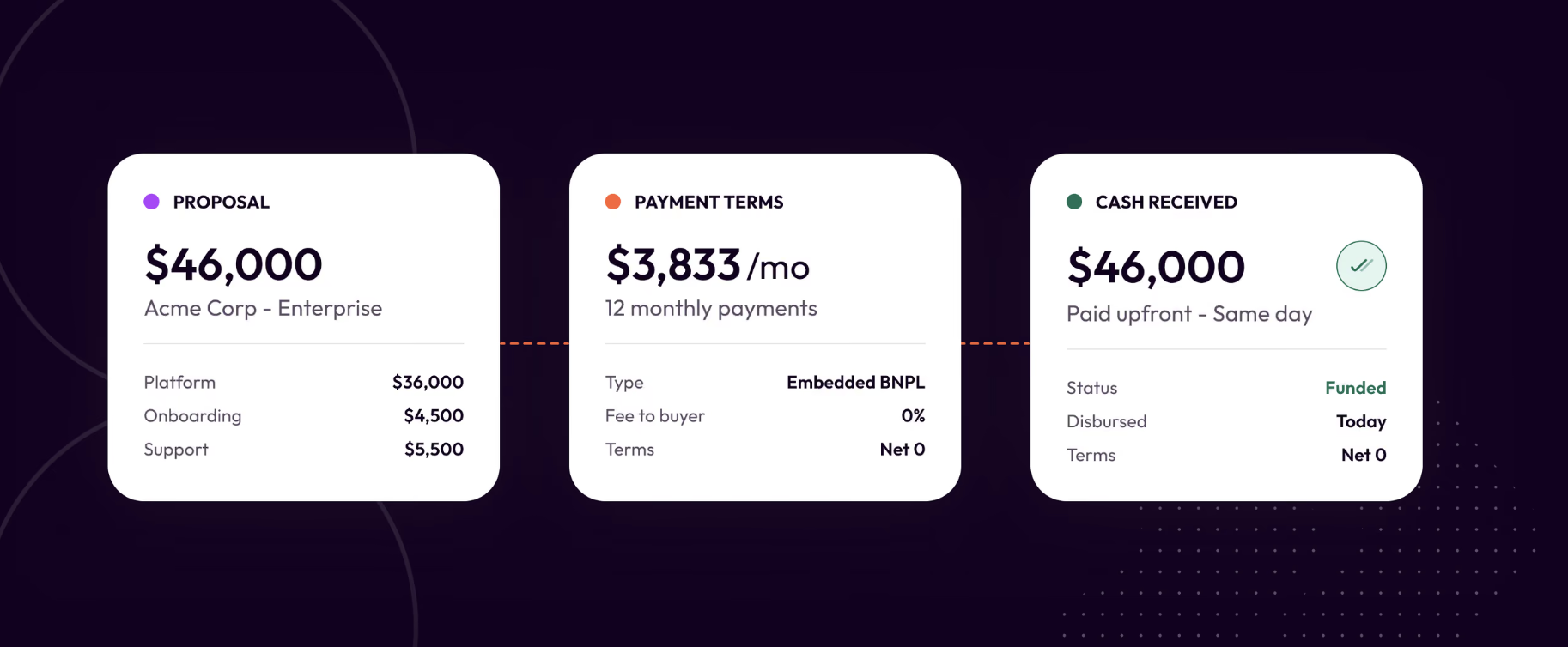
Payment terms are set on the same platform that builds the proposal, the signature triggers the cash, and billing and renewals pick up from the original terms without a re-key or an export. The buyer sees the flexibility they asked for. You see cash upfront and a close that ends when the cash does, not at signature.
In practice, the offer sits in the proposal next to the price. The buyer picks a schedule, monthly or quarterly, and Ratio underwrites the buyer on that specific contract before anything is extended, so approval reflects the buyer's credit and the length of the term. On approval, you collect the contract value upfront, net of Ratio's fee, and Ratio manages the payment schedule and the follow-up on late payments. The fee is set in the proposal, so both sides see it before anyone signs.
For finance, the change is what the forecast rests on. Under net terms, cash depends on when each buyer decides to pay, and the team spends its time chasing the ones who do not. When the contract value arrives at close, finance plans against cash it already has, and the buyer's schedule is managed on the Closing Motion Platform instead of in your receivables queue.
For sales, the change is the conversation. A buyer who asks to pay over time gets an answer in the same meeting, with the schedule in the proposal, instead of a discount or a follow-up with finance. Because the platform keeps billing, collections and renewals connected, the terms agreed at signature carry into the renewal, so the next payment conversation starts from the terms already in place.
DearDoc, a healthcare software company serving medical practices, ran into the trade-off this post describes: its buyers wanted to pay monthly or quarterly, and it needed the cash flow that annual, upfront contracts provide.
That used to mean choosing between winning the deal on the buyer's terms and protecting the company's cash position. With Ratio, practices got the payment schedule they wanted, and DearDoc collected the contract value upfront, net of Ratio's fee.
"Sales and Finance love the all-in-one platform from proposal to cash." Joe Brown, Founder and CEO, DearDoc
Watch DearDoc's full story, or see how Ratio's Closing Motion Platform works
How to Decide: Net Terms, B2B BNPL, or Both
Most sellers end up with both. A reasonable starting rule: keep net terms for buyers who are strong on credit, pay quickly, and do not ask for anything else, and offer B2B BNPL wherever a buyer asks to pay over time, a deal is stalling on payment terms, or a discount is the only thing standing between you and cash upfront.
A quick test: pull your last 20 deals, won and lost, and mark the ones where payment terms came up before signature. If a meaningful share of them ended in a discount, a delay, or a loss, you are paying for payment flexibility without getting credit for it. What would those deals have looked like if the payment schedule had been in the proposal from the start?
Book a demo to see how your own deals would look with the payment schedule in the proposal.
Frequently Asked Questions
Is B2B BNPL the same as consumer BNPL?
The idea is similar, but the mechanics differ. B2B BNPL is built around business buyers, larger contract values and multi-month payment schedules, not a handful of short consumer installments. See how B2B BNPL works for the details.
Will offering BNPL increase my close rate?
It removes payment timing as a reason for a deal to stall, shrink or walk. The effect on your own close rate depends on how often payment terms come up in your deals, which is why the quick test above is worth running first.
Can I offer both net terms and B2B BNPL?
Yes. Many sellers keep net terms for strong-credit buyers and offer B2B BNPL when a buyer wants more flexibility or a deal is stalling on payment terms.
How is B2B BNPL different from invoice factoring or receivables financing?
Factoring and receivables financing turn an invoice you have already issued into cash, so they start after the deal closes and the cost scales with how long the buyer takes to pay. B2B BNPL is part of the offer you make to the buyer, so the payment terms are set at the moment of yes. For more, see our glossary entry on factoring and receivables financing.
↗
The Closing Motion Platform
Sellers on Ratio see up to 30% higher close rates and 25% higher ACV.


