5 Best Proposal Management Software for B2B SaaS in 2026 That Solves What Proposal Tools Can’t
Most proposal tools do one thing well: get a polished quote out the door. But once your team grows, your deals get messier, and Finance starts asking questions, the gaps show up fast. This guide reviews five proposal management platforms built for modern B2B SaaS. And when none of them can fix what happens after the signature like billing, cash flow, or collections that's what Ratio Boost is built for. As a Closing Motion Platform, it connects your signed deal to upfront cash, without adding more tools to your stack.


Table of contents

Most proposal tools do one thing well: get a polished quote out the door. But once your team grows, your deals get messier, and Finance starts asking questions, the gaps show up fast. This guide reviews five proposal management platforms built for modern B2B SaaS. And when none of them can fix what happens after the signature like billing, cash flow, or collections that's what Ratio Boost is built for. As a Closing Motion Platform, it connects your signed deal to upfront cash, without adding more tools to your stack.
The Challenge: Proposals go out fast, but managing them slows you down
You’re using solid sales proposal software. Proposals get sent, signed, tracked — fast. But once signed, the process often slows down.
Here’s what starts breaking: Version sprawl and no clear source of truth, custom terms buried in email threads, and manual handoffs to billing, finance, and CRM.
The result? Delays you can’t see on a dashboard until a deal stalls.
In fact, 28% of sales pros say long sales cycles are the #1 reason prospects walk away.
That’s why we’re unpacking what the best Proposal Management Software(PMS) in 2026 actually includes. and where it stops being enough.
Let’s start with the base understanding.
What "Proposal Management Software" Actually Means in 2026
If you’re running a growing B2B SaaS company, you’ve probably already used proposal tools that help you send polished quotes. But managing all those proposals — across versions, teams, approvals, and billing systems — is where most of the real friction begins.
Proposal management software is not the same thing as proposal creation software. Worth being clear on that distinction.
- Proposal software (or “sales proposal software”) focuses on generating quotes and getting e-signatures.
- Proposal management software focuses on everything after that: organizing versions, enforcing approval workflows, syncing with CRM, managing shared content, and aligning signed docs with billing, legal, and collections.
It’s the difference between sending a polished proposal and managing dozens of them at scale across a 10-person sales team, a RevOps analyst, and a CFO who needs to know what’s committed.
What Modern B2B Buyers Actually Expect
Most teams have outgrown the "just send a PDF" approach. What they want now is coordination, control, and consistency.
Here are the five most requested features:
1. Centralized Content Library
Your reps shouldn’t be hunting through Google Drive for the latest legal clause or ROI slide.
Top platforms now provide a shared, searchable library of templates, pricing language, legal terms, and reusable blocks. All is version-controlled and permissioned by role.
2. Collaboration + Workflow Management
You’re not the only one touching a proposal — legal, finance, and leadership often weigh in.
Buyers now expect features like @mentions, threaded comments, real-time editing, and approval routing.
3. Role-Based Access + Version Control
You don’t want a junior rep editing legal sections or using an outdated pricing block.
Modern systems give granular access controls, audit trails, and version history. So only the right people edit the right content.
4. CRM + Deal Desk Integrations
Proposal data can’t live in a silo. SalesOps and Finance need real-time updates in the CRM.
Buyers expect integrations with Salesforce, HubSpot, or Zoho to:
- Auto-fill contact and pricing data
- Update deal stages upon e-signature
- Trigger billing and rev rec flows
5. Proposal Analytics + Performance Tracking
If a proposal stalls, you should know where and why.
Analytics features help teams see:
- When a proposal was opened
- Which sections were viewed most
- Who it was forwarded to
Teams using these insights can act on buyer behavior instead of guessing. For example, OpMentors used PandaDoc's page-level analytics to see exactly where prospects lingered or dropped off, so reps could follow up with the right message at the right moment.
6. Sync with Billing + Document Management
It’s not just about closing the deal. Post-signature workflows matter.
Modern proposal management tools offer hooks or APIs to integrate with billing systems, CLMs, or CPQ platforms, enabling faster invoicing, tracking, and compliance.
Reality check: Most B2B SaaS teams start with proposal software. But once deal velocity increases and teams grow, these six capabilities aren’t optional but essential.
And yet, even with all these features, something still breaks after the signature.
Up next, we’ll explore where even the best proposal management software falls short — and why it might be time to look beyond just managing proposals.
What the Best Proposal Management Software Still Doesn’t Solve
By this point, your proposal management software might be doing a solid job on content, collaboration, approvals, and CRM sync.
But if you zoom out and look at “quote → signature → cash in the bank”, there are still gaping holes. Those holes aren’t about documents. They’re about revenue operations.
(All of this ties back to one core challenge: how do you actually improve cash flow in B2B SaaS sales without delays or finance drama?)
Here’s what most PMS platforms still don’t deliver and why it matters:
1️⃣ No Ownership of the Full Quote-to-Cash Flow
Proposal management tools stop where quote-to-cash starts to get hard.
They manage the proposal and maybe the signature, but they don’t own what happens next:
- Creating billing schedules based on the contract
- Generating invoices tied to those schedules
- Managing payments and collections
Ops and finance teams end up bolting on manual workflows or spreadsheets to cover the gap.
A SaaS-focused Q2C breakdown explicitly calls out manual invoicing, misaligned contract data, and non-standard payment terms as key reasons cash flow gets delayed and customers get frustrated.
Impact: Deals show as “closed” in the CRM, but revenue recognition and cash collection lag behind. Sales thinks it’s done; Finance knows it isn’t.
2️⃣ No Reliable Execution for Non-Standard SaaS Terms
B2B SaaS deals rarely stay “clean”:
- Net-30 / net-60 / net-90
- Ramped pricing
- Usage-based components
- Milestone or phase-based billing
Your PMS can describe these terms in a document, but it doesn’t operationalize them.
Industry commentary on SaaS Q2C notes that non-standard terms and misaligned contract data are exactly where billing breaks and cash gets delayed.
Impact:
- Finance and billing don’t see the nuance buried in the PDF
- Invoices go out wrong or late
- You get revenue leakage and disputes, even when the proposal was “approved”
3️⃣ No Cash-Flow or Forecasting Awareness
PMS tools are obsessed with proposal status (draft, sent, viewed, signed).
But they have no native concept of:
- When the first payment is due
- How many installments exist
- What happens if payments slip
Q2C guides make it clear: the process only truly ends when payment is received and reconciled, not when a quote is signed.
Impact:
- RevOps is forecasting on the deal stage, not the cash timing
- CFOs see bookings but can’t trust when cash will hit
- You can’t easily model “What does our cash look like if 20% of customers pay late?”
Proposal management software simply wasn’t built to answer those questions.
4️⃣ No Embedded Way to Offer Flexible Terms Without Hurting Cash
This is the classic mid-market squeeze: buyers want monthly payments and deferred start dates, while finance wants upfront cash and predictable collections. PMS can show different terms but it can't resolve this tension.
Meanwhile, embedded finance is exploding. Research shows embedded finance and payments are becoming a core growth lever for software platforms, not a side feature.
The gap here isn't a proposal feature. It's a financing layer — something that lets buyers pay over time while you still collect predictably. That's the gap a Closing Motion Platform like Ratio Boost is designed to fill: financing and collections that sit on top of your proposals, so buyers pay over time while you collect upfront, every time.
5️⃣ No Unified Revenue View Across Sales, Finance, and Success
Even with good PMS + CRM, critical data is still fragmented:
- Proposal terms in one system
- Billing and payment status in another
- Customer health in yet another
RevOps and finance teams repeatedly call out disconnected systems and data silos as major drivers of hidden revenue loss and wasted time.
Impact:
- Customer success doesn’t see how payment behavior ties to renewal risk
- Finance doesn’t see how pipeline structure impacts cash runway
- Leadership can’t get a single, trustworthy “revenue reality” view
Proposal management software helps clean up documents. It doesn’t create that shared revenue picture.
These constraints reveal a simple pattern: proposal management software solves coordination, but it doesn’t solve revenue execution. So before you consider switching tools, it’s important to understand what actually makes a proposal stack enterprise-ready today.
A Feature Scorecard that Makes a Best Proposal Management Stack Enterprise-Ready
Before we go further, let’s be honest with each other:
Proposal management software can organize content, enforce approval logic, and improve collaboration, but enterprise readiness is about something else entirely.
Enterprise SaaS teams care about:
- Fast approvals
- Zero quoting errors
- Clean handoffs to billing
- Predictable cash flow
- Buyers are getting flexible terms without wrecking margins
- A single source of truth from quote → cash
Proposal software alone can’t do that.
Even proposal management software has limits.
But a Closing Motion Platform can.
💡 What is a Closing Motion Platform for B2B SaaS?
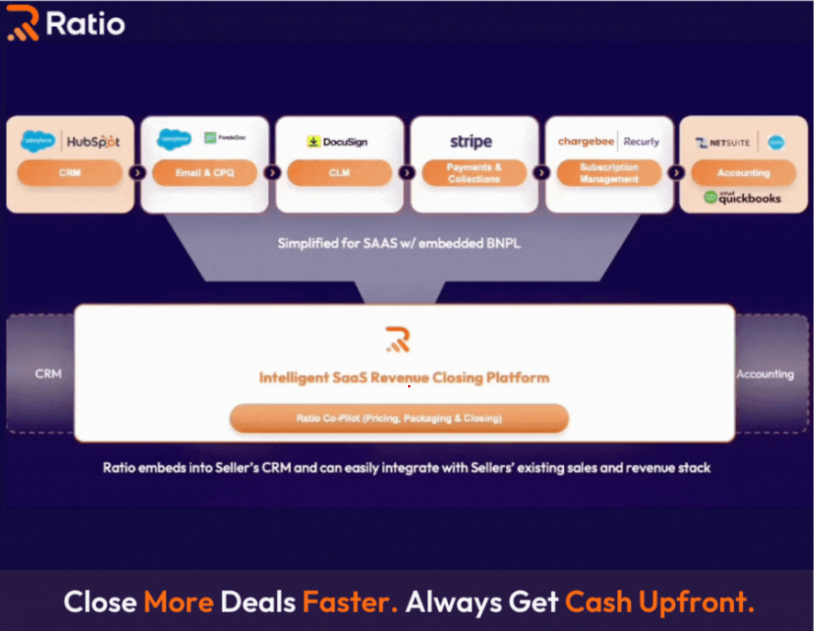
A Closing Motion Platform turns a buyer’s yes into cash upfront. It starts with proposals, adds BNPL so buyers can pay over time while you get paid upfront, and keeps renewals and collections in the same flow. It is designed to replace fragmented handoffs across the close with one connected path to cash upfront. Ratio Boost is built for this role. It plugs into your current proposal tools and helps connect the path from signature to cash upfront.
This is what separates a Closing Motion Platform from a proposal management tool: one manages documents, the other closes the gap between a signed deal and cash in the bank.
So here’s the feature scorecard that separates “good enough” from “enterprise-ready.”
Proposal Management Scorecard (2026)
| Capability | What It Helps With |
Business Impact |
Proposal Management Software |
Closing Motion Platform (Ratio Boost) |
|---|---|---|---|---|
| 📚 Centralized content library | Keeps templates, clauses, and messaging consistent | Faster proposal creation and fewer content errors | ✅ Core | — Not the primary job |
| 🔐 Role-based access and version control | Limits unauthorized edits and keeps teams on the right version | Less rework across sales, legal, and finance | ✅ Core | — Not the primary job |
| ✅ Approval workflows | Routes pricing and terms for review before a proposal goes out | Better control on discounts, terms, and exceptions | ⚠️ Core to partial, depending on tool depth | ➕ Carries the process forward after approval |
| 🔄 CRM sync | Keeps proposal activity tied to deal records | Less manual updating and cleaner pipeline data | ⚠️ Partial to core, depending on integrations | ➕ End-to-end sync (quote → cash) |
| 📊 Proposal analytics | Shows opens, views, and engagement signals | Better follow-up timing and rep visibility | ✅ Core | ➕ Ties analytics to revenue triggers |
| 🧠 Complex commercial terms | Captures ramps, milestones, and flexible payment structures | Fewer downstream handoff errors as terms get more complex | ⚠️ Can document them, but usually does not operationalize them | ✅ Built to carry terms into payment structure and cash timing |
| 🧾 Billing schedule readiness | Helps ensure signed terms can turn into the right billing structure | Less manual billing setup after signature | — Usually external or handled through integrations | ✅ Core to a connected path from yes to cash upfront |
| 💸 Collections operations | Keeps reminders, retries, and payment follow-up connected to the original deal | More predictable cash timing and less manual chasing | — Usually external | ✅ Core |
| 📈 Cash visibility | Helps teams understand when cash is expected, not just when a deal is signed | Better finance visibility and planning confidence | ⚠️ Limited | ✅ Core |
| 🤝 Buyer payment flexibility | Lets buyers pay over time without forcing the seller to wait for cash | Can support conversion while protecting cash timing | ❌ Not a native PMS function | ✅ Core |
| 🔗 Cross-functional continuity | Keeps proposal, payment, renewals, and collections connected | Fewer fragmented handoffs across sales, finance, and success | — Usually fragmented across tools | ✅ Core |
The scorecard makes one thing clear. Proposal management software is no longer the limiting factor. The real gap sits underneath it — in the revenue layer. So pause before upgrading your PMS.
Ask yourself a simpler question: Is the bottleneck really the proposal tool, or the missing closing motion engine by Ratio Boost that should be supporting it?
Let’s see.
What Do You Actually Need — Proposal Software, Proposal Management Software, or a Closing Motion Platform?
Not every team needs a new platform. Not every team needs a heavy proposal management system.
And most teams don’t need a full-blown overhaul. In many cases, the tools you already use can still work — if you add the right layer around them.
So here’s the simple way to decide which path fits your workflow:
Stick With Proposal Software (Qwilr, PandaDoc, Proposify, etc.) If…
Choose this option when your challenges are basic and predictable:
- You send clean proposals and need them to look polished.
- Your deals follow standard pricing.
- You don’t require deep approval logic or heavy content governance.
- Billing happens separately, but it’s simple enough to manage.
- Your ACV is low, and your process relies on speed, not oversight.
If this is you, your existing proposal software is enough.
No need for a PMS. No need for a rebuild.
Best fit: Early-stage B2B SaaS, low ACV (< $5K), product-led teams, simple subscription pricing.
Go for Proposal Management Software If…
Choose a PMS when your pain is coordination, not revenue execution:
- Too many people touch proposals, and you need structured workflows.
- You rely on centralized content, legal clauses, and version control.
- You need predictable approval routing for compliance.
- Proposal volume is high, and auditability matters.
- You want better alignment between Sales, Legal, and Ops.
If the core problem is “proposal chaos,” then a PMS upgrade is the right investment.
Best fit: Growing mid-market SaaS, 10+ reps, high volume proposals, complex internal review cycles.
Add a Closing Motion Layer (Ratio Boost) If…
Choose a unified Quote-to-Cash closing motion layer when your bottlenecks show up after proposals get approved:
- Terms don’t sync to billing cleanly.
- Custom pricing breaks your forecasts.
- Payment schedules require manual work.
- Cash collections are inconsistent.
- Discounts rise because buyers want flexible payment terms.
- Finance wants upfront cash while buyers want installments.
In these cases, upgrading your PMS will help.
You don’t need a new proposal platform — you need a revenue layer.
A closing motion platform like Ratio Boost fits on top of your existing proposal tools or PMS and fixes the part of the workflow they can’t reach.
Best fit: B2B technology scale ups selling recurring software or software + hardware, typically in the $5M–$100M ARR range, with annual contract value common but monthly billing often required by buyers.
By now, you’ve got a clear picture of what really matters before choosing any proposal management software to supercharge your sales play. So let’s make the decision even easier. First, we’ll look at a few of the best proposal management software options out there. Then, we’ll dive into everything Ratio Boost, the Closing Motion Platform brings to the table and why it’s that must-have extension in your sales tech stack.
Five Best Proposal Management Software for B2B SaaS in 2026 (Honest Review)
You asked: “Which proposal management software actually works for B2B SaaS?”
The problem is, the market is flooded with options. In fact, the global proposal-management software market is projected to reach $5.81 billion by 2030, growing at a 12.2% CAGR.
That makes choosing the right platform more confusing and more critical.
That’s why we narrowed it down to the top five proposal-management software options trusted by most B2B SaaS teams today:
- Responsive (RFPIO)
- Loopio
- QorusDocs
- XaitPorter
- PandaDoc
Each one is picked based on honest reviews and real user ratings, not hype.
Let’s look at them one by one.
#1. Responsive (formerly RFPIO)
Responsive is one of the popular and widely used proposal management software. Users describe it as a strong platform for managing the RFP process: fast, collaborative, and accurate. On G2, it holds ~4.5 stars across 1,200+ verified reviews.
What it does well: Centralized content library with version control, collaborative approval workflows, and proposal performance analytics.
Where it struggles: Library search is a recurring complaint. Users report difficulty surfacing the right responses when they need them. Setup and training requirements are higher than the marketing suggests.
Best fit for: B2B SaaS teams managing complex RFPs, security questionnaires, and multi-stakeholder review cycles. Use Responsive for content governance; layer in a revenue engine for everything after signature.
- Users describe it as “an excellent platform for managing the RFP process with speed and ease. Its user-friendly interface, automation, and collaboration tools save time and improve accuracy.”
- On G2, it holds ~4.5 stars based on 1,200+ verified reviews.
#2. Loopio
Loopio is built to help response teams move faster. The platform claims users respond 42% faster and win more business, with ease-of-use scores averaging ~9.1/10 on G2.

What it does well: Dynamic content library with a "Magic" suggestion engine for RFP responses, plus workflow and collaboration tools built for multi-disciplinary teams.
Where it struggles: The Magic auto-answer feature draws consistent criticism for surfacing irrelevant responses. Smaller teams also flag cost-to-ROI concerns, and template export formatting can be inconsistent.
Best fit for: SaaS firms that handle frequent RFPs or security/vendor assessments at scale. Use Loopio as the response engine alongside your existing proposal tool; note that monetization, billing, and cash flow remain outside its scope.
- Customers report productivity gains: for example, Loopio claims users respond 42% faster and “win more business.”
- On G2, strong ratings: ease of use averages ~9.1/10 in response-management categories.
#3. QorusDocs
QorusDocs is purpose-built for Microsoft-first sales teams, with verified reviews on Capterra highlighting flexible document assembly and strong library reuse inside O365 environments.

What it does well: Native O365 and SharePoint integration with a central content repository, approval workflows, document automation, and content search and retrieval.
Where it struggles: Stability issues come up repeatedly. Users report frequent crashes and slow load times on templates with complex rules. Setup complexity is also a concern, particularly in large SharePoint environments that require IT involvement.
Best fit for: SaaS sales teams with heavy document variation — SOWs, custom pricing tiers, complex add-ons — who already live in Microsoft 365. Use QorusDocs for content and approvals; billing and monetization still need a separate layer.
- Users highlight ease of use and integration with Microsoft Office/SharePoint workflows.
- Verified reviews on Capterra show flexible document assembly and library reuse.
#4. XaitPorter
XaitPorter is a cloud-based co-authoring platform rated ~4.3 stars on G2 across 114 reviews, built for teams managing large, complex documentation across multiple contributors.
What it does well: Cloud-based co-authoring for large teams, strong version control, and approval workflows for complex, multi-section documents.
Where it struggles: Most case studies skew toward engineering, oil & gas, and construction not pure SaaS. CPQ integration is notably weak, with a satisfaction score of ~68% based on user reviews.
Best fit for: SaaS companies selling into regulated industries like fintech or medtech, where documentation and approval requirements are heavy. XaitPorter handles the doc engine; the revenue layer still needs to sit elsewhere.
- G2 reports a user rating of ~4.3 stars from 114 reviews.
- Interesting feature list: online document creation, collaborative editing, approval workflows, template automation.
#5. PandaDoc (Enterprise / Proposal-Management Tier)
PandaDoc is one of the most widely adopted tools in this space, holding ~4.7 stars from 3,321 verified reviews on G2, with users consistently highlighting streamlined workflows and strong CRM integrations.
What it does well: End-to-end document creation, sending, tracking, and e-signature in one platform, with a reusable template library and native integrations with Salesforce and HubSpot.
Where it struggles: The template editor can feel clunky with large or complex documents, and conditional logic formatting is a known pain point. For enterprise quoting and billing workflows, additional systems are still typically required.
Best fit for: B2B SaaS teams that need proposal creation and management in one tool — recurring subscriptions, negotiated terms, and e-signature included. Pair it with a revenue engine like Ratio Boost to cover everything after the signature.
- On G2, PandaDoc holds ~4.7 stars with 3,321 verified reviews.
- Reviewers highlight streamlined document workflows, reusable templates, and integrations with Salesforce/HubSpot.
So these are the top proposal management software options trusted by B2B SaaS teams today. But as we’ve already seen, every one of them still misses the revenue side of the sales process. And that’s exactly where Ratio Boost fits in: not as a replacement for your proposal software or proposal-management software, but as the revenue layer your stack has been missing.
Let's go into detail to understand why SaaS sellers need it.
Ratio Boost: The Layer Your Proposal Stack Is Missing
Ratio Boost isn’t another tool to manage. It’s a Closing Motion Platform that sits on top of your existing workflow to eliminate fragmentation — uniting proposals, BNPL payments, renewals, and collections into one flow.
And here’s the part proposal systems never deliver:
Ratio Boost gives SaaS sellers cash certainty at the moment of yes.
Ratio eliminates the monthly billing drag. Buyers get the flexible payment terms they need (monthly, quarterly, net-60) while you collect full contract value upfront. No fragmented handoffs between sales and finance. No waiting on cash. No reactive collections fire drills. Renewals and collections stay connected in the same system.
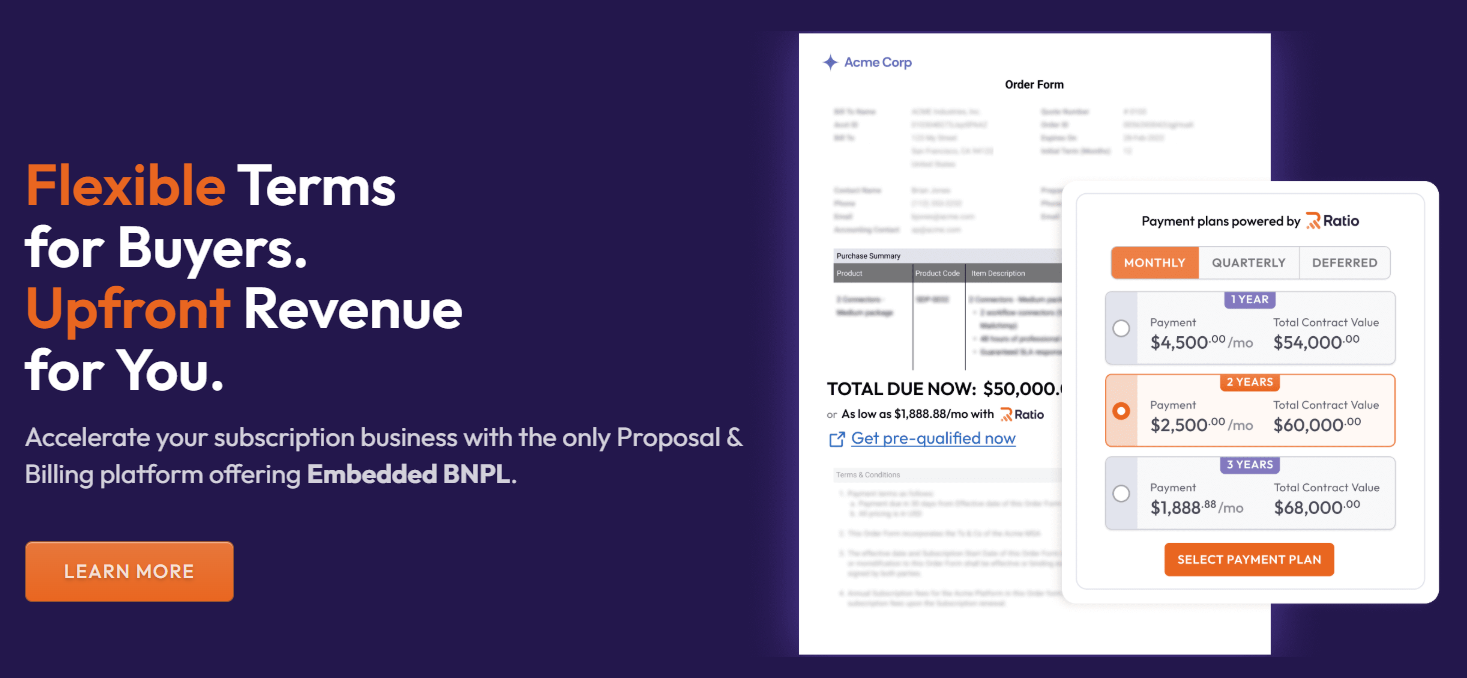
We’ve only scratched the surface of what Ratio Boost can do. If you want the full picture, you can check it out here. Or just reach out to the team for a personalized walkthrough. They’ll show you exactly how it can improve your closing velocity and turn a buyer's yes into cash upfront to fuel your growth plans
Now, let’s break down exactly how this unified engine works inside a SaaS sales workflow.
How Ratio Boost Fits Into Your Existing Workflow In 10 Simple Steps
Implementing Ratio Boost doesn’t require rebuilding your workflow or switching tools. It simply plugs into your existing CRM and proposal stack, then handles everything after a deal is accepted. Here’s how the process works, step by step:
1️⃣ Log into Ratio Boost from your CRM
Reps access Ratio directly inside Salesforce or HubSpot — no new system to learn.
2️⃣ Create an offer and select (or add) the buyer
Search for an existing buyer or add a new one. Ratio automatically pulls verification details, including EIN.
3️⃣ Configure payment terms & financing split
Choose who covers the financing fee (buyer, seller, or a split) and set 12/24/36-month terms with monthly or quarterly payments.
4️⃣ Submit the offer for instant underwriting
Ratio’s underwriting engine evaluates the buyer in seconds. Plaid verification is used when needed.
5️⃣ Buyer receives a personalized offer link
They can view options, compare plans, and collaborate internally — all self-serve.
6️⃣ Buyer selects a plan, signs, and enters ACH details
Ratio’s built-in e-signature makes the process fast, clean, and compliant.
7️⃣ You receive full upfront cash
Ratio disburses the total contract value within days. Buyers pay over time; you get paid immediately.
8️⃣ Ratio handles invoicing, reminders, and collections
Failed payments, follow-ups, reminders — all managed by Ratio Boost.
9️⃣ Sales & RevOps monitor repayment and account health
Teams get real-time visibility into the buyer’s schedule, status, and financing performance.
🔟 Renewals and add-ons are frictionless
Buyer details auto-populate, so reps generate new offers instantly.
What Happens When You Add Ratio Boost to Your B2B Sales Workflow
Now, let me show you what happens the moment you introduce Ratio Boost as your Closing Motion Platform on top of everything you already use.
To make this real, let’s look at a company you may know: DearDoc, a rapidly growing SaaS business.
Before RatioBoost (The Fragmentation Problem)
- Multiple tools just to quote, bill, and collect—creating massive fragmentation
- Reps manually nudging buyers after every proposal
- Finance waiting on slow monthly installments
- Deals looping through internal approvals despite strong proposal management software
- And most dangerously, cash timing is completely unpredictable, stripping away cash certainty
This is the classic pattern: the proposal is fine, but the handoffs ruin the momentum
After RatioBoost (Notice what shifts immediately)
- One single link combining proposals, CPQ, and BNPL payments
- Buyers pick payment terms that fit their budgets (monthly, quarterly, net-60) while you get paid upfront
- DearDoc receives up to almost all of the contract value upfront, within hours
- Ratio keeps invoicing, reminders, and collections connected in the same system
- Pricing friction disappears at the moment of yes, drastically improving your Closing Velocity
- Cash Acceleration jumps by 25% as deals instantly convert to upfront cash
See the shift? The proposal didn’t change. The closing motion did
Hear It Directly From the Founder
If your proposals are closing but your cash isn't moving, that's the gap Ratio Boost is built for. Worth a 15-minute look.
We’ll walk you through how Ratio Boost can reshape your entire revenue motion.
↗
The Closing Motion Platform
Sellers on Ratio see up to 30% higher close rates and 25% higher ACV.


