Quote-to-Cash Solutions for SaaS: Why Legacy Platforms Fall Short and What Modern SaaS Teams Need in 2026
Every SaaS operator we've talked to hits the same wall: the deal closes, the contract is signed — and then the process falls apart. Quote-to-cash is supposed to connect quoting, billing, payments, and collections into one coherent motion. In practice, legacy tools treat these as disconnected steps, and that gap costs real revenue. This guide covers where those systems fall short, what to look for instead, and how to evaluate your options in 2026. If you want to close the gap between signature and cash without rebuilding your stack, Ratio Boost is a must.


Table of contents

Quote-to-cash platforms manage everything up to signature, then leave the gap between a signed contract and money in the bank. This guide breaks down where legacy systems fail sales, RevOps and finance, sets the criteria a 2026 stack has to meet, and compares Salesforce, Conga, Oracle, SAP and Maxio. It closes with how Ratio Boost layers payment flexibility onto tools you already run.
The Challenge: You’re searching for quote-to-cash solutions, but most tools still fail to support the way SaaS actually sells.
Many platforms promise cleaner workflows and faster quotes. Yet deals still slow down in approvals, billing setup, contracting, and payment timing. A 2025 survey found that 93% of high-growth SaaS companies lose more than 10% of ARR to payment delays and post-signature friction. These are problems traditional Q2C platforms rarely fix.
This guide explains why legacy systems struggle, what modern SaaS teams need in 2026, and how to evaluate the right solution without another heavy overhaul. You’ll also see where Ratio Boost fits, especially for teams that want to add payment flexibility and reduce friction between signed deals and actual cash flow.
Here's what that friction looks like — and why the standard fixes keep falling short.
The Real Challenges Behind Quote-to-Cash for SaaS (Sales, RevOps, Finance Perspectives)
When SaaS leaders search for “quote-to-cash solutions,” they’re not looking for another workflow diagram. They’re experiencing real revenue friction. Deals slow down. Data becomes unreliable. Cash flow gets unpredictable. And teams begin to feel that the process (not the product) is holding growth back.
Here’s what that pain looks like inside each team.
Sales: Slow deals, messy workflows, and buyer friction
For sales teams, the quote-to-cash flow often feels like this:
- Slow, multi-step quoting and approvals
Sales leaders complain that CPQ (Configure, Price, Quote) setups are so complex that they actually slowed quoting and led to missed deals and angry stakeholders, instead of accelerating them. - Disjointed tools that stall momentum
A typical SaaS stack from quote to cash might include Stripe, QuickBooks, HubSpot/Salesforce, PandaDoc, and Google Sheets for revenue tracking. Sales, finance, and ops end up working in five different systems and no one fully trusts the numbers. - Lost deals when buyers ask for flexible payment terms
Buyers expect net terms or flexible schedules (Net 30/60/90 and custom terms are now considered a competitive necessity in B2B). When sellers can’t offer this easily, deals drag or die. - Reps over-discounting to force annual upfront
With no structured way to offer flexible terms safely, sales teams fall back on big discounts for annual upfront payment, eroding Annual Contract Value (ACV) and conditioning buyers to expect concessions. - Zero “checkout-like” experience
The conversations we hear from operators every week reflect the same reality: teams are still cobbling together manual processes just to get a clean quote out the door. This Reddit thread shows teams still looking for basic quote-to-cash software just to clean up manual quotes, approvals, and billing, because everything is cobbled together.
The bottom line for Sales: process friction is costing deals and margin — not product-market fit.
RevOps: Fragmented systems, dirty data, and unscalable workflows
RevOps sits at the point where quoting, contracts, billing, and reporting all need to stay aligned. That means much of the quote-to-cash friction shows up in their workflows first.
- Too many systems, not enough alignment
RevOps leaders often point out how many tools SaaS teams rely on just to get from quote to cash, with CRM, billing, contracts, and spreadsheets all telling different versions of the story. When those systems do not stay in sync, the revenue process turns into a manual tangle of approvals, Slack messages, spreadsheets, and delays. - Dirty data and broken downstream processes
CROs and RevOps leaders regularly describe forecasting confidence being eroded by duplicate records, inconsistent data, and broken handoffs across licensing, provisioning, renewals, and billing workflows. - Inconsistent quoting behavior
Without robust but usable guardrails, reps start creating one-off discounts, non-standard terms, and custom deal structures. RevOps then spends valuable time cleaning up ARR/NRR classifications and contract metadata so Finance and leadership get a coherent picture. - Workflows that don’t scale with product complexity
As teams introduce usage-based pricing, add-ons, and multi-year contracts, the revenue workflow becomes harder to manage across disconnected systems. Many teams struggle to handle estimates, quotes, and invoicing cleanly for consumption-based SaaS inside their current stack.
For RevOps, it's a systems problem: a revenue model that has grown in complexity, layered on top of tools that were never designed to connect.
Finance: Cash-flow risk, revenue leakage, and endless clean-up
Finance feels the pain of broken quote-to-cash in cash flow, collections, and reporting.
- Unpredictable cash flow from flexible terms
Payment terms like Net 30/60/90 are standard in B2B and increasingly used by SaaS companies, but they stretch cash conversion and heighten risk if there’s no structured way to manage them. - Collections drag and revenue leakage
AR and collections experts note that revenue leakage often hides in disputes, write-offs, and late collections; studies estimate companies lose 1-5% of EBITDA to revenue leakage in these areas.
When Q2C is messy, invoices are wrong, follow-ups are manual, and “late collections” become normal, the leakage compounds.
- Month-end chaos and rev rec risk
CFO-focused content stresses that billing, collections, and revenue recognition can’t live in separate silos. When a change in contract terms or usage doesn’t flow through cleanly, “the whole engine misfires,” and Finance is forced into manual adjustments at close. - Internal tension with Sales and RevOps
Sales pushes for flexibility to close deals; RevOps pushes for process; Finance pushes for cash and risk control. With no coherent Q2C backbone, Finance ends up being the “no” team, even when the real issue is system design.
For Finance, the core need isn't more automation: it's predictability. Fewer surprises between Closed Won and cash in the bank.
These are the lived problems that send SaaS leaders searching for “quote-to-cash solutions” in the first place: not curiosity about a buzzword, but a need to fix slow deals, dirty data, and fragile cash flow.
Next, we’ll look at why the legacy quote-to-cash platforms often disappoint in exactly these areas.
Why Traditional Quote-to-Cash Solutions Still Disappoint SaaS Teams
Traditional quote-to-cash tools were built for a different era. The one where products were static, billing was predictable, and nothing changed after a contract was signed. But SaaS in 2026 looks nothing like that world. Today, subscription upgrades, usage spikes, custom terms, and mid-cycle changes are the norm. And the truth is, legacy Q2C platforms simply weren’t designed to handle this level of movement.
Here’s why many traditional quote-to-cash platforms still don’t cut it:
1. Legacy Q2C tools weren’t built for SaaS complexity
- Pricing, packaging, usage, and subscription logic break the classic model.
As SaaS pricing shifts toward subscriptions, usage, and hybrid models, many platforms struggle with amendments, expansions, and mid-term changes, forcing teams back into manual workarounds. - Upgrades, downgrades, amendments, and entitlements are often unsupported or fragile.
Older systems assume a “buy once, fulfill once” mentality. In SaaS, customers expand, contract, adjust, and legacy Q2C systems often treat these as new transactions, causing friction, manual overrides, or revenue-recognition errors.
Result: what looks like a streamlined flow at implementation crumbles under real-world SaaS complexity — leaving teams with manual patches and back-office chaos instead of the velocity they were promised.
2. Implementation drag, high cost, and brittle customization
- Long, painful implementations — often mismatched with business evolution.
A full CPQ/Q2C rollout can take months. By the time it’s done, the product catalog might have changed, pricing tiers updated, or new offerings launched, making the initial config obsolete. - Customization means heavy engineering and maintenance, often unsustainable.
Custom pricing rules, discount models, renewals, amendments; they all require bespoke logic or professional services. Many companies end up pouring 3-4× more effort into connecting tools than what they saved in automation. - As business evolves, the Q2C setup becomes brittle and costly to change.
Complexity grows; data migrations break; pricing rules conflict. Teams often fall back on spreadsheets and manual overrides, defeating the purpose of automation.
Result: Instead of freeing teams, traditional Q2C becomes another sprawl. A costly, fragile, and maintenance-heavy burden.
3. Data silos, visibility gaps, and poor integration across functions
- Disconnected systems: CPQ, billing, revenue recognition, CRM; all with their own data models. When data doesn’t flow end-to-end, visibility is lost. Discounted deals slip through, renewals get mis-timed, usage billing gets mis-recorded.
- Revenue and profitability analysis become unreliable.
Without full visibility into margin, product performance, or customer-level profitability, leadership can’t make informed decisions. Traditional Q2C often fails to support this level of insight. - Billing and invoicing errors creep in.
Complex bundles, discounts, add-ons when misaligned across systems, generate inaccurate invoices or revenue-recognition mistakes.
Result: What should be a unified “single source of truth” becomes a fractured view. Teams lose trust in their data. And often revert to manual spreadsheets or external reconciliation efforts.
4. Automation of a flawed process, building bureaucracy not agility
- Automating bad workflows embeds inefficiency into code.
One of the most common failures of Q2C implementations is automating an already broken sales-to-billing workflow; then ending up with “automated chaos.” - Delayed stakeholder involvement (Finance, Legal) leads to fragile setups.
Many implementations push configuration and pricing logic without aligning with finance or legal, making future amendments or compliance updates cumbersome and risky. - What was meant to speed deals ends up slowing them further.
CPQ generation, approval flows, custom pricing logic, billing handoffs; all add rigid sequential steps. For SaaS deals needing flexibility, this setup kills velocity.
Result: Instead of speeding revenue, traditional Q2C automation often increases friction. Especially for agile SaaS sellers who need flexibility.
5. Legacy Q2C Hurts the Buyer Experience and Your Close Rates
- Contracts and checkouts feel outdated.
Buyers have grown accustomed to near-instant, self-serve checkout experiences. Traditional Q2C often forces them back into long quoting, contracting, and billing cycles. - Payment Flexibility is limited.
For buyers needing net terms or custom plans, old Q2C systems rarely offer the flexibility, leading to lost deals or forced concessions. - Customer experience degrades post-signature: delayed invoices, billing errors, manual follow-ups.
What started as a “friendly SaaS sale” ends up feeling like enterprise-ERP work. Causing frustration, churn risk, and poor perception of your SaaS brand.
Result: Legacy Q2C steals not just sales velocity, but also buyer trust; two key levers for SaaS growth.
This gap between what legacy Q2C systems assume and what modern SaaS needs has only widened.
What you really need is a modern Q2C approach. One that combines flexibility, finance-friendly terms, operational rigor, and data alignment across the revenue lifecycle.
Only then can you avoid repeating the same mistakes. Like long implementations, billing chaos, and data silos, instead build a revenue engine that scales.
What a Modern Q2C Solution Must Deliver to be Relevant for B2B SaaS in 2026
The B2B SaaS market is expanding faster than ever. It’s projected to reach USD 0.49 trillion in 2026 and grow to USD 1.58 trillion by 2031. A 26.24% CAGR that signals just how quickly the industry is scaling. That growth creates opportunity. It also creates operational complexity that most revenue systems were never designed to absorb.
As more SaaS companies enter the market, buyers now expect:
- More pricing flexibility
- More contract fluidity
- More payment options
- More clarity and accuracy in billing
- More consumer-grade ease in the purchase experience
Traditional Q2C systems weren't built for this level of movement.
Here's the benchmark we use when evaluating whether a revenue platform is actually ready for 2026:
1. Support for Dynamic SaaS Pricing Models
A modern Q2C system must handle subscription, usage, hybrid, and multi-product pricing without breaking workflows.
What this looks like:
- Accurate setups for monthly, annual, and multi-year terms
- Native support for upgrades, downgrades, co-terming, add-ons, and renewals
- Seamless handling of usage estimates vs. actual consumption
- Automated proration and mid-term changes
Why it matters: SaaS pricing changes constantly. If Q2C can’t keep up, your revenue engine slows down.
2. Frictionless Quoting, Contracting, and Approvals
Buyers expect speed. Reps need control. RevOps needs accuracy.
A modern system must deliver:
- Fast quote creation with guardrails
- Automated approvals (rules-based, not bottleneck-based)
- Error-free contract generation with accurate terms
- A “click-to-close” experience instead of PDF chaos
Why it matters: Every approval loop and manual contract edit adds drag to the deal cycle — often at the worst possible moment.
3. A Buyer Experience That Matches Modern SaaS Expectations
Legacy Q2C optimizes internal control. Modern Q2C optimizes the buyer journey.
Must-have capabilities:
- Clean, self-serve checkout options
- Real-time visibility into payment plans, terms, and invoice details
- Fast, digital acceptance workflows
- Embedded payment experiences that feel like modern SaaS, not legacy ERP
Why it matters: Buyers judge your product by how easy it is to buy.
Must Read: Is Payment Flexibility Hurting Your Business In Ways You Didn’t Know?
4. Native Support for Flexible Payment Terms (Without Breaking Cash Flow)
This is the biggest shift in modern Q2C requirements.
Today’s buyers expect:
- Monthly or quarterly payment options
- Net terms
- Custom payment schedules
- Pay-over-time models
A modern Q2C system must:
- Offer flexible terms without requiring heavy discounting
- Manage term risk through structured processes
- Handle invoicing, reminders, and collections automatically
- Keep cash predictable, even when buyers pay slowly
Why it matters: Flexible terms can increase close rates. But they destroy cash flow if not supported properly.
Read More: Payment Flexibility: With vs. Without B2B BNPL
5. Unified Billing, Revenue Recognition, and Cash Collection
A modern solution must extend beyond quoting.
It must bring together:
- Automated billing for all pricing structures
- Accurate ASC 606 / IFRS 15 revenue recognition
- Timely invoicing
- Automated collections follow-up
- Real-time cash status
Why it matters: Q2C is only complete when quotes actually turn into cash. Accurately and on time.
6. Deep, Seamless Integrations Across the Revenue Stack
Modern SaaS teams can’t afford data silos. Every system must speak the same language.
Required integrations:
- CRM (Salesforce, HubSpot)
- Billing platforms (Chargebee, Stripe Billing, Maxio, Recurly)
- ERP/Accounting (NetSuite, QuickBooks)
- RevOps tools, e-signature, usage metering, and payment processors
Why it matters: Clean data = clean reporting, clean forecasting, clean renewals.
Modern Q2C is less about replacing your stack, and more about unifying it.
7. A Single Revenue Data Model Across the Lifecycle
No more mismatched ARR.
No more contracts that don’t match CRM.
No more invoices that don’t match quotes.
A modern Q2C system must offer:
- Consistent contract metadata
- Unified ARR/NRR logic
- Accurate customer history and entitlement data
- Real-time visibility from quote → contract → billing → cash → renewal
Why it matters: You can’t scale a SaaS business on inconsistent data.
Modern Q2C must create a true revenue spine, not five disconnected snapshots.
8. Operational Efficiency Without Heavy Admin Overhead
RevOps shouldn’t need to rebuild your Q2C every quarter.
Modern Q2C must be:
- Easy to update as pricing evolves
- Flexible without being fragile
- Configurable without heavy engineering
- Maintainable without a full-time internal admin team
Why it matters: Every SaaS company evolves fast. Your Q2C must evolve with you; not slow you down.
9. Visibility, Forecasting, and Revenue Intelligence
A modern solution must give teams clear, real-time visibility into:
- Live deal terms
- ARR/NRR impact
- Invoicing status
- Collections status
- Cash conversion cycles
- Renewal and expansion readiness
- Customer-level profitability (especially with usage)
Why it matters: Leaders need predictable revenue. Modern Q2C gives them the insights to make strategic decisions — not guesses.
These capabilities define what “good” looks like in 2026. But knowing the ideal is only half the battle. The next step is understanding how to evaluate Q2C options realistically, compare tradeoffs, and choose a solution that fits your pricing model, sales motion, team constraints, and cash-flow strategy.
How to Evaluate Quote-to-Cash Solutions for SaaS in 2026
In SaaS, adding a new platform to your tech stack is never a casual decision. Q2C systems touch quoting, pricing, billing, invoicing, revenue recognition, and cash flow. Which means a wrong choice doesn’t just create friction, it creates financial risk. And because SaaS tools come with high ACVs and long implementation timelines, you can’t go fast or go on gut instinct.
- You evaluate deliberately.
- You ask hard questions.
- You pressure-test every assumption.
Here are the critical areas to evaluate and the questions every SaaS team must ask before choosing a modern quote-to-cash solution:
1. Pricing & Packaging Flexibility
Ask:
- Can it support subscription, usage-based, hybrid, and tiered pricing models?
- Can it handle upgrades, downgrades, add-ons, and mid-term changes without manual work?
- Can it adapt when pricing or packaging changes?
- Can it keep billing, contract terms, and revenue rules in sync as pricing evolves?
- Can non-technical teams update pricing logic safely?
2. Fit With Your Sales Motion
Ask:
- Does it support the deal types we run (transactional, mid-market, enterprise, or mixed)?
- Can it generate quotes at the speed our sales cycle requires?
- Can it handle the contract complexity our motion demands?
- Does it automate the approval paths our deals typically follow?
- Does it keep quoting → approval → contract → billing connected without handoffs?
3. Integration Depth Across Your Stack
Ask:
- Does it integrate natively with our CRM (Salesforce/HubSpot)?
- Do contract terms, product details, and pricing sync both ways?
- Can it pass accurate data to billing, rev-rec, and payment systems?
- Can it handle amendments and renewals without breaking the sync?
- Does it support real-time updates instead of batch jobs?
4. Billing, Invoicing, and Collections Capability
Ask:
- Can it trigger accurate invoices automatically from signed contracts?
- Can it handle different billing frequencies and schedules?
- Can it automate reminders and collections follow-ups?
- Does it reduce invoice errors tied to pricing or contract changes?
- Can it maintain a clean audit trail from quote → invoice → payment?
5. Payment Flexibility & Cash-Flow Impact
Ask:
- Can it support net terms, installment plans, or custom payment schedules?
- Can it handle different payment methods cleanly (ACH, card, bank transfer)?
- Can it forecast cash flow reliably based on buyer payment behavior?
- Can it manage payment risk without relying on heavy discounts?
- Can it automate payment collection for staggered schedules?
6. Revenue Recognition Alignment
Ask:
- Does it pass correct data to our rev-rec system without manual cleanup?
- Can it handle multi-element arrangements, usage, and mid-term changes?
- Does each contract version map cleanly to revenue schedules?
- Can it support ASC 606/IFRS 15 requirements?
- Does it avoid end-of-month manual adjustments?
7. Data Consistency & Revenue Accuracy
Ask:
- Does it maintain a single source of truth for ARR/NRR?
- Are contract terms consistent across CRM, billing, and Finance?
- Does it eliminate discrepancies between quote, invoice, and rev-rec?
- Can it reduce manual reconciliation work across systems?
- Does it keep customer-level revenue history clean and up to date?
8. Implementation Time & Change Management
Ask:
- How long does implementation take for teams similar to ours?
- Can RevOps administer the system without heavy engineering?
- How easily can we update workflows as our business evolves?
- Does it require paid professional services for basic adjustments?
- Can it scale without becoming a maintenance burden?
9. Buyer Experience & Checkout Flow
Ask:
- Does it provide a clean, modern experience for buyers signing and paying?
- Can buyers view terms, schedules, and invoices without friction?
- Does it reduce back-and-forth during closing?
- Can it support embedded or self-serve checkouts if needed?
- Does the buyer experience match the expectations of modern SaaS customers?
This evaluation framework helps SaaS teams choose the Q2C solution that fits their pricing, motion, data flows, and cash strategy. Not just the flashiest demo.
Next, we’ll look at the quote-to-cash solutions available today. Each solution below is evaluated using the criteria above and listed so you can see how closely they align with modern SaaS requirements.
Most Popular Quote-to-Cash Solutions Worth Considering in 2026
Most SaaS leaders evaluating quote-to-cash software aren’t looking for slick marketing or vendor slogans. They want clarity on which platforms actually hold up inside real revenue operations, not theoretical workflows.
This section strips away that noise. Below are the Q2C platforms SaaS teams consistently evaluate:
- Salesforce Revenue Cloud (CPQ + Billing + Revenue)
- Conga Revenue Lifecycle Cloud (formerly Apttus Q2C)
- Oracle CPQ + Subscription Management (Oracle Q2C)
- SAP BRIM + SAP CPQ (SAP Q2C)
- Maxio (Subscription Revenue Platform)
We break down what real users report, where each platform excels, and the limitations that matter if you’re running a modern SaaS revenue engine.
Let’s get into it.
1. Agentforce Revenue Management (formerly Revenue Cloud)
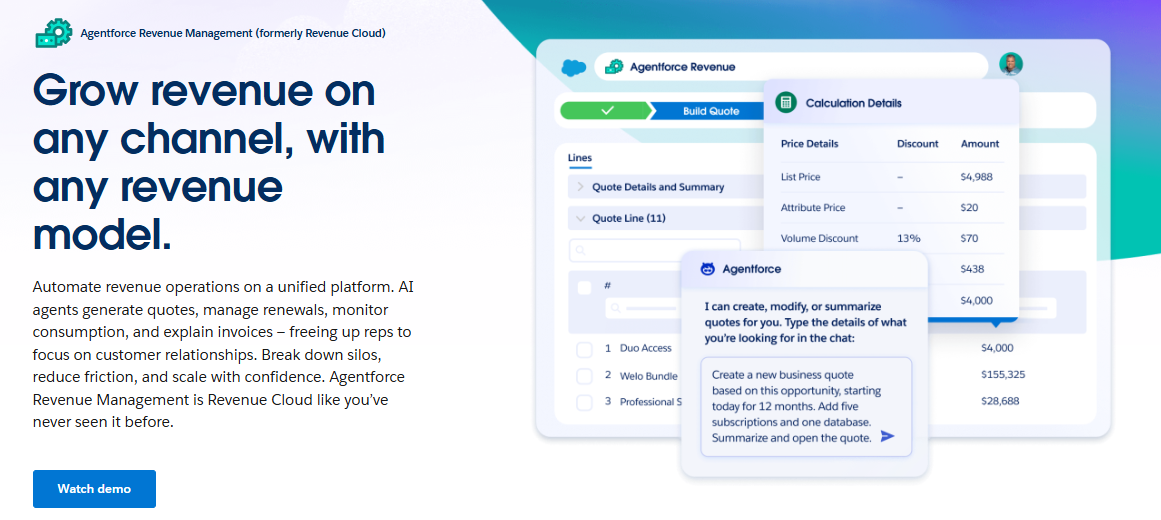
Salesforce Agentforce Revenue Management is Salesforce’s end-to-end quote-to-cash suite, combining CPQ, billing, invoicing, and revenue management within the Salesforce platform. It’s designed to centralize quoting, contracts, orders, and invoices so sales and finance can run the entire revenue lifecycle on one system of record.
Rating
- G2: 4.2★ (1,481+ reviews) for Salesforce Revenue Cloud
Key Q2C Capabilities
- Advanced CPQ: configurable bundles, guided selling, pricing rules, discount controls
- Subscription + Usage Billing: automated billing triggered directly from approved quotes
- Invoicing + Payments: automated invoice generation and payments workflows
- Revenue Recognition: ASC 606 aligned automated revenue schedules
- Lifecycle Visibility: quote → contract → billing → revenue → renewal in one system
These capabilities make it one of the few true end-to-end Q2C platforms on the market.
What Users Like (From Verified G2 Reviews)
- “Provides end-to-end visibility and reduces manual quoting errors.”
- “Automates approvals and connects sales to billing seamlessly.”
- Strong integration with Salesforce CRM, minimizing data sync issues.
Overall sentiment: automation + consistency + reduced revenue leakage.
Limitations (User-Reported)
- Requires heavy admin effort and ongoing configuration
- Customization is expensive and time-intensive
- Slower performance when quotes have very large line-item volumes
- Can feel rigid for companies without structured pricing models
These limitations matter most for mid-sized SaaS teams without internal ops or technical resources.
Pricing
- Salesforce does not publicly publish all-in Revenue Cloud pricing. CPQ/Billing pricing is typically quote-based and highly dependent on scope and modules.
2. Conga Revenue Lifecycle Cloud (Conga CPQ + CLM + Billing)
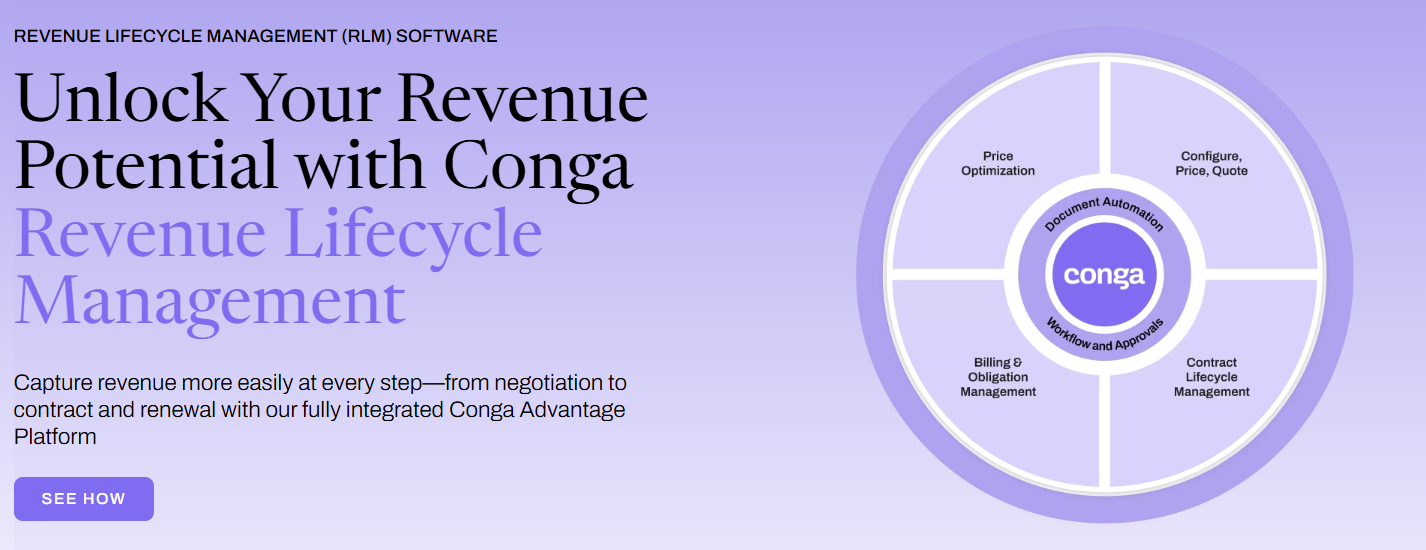
Conga’s revenue lifecycle platform connects CPQ, CLM, and billing into one stack designed to run the entire quote-to-cash process on a single data model. It’s tightly aligned with Salesforce environments and is often chosen by teams that want CPQ + contracts + billing within one configurable framework.
Ratings & Public Feedback
- G2 (Conga CPQ): 4.3★ (243 reviews)
Key Q2C Capabilities
- CPQ for complex products: rules-driven configuration, advanced pricing, discounting, and guided selling.
- Contract lifecycle management (CLM) to generate, negotiate, and manage contracts tied to quotes.
- Conga Billing to connect quotes and contracts to automated billing, invoicing, and revenue events in Salesforce.
- Single data model for quote-to-cash across CPQ, contracts, and billing, marketed as “run your entire quote-to-cash on one model.”
What Users Like (From G2)
- Ease of integrating Conga CPQ with Salesforce and other Conga products (Composer, CLM, etc.).
- Strong guided selling and configuration engine for complex products and pricing rules.
- Flexibility in setting up product catalogs and pricing logic once and reusing across deals.
Limitations (User-Reported)
- Pros & cons data shows recurring themes: slow performance, limited customization, difficult customization, and complex implementation for some teams.
- Several reviewers mention higher implementation and operational costs due to limited documentation and need for specialist skills.
Pricing
- Conga CPQ and related modules are sold via sales-driven, custom quotes; Capterra lists Conga CPQ but does not provide transparent per-user public pricing.
3. Oracle CPQ + Oracle Subscription Management (Oracle Q2C Stack)
Oracle positions Oracle CPQ together with Oracle Subscription Management and Oracle’s CX/ERP stack as a modern quote-to-cash solution. CPQ centralizes product, pricing, discounting, and approvals, while Subscription Management automates invoicing, billing, and revenue recognition across recurring revenue streams.
Ratings & Public Feedback
- G2 (Oracle CPQ): 4.0★ (266 reviews)
Key Q2C Capabilities
- Oracle CPQ: scalable CPQ that centralizes business rules, pricing, discounting, contracts, and renewals to automate the configuration–price–quote cycle.
- Subscription Management: connects lifecycle touchpoints, automates invoicing and billing, improves revenue recognition, and speeds payment collection for recurring models.
- Oracle’s “quote-to-cash model” documentation explicitly describes the flow: manage opportunities, create quotes/orders/subscriptions, bill, and manage revenue in an integrated way.
What Users Like (From G2 + Capterra)
- Strong fit for enterprises with complex configuration needs and existing Oracle footprint.
- Robust approval workflows and guided selling features are repeatedly highlighted in comparisons.
- Stable for large data volumes and sophisticated pricing structures when correctly implemented.
Limitations (User-Reported)
- Users frequently mention slow performance, especially saving/syncing data during heavy usage.
- UI and reporting can feel dated or less intuitive compared to newer SaaS-native tools.
- Implementation tends to be resource-intensive and is usually partner-led for complex Q2C scenarios.
Pricing
- Oracle CPQ and Subscription Management pricing is not publicly standardized; Capterra shows Oracle CPQ with a nominal “from $1 one-time” placeholder, which is not representative of typical enterprise Q2C deals.
4. SAP Quote-to-Cash Stack (SAP BRIM + SAP Subscription Billing + SAP CPQ)
SAP’s quote-to-cash story is built around SAP Billing and Revenue Innovation Management (BRIM) plus SAP Subscription Billing and SAP CPQ, positioned as an integrated stack for high-volume, subscription and usage-based billing scenarios.

Ratings & Public Feedback
- G2 (SAP BRIM – Billing and Revenue Innovation Management): 5.0★ (but only 1 review).
- G2 (SAP Subscription Billing): 4.2★ (18 reviews).
- No unified G2 listing that covers “BRIM + Subscription Billing + SAP CPQ” as one product.
Key Q2C Capabilities
- SAP Q2C management: SAP markets BRIM + Subscription Billing + CPQ as an integrated quote-to-cash portfolio to monetize subscriptions and usage-based offerings.
- SAP BRIM: high-volume usage and recurring billing, complex rating, invoicing and revenue management for subscription/XaaS models.
- SAP Subscription Billing: design, launch, and manage subscription and pay-as-you-go offers with flexible pricing, bundling, and billing options.
- Integration with SAP S/4HANA and broader SAP financials to tie Q2C into core ERP.
What Users Like (From G2 & Ecosystem Content)
- Strong fit for very high-volume billing and complex enterprise revenue models.
- Deep integration with SAP’s ERP stack: attractive for enterprises already standardized on SAP.
Limitations (User-Reported)
- Very few public G2 reviews, so sentiment data is thin; especially compared to Salesforce, Conga, or Maxio.
- Skill availability: partners note it can be hard to find BRIM experts and implementations are typically long and complex.
- Overkill for most mid-market SaaS that don’t need telco-grade usage volumes or deep SAP integration. (Inference from SAP’s positioning around high-volume usage and large ERP footprints.)
Pricing
- SAP doesn’t publish list pricing for BRIM or Subscription Billing; deals are highly customized and usually sold as part of broader SAP programs.
5. Maxio (Billing + Rev Rec + SaaS Metrics)
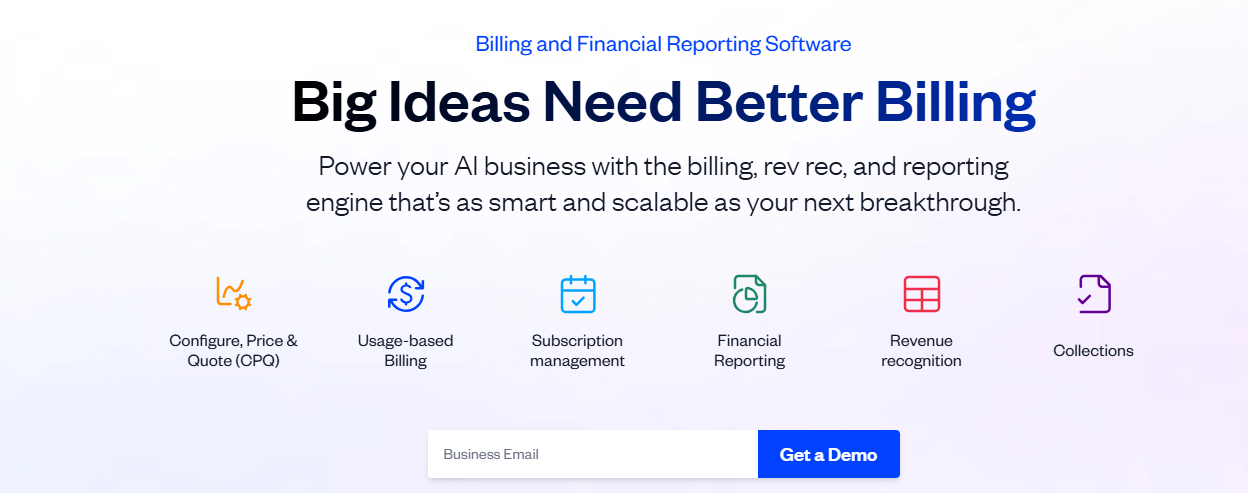
Maxio is a financial operations platform built specifically for B2B SaaS, covering subscription billing, usage-based billing, revenue and expense recognition, and SaaS metrics in one system. It’s positioned less as “traditional CPQ” and more as the billing, rev-rec, and analytics backbone that connects into Q2C flows and replaces spreadsheet-driven finance ops.
Ratings & Public Feedback
- G2 (Maxio): 4.3★ (800+ reviews)
- Capterra: 4.3★ (250+ reviews)
Key Q2C-Relevant Capabilities
- Subscription + usage-based billing with support for complex SaaS pricing models.
- Subscription management: track MRR/ARR, renewals, changes, and plan movements with alerts on revenue shifts.
- GAAP-compliant revenue & expense recognition (ASC 606 / IFRS 15) with automation for complex contracts and multiple revenue streams.
- SaaS metrics & analytics: reporting across billing, revenue, churn, cohorts, and investor-grade dashboards.
- Integrations with CRMs (e.g., Salesforce, HubSpot) and GL/ERP systems to tie quote/customer data into billing and rev-rec.
What Users Like (From G2)
- Strong billing management and automated invoicing for recurring revenue.
- Ability to replace massive Excel models for bookings, ARR, renewals, invoicing, and revenue reconciliation.
- Deep integrations and SaaS-specific reporting (MRR, churn, etc.) valued by finance teams.
Limitations (User-Reported)
- Some users find reporting “rigid or confusing” and need to piece together multiple reports.
- Occasional integration glitches (e.g., syncing issues with Salesforce) are noted.
- Setup and navigation can feel complex for certain use cases; a few users cite missing or inconvenient UX features.
Pricing
- Maxio uses sales-driven pricing; neither Maxio’s site nor G2/Capterra provides a simple per-seat public price.
These platforms help SaaS teams manage important parts of quoting, billing, and revenue operations. Some also support flexible pricing and billing structures. But they still leave a critical gap between signed agreement, buyer payment flexibility, and actual cash flow. That is where Ratio Boost fits differently, not as another quote-to-cash solution, but even better as a Closing Motion platform that helps sellers turn signed deals into cash more smoothly.
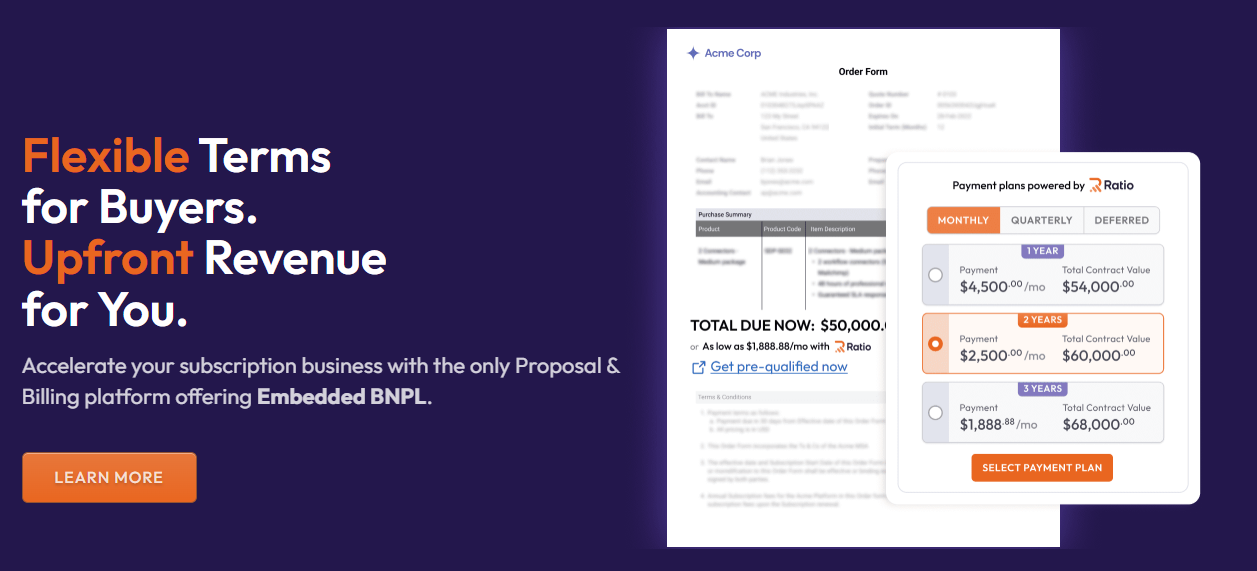
Let’s uncover more in the next section.
Ratio Boost: A Quote-to-Cash Solution That Supports the Closing Motion
When we built Ratio Boost , we made a deliberate choice: don't force operators to rip out their existing stack. Work alongside it. Ratio Boost integrates with the tools SaaS teams already rely on — Salesforce, HubSpot, Chargebee, Stripe, Recurly — and adds what those tools can't do on their own: turning a signed deal into cash, not just a contract.
What makes Ratio Boost different is where it focuses: not on the quote, but on what happens after the signature. That's the Closing Motion, and it's exactly where most Q2C platforms stop.
In practice, that means helping SaaS teams move beyond signature and turn buyer commitment into actual cash flow with less friction. The quote-to-cash solutions we covered help manage the process. Ratio Boost helps make sure the process ends in cash, not just a signed agreement.
Here’s What Ratio Boost Adds
- SaaS-ready contract support: Built for recurring revenue. Supports subscription contracts, service agreements, renewals, and upsells, not just one-time invoices.
- Payment flexibility: Buyers can choose monthly, quarterly, annual, net terms, or custom payment plans that align with their budget cycles.
- Real-time underwriting: Ratio evaluates buyers and supports financing decisions quickly, helping deals move forward with less manual friction.
- Configurable financing fees: Financing costs can be absorbed by the seller, passed to the buyer, or split between both sides, giving teams more flexibility in how they structure offers.
- Buyer-friendly digital experience: Buyers get a clean, branded digital flow to review payment options and complete next steps more easily.

- Seller cash upfront: When a deal is approved through Ratio, the seller receives payment upfront, not stretched across the buyer's installment schedule. That's the gap we close.
- Billing and collections management: Ratio manages invoicing, reminders, repayment workflows, and collections, reducing operational burden on finance and AR teams.
- Repayment tracking dashboard: Teams get visibility into repayment status and buyer activity, making it easier to monitor post-signature progress and plan renewals or follow-ups.
Proof: How DearDoc Used Ratio Boost to Unlock Faster Cash
In practice: How DearDoc used Ratio Boost DearDoc sells to medical practices — buyers who need payment flexibility but often can't commit to annual upfront terms. With Ratio Boost, DearDoc offered monthly and quarterly payment options while still receiving full payment immediately. The result: higher close rates, stronger ACV, shorter sales cycles, and predictable revenue even when buyers chose extended terms.
Hear it directly from the founder:
If any of this resonates (the gap between signed and paid, the cash-flow timing, the operational overhead) I'd encourage you to see how Ratio Boost works in your specific context. Book a 15-20 minute strategy call today.
↗
The Closing Motion Platform
Sellers on Ratio see up to 30% higher close rates and 25% higher ACV.


