Searching for Embedded Finance B2B Platforms? Here’s What Most SaaS Teams Use in 2025
SaaS companies lose revenue when deals stall over payment friction. Embedded finance platforms let B2B companies offer flexible terms while collecting cash upfront, boosting conversions, removing discount pressure, and accelerating growth. This guide compares the top embedded finance platforms built for B2B SaaS in 2025 and how to choose the one that best fits your sales motion.


Table of contents

SaaS companies lose revenue when deals stall over payment friction. Embedded finance platforms let B2B companies offer flexible terms while collecting cash upfront, boosting conversions, removing discount pressure, and accelerating growth. This guide compares the top embedded finance platforms built for B2B SaaS in 2025 and how to choose the one that best fits your sales motion.
The Challenge: Why Your Hottest SaaS Deals Stall at the Finish Line
Your team nails the pitch. The buyer is sold.
Then comes the payment conversation—and suddenly, silence. Offer 6-month terms? Finance flags the risk. Ask for upfront payment? The buyer hesitates or ghosts.
This tension kills velocity, bloats discounts, and drains cash flow.
That's why embedded finance B2B platforms are no longer optional for SaaS sales teams. These tools let SaaS sellers offer flexible terms without losing margin, speed, or control.
What Is Embedded Finance
At its core, embedded finance enables SaaS companies to integrate financial services (such as BNPL (Buy Now, Pay Later), credit, or invoice financing) directly into their sales flow.
Instead of sending buyers to banks, third-party lenders, or slow approval processes, embedded finance gives them instant access to payment options at the point of sale or in a quote.
In practice that means:
- Flexible terms like monthly or milestone-based payments.
- Instant approval without redirecting the buyer.
- Cash upfront to you, no matter how they choose to pay.
For B2B SaaS, this isn’t just a convenience; it’s a way to:
- Accelerate time-to-cash
- Reduce discounting
- Eliminate churn from budget friction
- Free your team from collections
That's what embedded finance does operationally. The strategic impact shows up when you zoom out to the full revenue motion.
Top Embedded Finance B2B Platforms for SaaS in 2025
There’s no shortage of vendors claiming to “simplify payments” or “accelerate cash flow.” But when it comes to high-velocity B2B SaaS sales, most platforms weren’t built for your deal structure, risk profile, or sales cycle complexity.
We’ve analyzed the top embedded finance providers through the lens of real SaaS needs (instant underwriting, upfront payouts, CRM-native workflows, and non-recourse financing) and narrowed it down to six worth your time.
- Ratio (Boost)
- Capchase (Capchase Pay)
- Tranch
- Resolve (Affirm B2B)
- ChargeAfter
Let’s break them down, starting with the one built from the ground up for B2B SaaS: Ratio.
#1. Ratio Boost- Embedded BNPL Built for B2B SaaS Revenue Teams
Many embedded finance tools were built for eCommerce checkout flows or SMB credit; not complex B2B SaaS sales. They allow buyers to split payments. But sellers still wait for cash, or wrestle with broken quote-to-cash workflows.
Ratio Boost was built from the ground up to solve this.
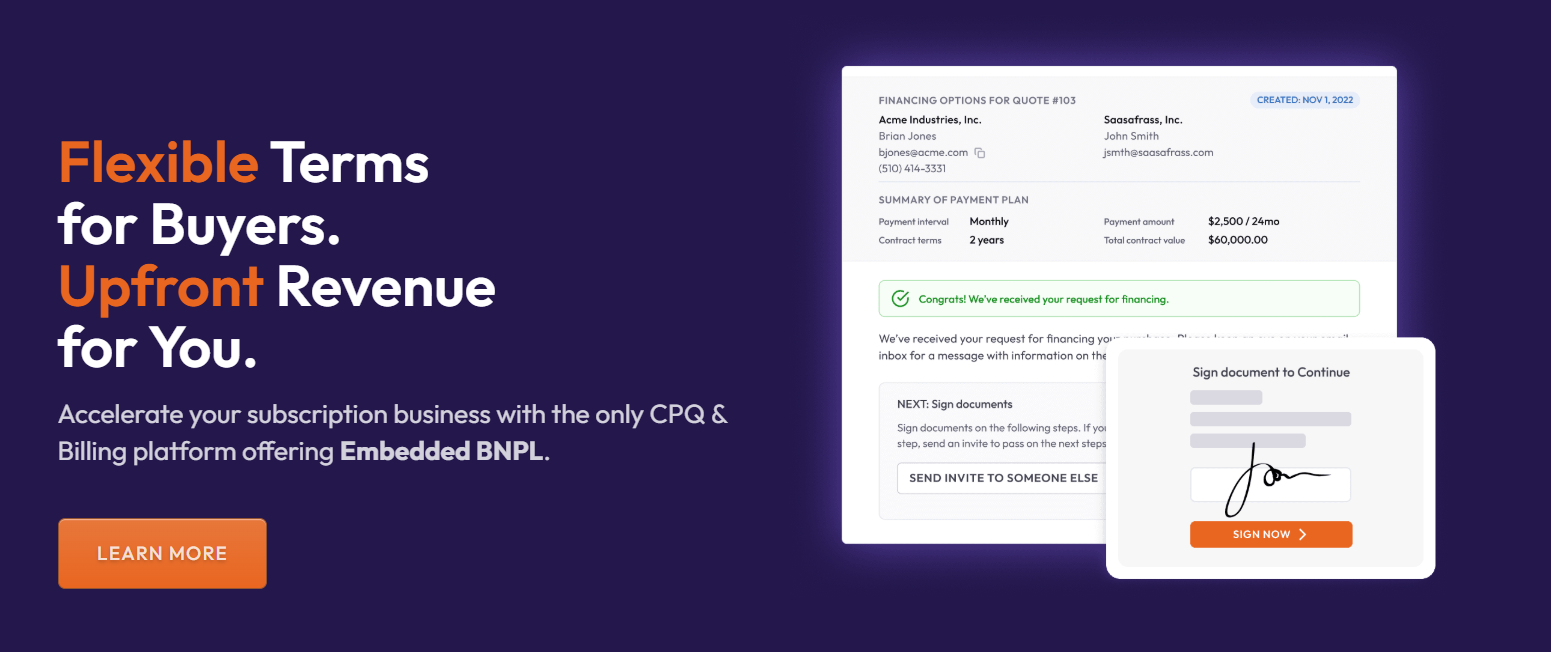
It's an embedded finance platform(and a Closing Motion Platform) purpose-built for high-velocity, high-ACV SaaS teams. Ratio embeds flexible payment options directly into your sales process, delivers upfront cash when deals are financed, and keeps Sales and Finance aligned through the full close.
Key Features and Benefits
Embedded BNPL for B2B SaaS Deals
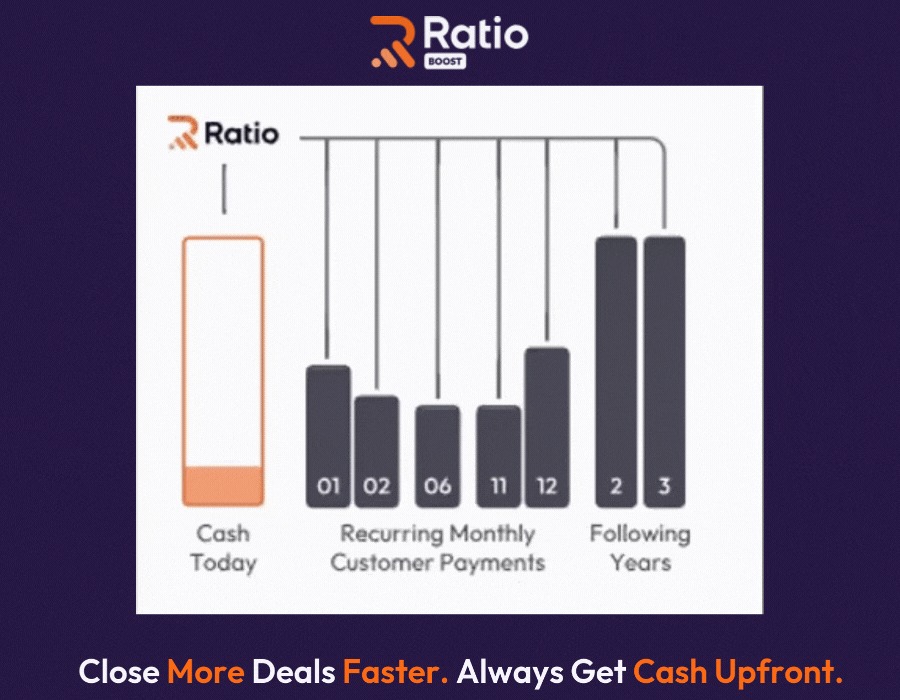
Ratio offers a Buy Now, Pay Later (BNPL) model tailored for high-velocity SaaS sales teams. Your buyers get flexible options while you get paid upfront.
Just faster closes, healthier cash flow, and more deals across the finish line.
With Ratio, you get:
- Access up to 100% of contract value when deals are approved
- Protect CAC payback and forecast with confidence
- No more working capital drag from long payment terms
Embedded Inside Your Sales Workflow
No portals. No handoffs. No disruption. Ratio lives in Salesforce or HubSpot and is triggered natively from your deal flow.
- Launch offers from CPQ or quote stage to increase chances of deal closures
- Align Sales and Finance with real-time visibility
- Streamline financing approvals and automate collections
- Embed financing terms in the buyer’s contract. Close the deal in one seamless motion: no separate paperwork, no friction, no delays.
Deal-Level Embedded Financing
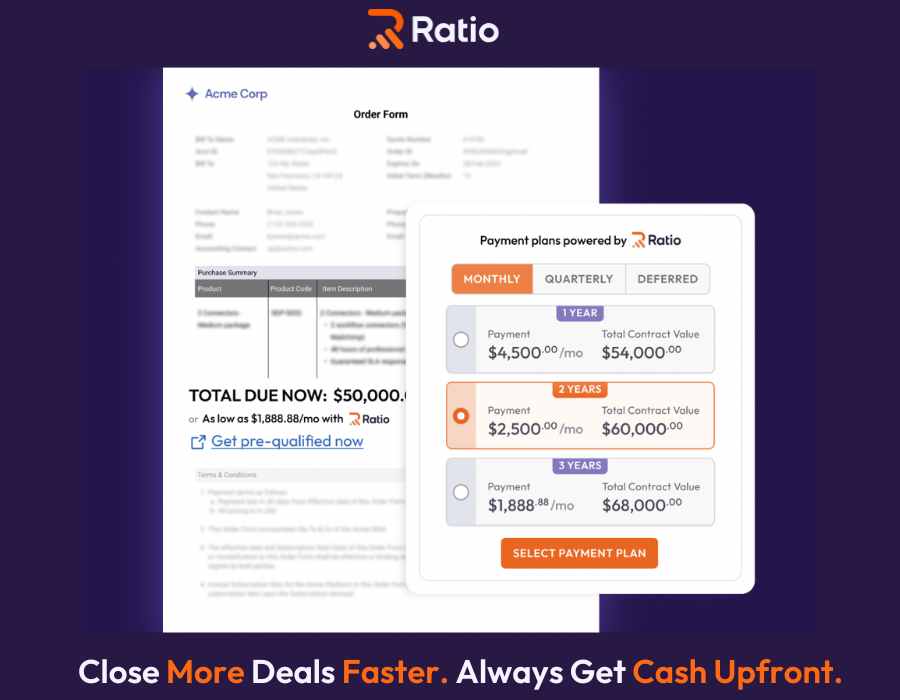
With Ratio, financing is triggered directly inside Salesforce or HubSpot at the quote stage.
Sales reps can select flexible payment terms per opportunity without rewriting contracts or sending buyers to external applications.
- Launch financing from the opportunity or quote
- View buyer eligibility in seconds before contract finalization
- Enable or disable financing per deal
- Use fallback options like standard net terms for non-qualifying buyers
- Keep Sales and Finance aligned inside the same closing motion
Finance teams can configure approval workflows for non-standard terms, while underwriting thresholds are managed through the platform.

Control Where It Matters: At the Close
Whether it’s a $5K pilot or a $250K enterprise agreement, financing isn’t one-size-fits-all.
- Sales chooses when financing is presented as part of the quote
- Finance sets guardrails around eligibility and cost allocation
- Terms adapt to contract value, duration, and risk tier
- Payment flexibility replaces reactive discounting
Seamless Integration With Your Revenue Stack
Set it up once: then quote, close, and collect without switching tools.
- CRM & CPQ: Salesforce, HubSpot
- Billing: Chargebee, Recurly, Stripe
- Contracts: PandaDoc, DocuSign
- Accounting: NetSuite, QuickBooks, Xero
- Banking and Payments: Plaid, GoCardless, ACHQ
Pros
- Accelerates cash collection without discounting.
- Embeds into sales workflows; no rep behavior change.
- Reduce seller exposure
- Structured payment schedules aligned to SaaS contracts
- Fast onboarding and instant approvals.
Cons
- Advanced usage-based pricing may require a custom setup.
- Enterprise buyers with internal financing may opt out.
- Custom deal terms beyond standard formats may need Ratio support.
Pricing
Unlike other embedded financing B2B platforms that charge subscription or platform fees, Ratio has no subscription cost.
Instead, a financing fee applies, and sellers can choose how to handle that fee:
- Cover it themselves
- Pass it to the buyers or
- Split it 50/50
This gives SaaS sellers complete control over how financing affects margins and the buyer experience.
Customer Success Spotlight
DearDoc, a B2B healthtech SaaS company, used Ratio Boost to remove financing friction and bring deals to the finish line faster.
By embedding financing directly into their sales workflow, the company eliminated approval delays and simplified the entire close process—from proposal to payment.
The results?
- Financing approvals reduced to 30-45 minutes
- 20-30% improvement in close rates
- 25% increase in average selling price (ASP)
And don't just take our words for it. Hear it directly from the DearDoc team:
Ratio powers revenue for many other fast-growing B2B companies across healthtech, fintech, and logistics, including MarketJoy, Lucid Bots, and Taxwell. The company is rated 4.4/5 on G2.
Demo / Free Trial Availability
Ready to see how Ratio fits into your stack?
Schedule a free demo. Let’s walk through your sales flow together.
See how Ratio Boost fits into your existing sales stack. Book a 25-minute demo — we'll walk through your deal flow and show you exactly where embedded financing connects.
#2. Capchase Pay - Revenue-Based Financing for Growing SaaS Startups
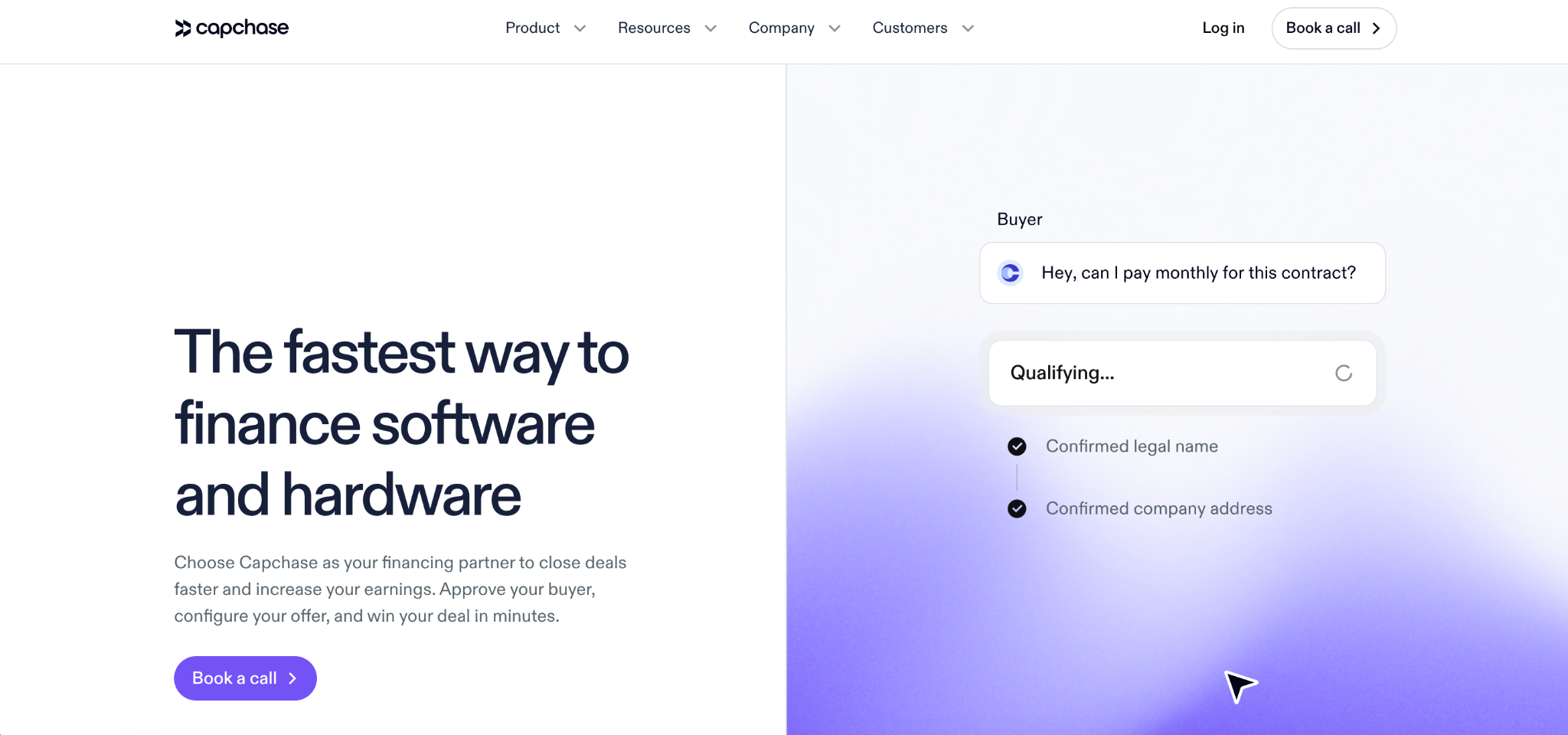
Capchase Pay gives B2B SaaS sellers a fast way to offer flexible payment terms without risking cash flow or margins.
You offer your buyer monthly or quarterly terms. Capchase pays you the full contract value upfront on approved deals and handles collections directly with the buyer, including assuming the risk of payment default. Sellers have no repayment responsibility once funds are disbursed.
For sales-led teams navigating tight budgets and lengthy approvals, Capchase helps reduce payment friction by replacing large upfront-payment discounts with flexible monthly or quarterly terms, without requiring internal credit extensions.
Key Features and Benefits
- Advance a portion of future ARR from signed contracts
- Funds released in monthly tranches or lump sum based on the risk profile
- Visibility into financing activity and payment performance
- Integrates with Stripe, QuickBooks, Xero, Chargebee, and more
Pros
- Access working capital without dilution
- Works well for CFOs managing long contracts and cash flow
- Transparent pricing tied to contract health and risk score
Cons
- Buyer payment experience may feel complex in certain workflows
- Approval amounts may be lower than requested, requiring additional review
- Requires existing, signed contracts to draw funds
Pricing
Custom fee structure based on contract quality, size, and repayment terms. Typically structured as a percentage of capital deployed with clear terms.
#3. Tranch – Installment-Based BNPL for SaaS and Services Contracts
Tranch is an embedded finance solution that offers BNPL terms to B2B buyers, targeting professional service-based businesses, agencies, and SaaS companies. It lets buyers split large invoices into manageable monthly payments while still paying sellers upfront.
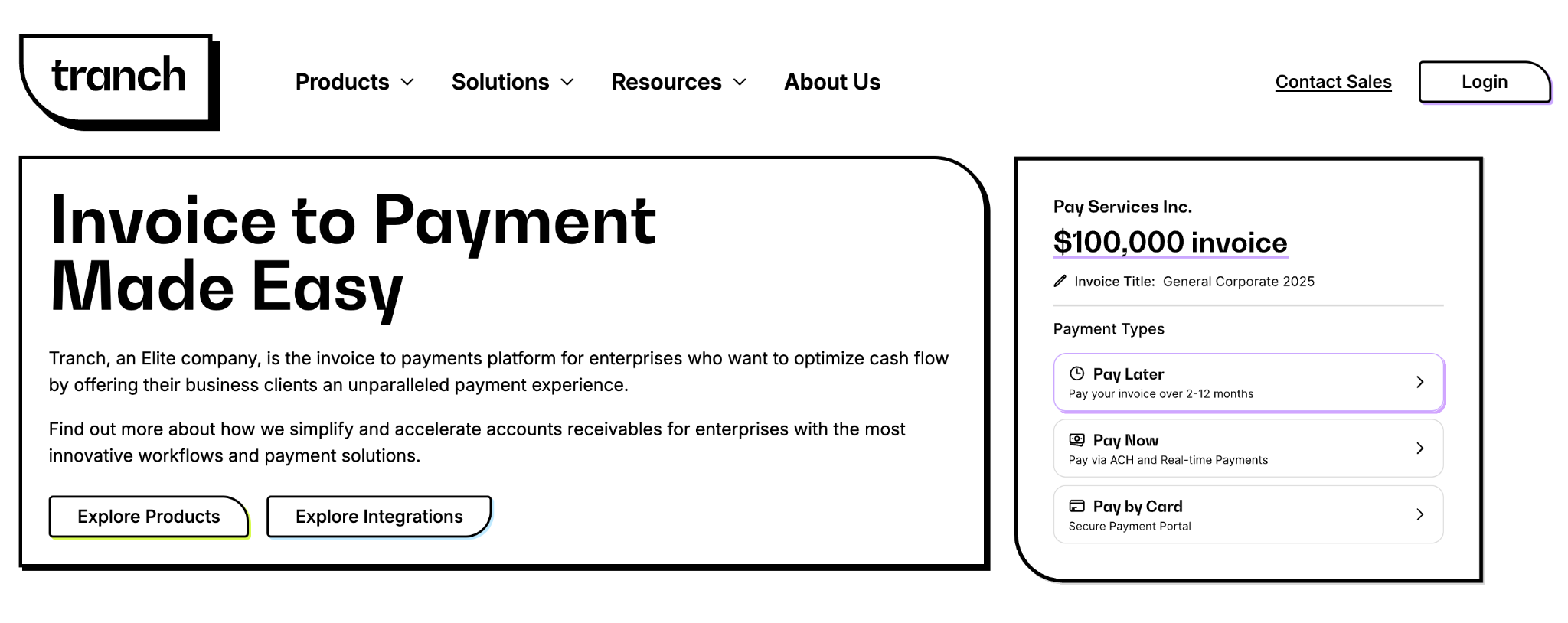
Unlike broader platforms, Tranch is more checkout-focused and best suited for one-time or contract-based transactions rather than recurring SaaS workflows.
Key Features and Benefits
- BNPL terms (up to 12 months) for B2B invoices
- Credit checks and buyer approvals
- Upfront payment to vendors, minus a transaction fee
- Integrates with ERP systems
- Supports API or low-code implementation for invoice and payment workflows
Pros
- Simplifies large-ticket sales with flexible terms
- Seller gets paid upfront, reducing cash flow risk
- Streamlined experience for both buyer and seller
Cons
- Not necessarily designed for CRM or quote-to-cash integration
- Limited support for recurring SaaS or milestone billing
- Better suited for agencies or one-off service deals
Pricing
Specific pricing models are not publicly disclosed; fees typically depend on term length, invoice size, and risk profile (vendors/clients negotiate terms with Tranch)
#4. Resolve (Affirm B2B) – Net Terms Management for B2B Invoicing and Trade Credit
Resolve, spun out of Affirm, focuses on offering net terms to B2B buyers, typically at the invoice or checkout stage. It’s designed for B2B merchants and platforms looking to automate credit checks, offer Net 30/60/90 terms, and improve collections without taking on risk.
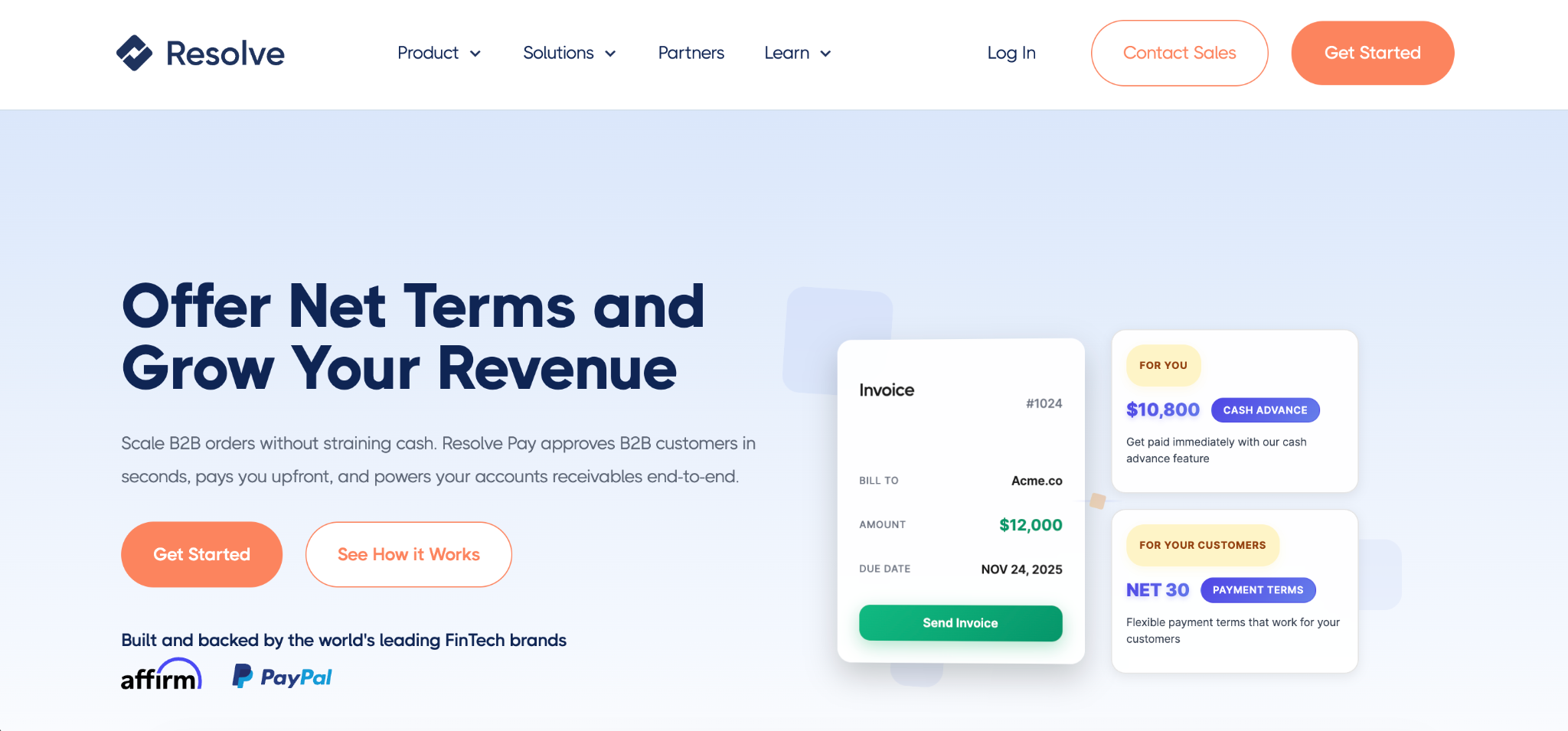
It’s especially popular in industries like wholesale, manufacturing, and B2B marketplaces. For SaaS sellers, it may be limited by a lack of CPQ, CRM, or contract workflow integration.
Key Features and Benefits
- Net terms financing (30/60/90) with credit checks
- Seller payout with Resolve managing buyer repayment
- Buyer portal with invoice tracking and reminders
- Basic API and eCommerce plugin support
Pros
- Automates credit decisions and collections
- Preserves seller cash flow with upfront payments
- Ideal for transaction-based or product-led B2B businesses
Cons
- Not purpose-built for SaaS workflows
- No CPQ/CRM/contract integration
- Limited customization for complex sales motions
Pricing
- Pricing is risk-based and varies depending on advance rate, term length, and buyer profile.
- Sellers can pass fees to buyers.
#5. ChargeAfter – Multi-Lender BNPL Platform for B2B eCommerce
ChargeAfter offers a point-of-sale financing platform that connects merchants with a network of lenders. While it’s primarily built for B2C and retail-style B2B purchases, it provides flexible checkout financing with real-time approvals across multiple lenders.
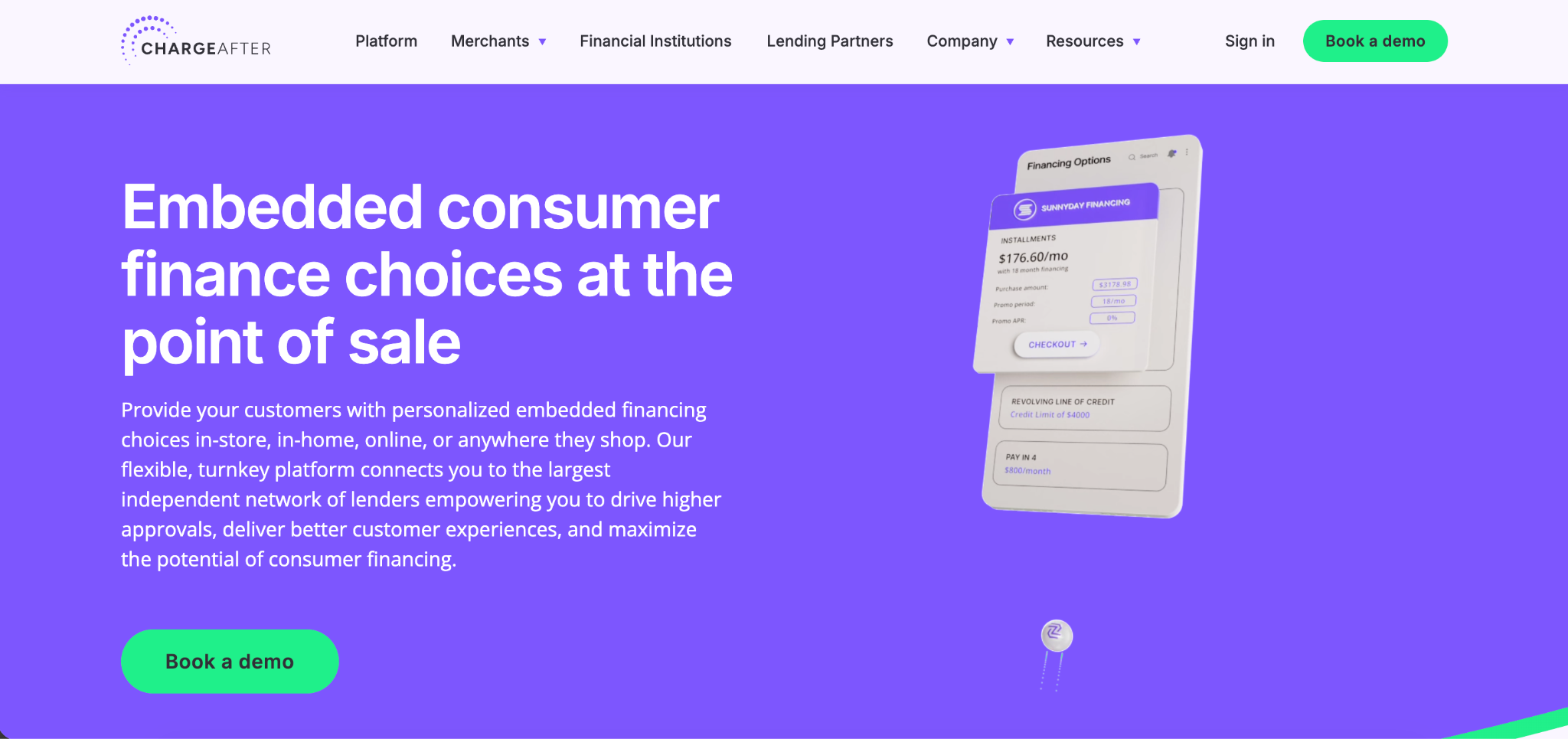
For SaaS sellers, the value is more limited—ChargeAfter lacks native CPQ or CRM integration, and its underwriting is geared toward consumer-style purchases rather than recurring contracts.
Key Features and Benefits
- Multi-lender financing engine with broad buyer approval
- Credit checks and real-time financing offers
- White-labeled checkout experience
- Lender waterfall model to maximize approvals
Pros
- Strong buyer-side flexibility and high approval rates
- Works well for platforms or marketplaces selling bundled SaaS/hardware
Cons
- Not specifically designed as a quote-to-cash CRM/CPQ-native tool.
- No embedded quoting or contract-level financing
- Seller-side controls are limited
Pricing
- Pricing is not published publicly and typically involves per-transaction or partner fees associated with lending products and lender terms.
With so many vendors on the table (each with different strengths, trade-offs, and target use cases) what matters most is finding an embedded finance company built for your revenue model, sales workflow, and growth stage.
Now let’s look at why more SaaS sellers are choosing Ratio to lead that shift.
Ratio Boost: The Embedded Finance Company Modern SaaS Teams Are Partnering With
When B2B SaaS companies rethink how they manage cash flow, close deals, and remove friction from sales, more of them are choosing Ratio.
Behind the company are SaaS operators and finance veterans who’ve lived the pain of slow payments, rigid approvals, and broken quote-to-cash workflows. Ratio exists to solve a systemic problem: the way software is bought, sold, and funded is outdated.
That vision is backed by real momentum.
Ratio recently raised $15.8M and Secures $100M in Lending Capacity, so it’s not just ready to power your next deal, it’s built to solve your cash flow constraints. The company is reimagining embedded finance from the ground up.
And it's working!
SaaS teams using Ratio are seeing faster closes, higher ACVs, better cash flow, and fewer deals lost in procurement limbo.
Join the companies rewriting their revenue playbook. Schedule a free demo today and see what’s possible with embedded financing designed for SaaS.
Disclaimer: All insights in this post are based on publicly available data, vendor websites, and user reviews as of our latest research. While we've prioritized accuracy and relevance for B2B SaaS decision-makers, we recommend validating features, pricing, and fit through vendor demos and tailored consultations before making a final selection.
FAQs
- How Does Embedded Financing Impact Negotiations, Pricing, and Legal Terms?
Embedded financing gives SaaS vendors more flexibility and control during negotiations. Instead of reducing prices or extending terms to meet buyer demands, vendors can offer flexible payment plans (e.g., monthly, milestone-based, or Net 60) while still collecting full payment upfront.
From a legal perspective, the impact varies by provider and deal structure. In some cases, financing terms can be incorporated into the standard contract. In others, payment obligations shift to the financing provider, which manages billing and collections separately.
The overall effect is often fewer payment-related negotiations, but the legal structure depends on the model used.
- What Happens If a Buyer Defaults or Churns Early?
With non-recourse embedded finance providers, the seller is protected. If a buyer defaults or churns, the financing partner absorbs the loss. There are typically no clawbacks, penalties, or repayment obligations for the SaaS vendor, as long as the deal meets the provider’s approved criteria. This is why provider selection is critical; terms vary by platform.
- How Do Financing Fees Compare to Discounts or Internal Credit?
In most cases, embedded finance fees are lower than the effective cost of discounts or internal credit. For example, a 10-20% discount to close a deal may cost more than a 4-8% financing fee, especially when you account for CAC payback and working capital impact. Unlike revenue-based financing, embedded finance is deal-specific and doesn’t dilute equity or add long-term repayment obligations.
- When Is Embedded Financing Not a Good Fit?
Embedded financing works best for mid-sized to large SaaS deals with predictable revenue and contract value. It may not be ideal for:
- Small-ticket deals (<$2K)
- Usage-based or highly variable billing
- Buyers with internal credit lines or procurement financing
- How Does Financing Affect Buyer Trust and Relationships?
When positioned well, embedded financing builds trust by removing budget barriers and aligning payment with value. For enterprise deals, integration into quoting and contracting is key—it should feel like part of the offer, not an afterthought.
↗
The Closing Motion Platform
Sellers on Ratio see up to 30% higher close rates and 25% higher ACV.


