Your HaaS Financing Guide to Power Hardware Subscriptions in 2026
Hardware sold as a subscription breaks the cash-flow model it was priced for: the buyer pays monthly while the seller has already covered inventory, logistics, and support. Traditional lenders rarely underwrite subscription hardware, so the gap stays open. This guide covers what HaaS financing is, how capital and contracts move, the criteria that separate a real partner from a repackaged lender, and the three providers hardware sellers use today.


Table of contents

You're trying to sell hardware on a subscription plan but your customers want to pay monthly while you need cash upfront. That mismatch slows down deals, hurts cash flow, or forces you to discount. This blog covers the top HaaS financing providers in 2026 that help you offer flexible payments to your buyers while getting you paid upfront.
The Challenge: Hardware subscriptions are in demand—but the cash flow model is broken.
You’re ready to offer Hardware-as-a-Service. Buyers want flexibility, lower upfront costs, and predictable OpEx—and that demand is only accelerating. The HaaS market is projected to grow from $154B in 2026 to over $525B by 2031, at nearly 28% CAGR.
But scaling HaaS is harder than it looks.
You’re covering inventory, logistics, and support costs upfront—while customers pay you back slowly over time. For many HaaS sellers, that means the deal may be signed, but the cash still arrives too late to support growth. And traditional lenders rarely fund subscription-based hardware.
To scale, you need a financing model built for how HaaS actually works. In this post, we’ll break down the top 3 HaaS financing providers (including options like Ratio Boost) to help you choose the right partner.
But first, let’s look at the real-world challenges HaaS sellers are facing.
What Real-World Challenges are HaaS Sellers Facing Today?
Making the shift to Hardware-as-a-Service isn’t just a pricing decision—it’s a full operational and financial transformation. Once the model is in motion, hardware companies quickly uncover a different set of obstacles: not just how to sell subscriptions, but how to support, fund, and scale them sustainably.
These aren’t hypothetical concerns. They’re patterns we’ve seen across early-stage startups and scaling enterprises alike—surfaced in finance forums, CFO Slack groups, operator threads, and venture banking case studies.
Ranging from inventory constraints to bank rejections, pricing pressures to margin leaks—these are the real constraints that HaaS sellers are up against after the contract is signed.
Let’s break them down.
1) Upfront Hardware Costs Create a Working-Capital Gap That is Hard to Close
Hardware businesses consistently point out a core issue: profitability does not equal liquidity.
In multiple r/startups discussions, finance leaders explain that even profitable companies rely on credit lines because of the timing gap between:
- Paying for production and inventory
- Shipping hardware
- Invoicing customers
- Collecting cash
One commenter with finance experience at large companies explains that this gap forces businesses to use working-capital financing even when margins are strong. Another adds that millions in COGS and payroll cash may be required before revenue is realized.
For HaaS sellers, this problem is amplified. Subscription pricing delays cash even further, making the working-capital gap a structural risk, not a temporary one.
2) Selling Subscriptions Means Sellers are Expected to Bankroll the Hardware
In a Workstations-as-a-Service discussion, an MSP founder states the problem directly:
“We’d prefer not to be the one carrying the financial burden… trying a HaaS model for the first time could be costly for us, if we’re the financial backers.”
This reflects a common seller dilemma:
- Customers want monthly pricing
- Sellers want adoption and deal velocity
- But sellers do not want to self-fund hardware, inventory, and long payback periods
This is one of the clearest reasons HaaS sellers search specifically for HaaS financing, not generic loans.
3) Hidden Risk and Operational Costs Quietly Squeeze Margins
Service providers repeatedly warn that HaaS pricing must account for more than hardware cost.
In sysadmin discussions about renting enterprise devices, sellers point out the need to price in:
- Liability
- Insurance
- Maintenance teams
- Device failures and replacements
One provider notes that the markup required to make this viable is “extreme.”
For HaaS sellers, this means:
- Risk is cumulative
- Underpricing leads to slow margin erosion
- Problems surface months later, not at deal close
4) Growth Increases Capital Pressure Instead of Relieving it
Many hardware founders describe hitting a growth ceiling for reasons unrelated to demand.
In r/startups discussions, sellers explain that:
- Inventory requires upfront cash
- Production cycles are capital intensive
- Distributors and deployments require stock
One comment summarizes it plainly: funding and inventory become the bottleneck.
In a HaaS model, every new customer increases the amount of capital required. Growth accelerates cash pressure before it improves cash flow.
5) Supply-Chain Volatility Turns into Financing Risk
Hardware sellers also deal with operational risks that directly affect financing.
Founder discussions highlight:
- Component price fluctuations
- Supply shortages
- Import and certification issues
- Product returns due to compliance failures
One example describes a business losing momentum after early orders due to silicon shortages and returned units.
From a finance perspective, this volatility:
- Increases perceived risk
- Raises cost of capital
- Or prevents access to financing altogether
6) Traditional Banks Struggle to Support Subscription-Based Hardware Models
Finance leaders frequently report being turned away by banks despite traction.
Common reasons cited include:
- Subscription contracts are hard to underwrite
- Inventory is weak collateral
- Early-stage businesses lack long financial histories
In r/EcomCFO, one post summarizes the experience bluntly: banks say no, repeatedly.
As a result, sellers either delay growth or rely on expensive short-term capital.
7) Risk Accumulates on the Seller’s Balance Sheet
In most HaaS models, sellers retain ownership of the hardware.
This means they carry:
- Depreciation
- Maintenance and replacement risk
- Insurance exposure
- Customer default risk
A sysadmin discussion about VARs explains why large vendors prefer channel partners: once the VAR pays, default risk shifts away from the vendor.
HaaS sellers without a financing partner keep all of this risk in-house.
8) Operational Delays Quietly Turn into Finance Leakage
HaaS sellers also deal with process friction that has real financial impact.
Operators describe:
- Customer sign-off delays
- Post-sale changes
- Deployment dependencies
In the same Workstations-as-a-Service discussions that we discussed earlier, sellers mention absorbing financing charges while waiting for billing to begin.
Even short delays can lead to:
- Interest expense
- Missed cash-flow projections
- Margin leakage that compounds over time
9) Buyer CapEx vs OpEx Preferences Complicate Deal Structuring
Finally, sellers must adapt to how buyers want to pay.
Sysadmin discussions highlight a common pattern:
- Smaller organizations prefer OpEx for predictability
- Larger enterprises often prefer CapEx for depreciation and control
To sell OpEx when buyers demand it, sellers need financing support behind the scenes.
At this point, one thing should be clear.
The challenges above all point to one core issue: selling hardware as a subscription breaks traditional cash-flow and risk models. That gap isn’t a failure of execution. It’s a structural problem between customer commitment and cash realization, and HaaS financing exists to help close it. HaaS financing exists to solve exactly that, and understanding what it is and how it works is the next step before evaluating any provider.
What Is HaaS Financing (Let’s Unfold All About It)
HaaS financing refers to specialized financing arrangements designed specifically for hardware businesses that sell their products as a subscription.
Instead of the seller:
- Paying for hardware upfront
- Carrying the asset on their balance sheet
- Waiting months or years to recover costs
A HaaS financing provider steps in to fund the hardware cost upfront or restructure how and when capital flows. In practice, that matters because recurring contract value only becomes strategically useful when it can be turned into usable cash flow at the right time.
The goal is simple:
Allow hardware sellers to offer subscription pricing without self-funding growth or absorbing disproportionate financial risk.
This is not generic lending.
It is financing built around the realities of:
- Long payback periods
- Subscription and usage-based contracts
- Hardware depreciation
- Ongoing service and support obligations
To make sense of all this, it helps to look at how HaaS financing works in practice. That’s where we’ll go next.
How HaaS Financing Works
To understand HaaS financing properly, it helps to stop thinking about it as “a loan” and instead view it as a structured way to move capital, risk, and ownership across the lifecycle of a subscription hardware deal.
Based on how HaaS-focused lenders, venture banks, and finance operators describe it, the process typically works like this.
Step 1: The Hardware is Sold as a Subscription, Not a One-Time Purchase
The starting point is a commercial decision by the seller.
- Hardware is bundled with software, services, or support
- Pricing is structured as monthly, quarterly, or usage-based payments
- Contracts are usually multi-year to match the useful life of the asset
At this stage, nothing about financing has happened yet. This is purely how the product is sold.
What matters from a financing perspective is that the seller now has contracted future cash flows instead of an upfront payment.
Step 2: The Financing Provider Underwrites the Contract, Not Just the Hardware
This is where HaaS financing diverges from traditional lending.
Instead of underwriting only:
- The resale value of the hardware, or
- The seller’s balance sheet
HaaS financing providers evaluate a combination of:
- The subscription contract terms
- Contract duration and termination clauses
- The customer’s credit profile
- Expected cash flows over time
Research and venture banking commentary consistently highlight this point: contracted, recurring revenue is what makes HaaS models financeable, even when payback periods are long.
In other words, financing is based on visibility, not speed of repayment.
Step 3: Hardware Costs are Funded Upfront or at Deployment
Once the deal is approved, the financing provider supplies capital so the hardware can be deployed.
Depending on the structure, the provider may:
- Fund the cost of manufacturing or purchasing the hardware
- Pay the seller at deal close or at deployment
- Cover logistics or installation-related costs
The key outcome is the same: the seller does not have to wait for subscription payments to fund the hardware.
From the customer’s perspective, nothing changes. They still pay according to the subscription agreement.
Step 4: Customer Payments and Financing Repayments Run in Parallel
After deployment, two things happen at the same time:
- The customer pays according to the subscription schedule
- The financing arrangement runs separately in the background
Depending on the model:
- The seller may repay the financing provider over time, or
- The provider may collect payments directly and remit a portion to the seller
What matters is that the customer experience remains unchanged, while capital recovery is structured behind the scenes.
Step 5: Ownership and Risk are Deliberately Allocated
One of the most important aspects of how HaaS financing works is intentional allocation of risk.
Based on the provider and structure:
- Hardware ownership may stay with the seller or transfer to the financier
- Which party is exposed if a customer stops paying is set out in the agreement rather than left implicit
- Collections, recovery, or redeployment may be handled by the provider
This is not accidental. Research consistently shows that HaaS financing exists largely to prevent risk from silently accumulating on the seller’s balance sheet as deployments scale.
Step 6: The Seller Operates with Planned Capital Instead of Reactive Funding
Once HaaS financing is in place, the seller’s financial behavior changes.
- Hardware deployments are no longer funded deal by deal
- Growth planning is no longer constrained by short-term liquidity
- Cash forecasting becomes predictable
The business model itself does not change. What changes is how growth is funded and risk is managed.
That is why finance leaders treat HaaS financing as infrastructure, not a one-off funding event.
Now that the mechanics are clear, this brings us to the next section, which covers the benefits of HaaS financing for hardware sellers.
What are the Key Benefits of HaaS Financing for Hardware Sellers
In conversations with hardware founders and finance leaders, the same questions come up again and again: When do we actually get cash? What limits our ability to scale? Where does the risk sit as deployments grow?
Instead of answering these in theory, the benefits below respond to those questions directly — showing what changes in a hardware business once HaaS financing is designed to support subscription-scale operations:
1. Liquidity Improves
Question answered: When do I get cash?
HaaS financing provides capital upfront or at deployment, even though customers pay over the life of the contract. This eliminates the delay between incurring hardware costs and recovering capital, allowing sellers to fund deployments without waiting for recurring payments to accumulate.
This benefit is strictly about timing of cash, not growth or risk.
2. Growth Becomes Scalable
Question answered: What limits my growth?
Without financing, each new deployment competes with working capital. With HaaS financing, hardware expansion is funded externally, so growth is no longer constrained by internal liquidity.
This benefit is about capacity to scale, not cash flow mechanics.
3. Exposure Is Defined Upfront
Question answered: What risk stays with me?
Depending on structure, ownership of the hardware and responsibility for collections and recovery can sit with the financing provider rather than the seller. Rather than being discovered as deployments increase, this is set out in the agreement from the start.
This benefit is about where obligations sit, not margins or pricing.
4. Unit Economics Become Predictable
Question answered: Can I price and forecast with confidence?
HaaS financing replaces ad-hoc funding and reactive borrowing with a defined cost of capital. Sellers can price contracts knowing exactly how financing affects margins over the full contract term.
This benefit is about economic predictability, not growth or liquidity.
5. HaaS Model Becomes Operationally Sustainable
Question answered: Can I run this model for years, not quarters?
Because HaaS financing supports ownership, maintenance, refresh, and redeployment cycles, sellers can plan for the entire asset lifecycle instead of absorbing costs unpredictably later. This is what turns HaaS from a sales model into a long-term operating model.
This benefit is about durability, not cash or risk.
Once HaaS reaches this point, the question shifts. It’s no longer “does financing help?” but “what kind of financing actually supports this model?” So let's now address this question.
Types of HaaS Financing Methods (and When Each Makes Sense)
There’s no one-size-fits-all financing model for HaaS. The right choice depends on your business stage, deal size, customer base, and appetite for owning risk.
Here are the three most common financing methods used by hardware sellers today and when each one makes sense:
1. Traditional Bank Financing (Loans and Credit Lines)
This option comes from the commercial lending market, not the HaaS ecosystem.
Banks typically offer:
- Term loans
- Revolving credit lines
- Working capital facilities
Underwriting is based on:
- Balance sheet strength
- Historical financial performance
- Collateral such as inventory or fixed assets
Market Options
- JPMorgan Chase – Commercial Banking
- Wells Fargo – Commercial Lending
- Bank of America – Business Credit Facilities
- Comerica Bank – Tech & Equipment Lending
These are traditional lenders hardware sellers might approach for lines of credit or term loans.
When this Makes Sense
- Early experimentation with a HaaS model
- Short-term liquidity needs
- Businesses with strong balance sheets
Limitations
- Not designed for subscription payback timelines
- Does not scale with deployment volume
- Leaves asset ownership and default risk with the seller
2. Equipment Leasing and Asset Finance Companies
This option comes from the equipment leasing market, commonly used in IT and industrial hardware.
Leasing companies:
- Own the hardware asset
- Lease it directly to the customer
- Pay the seller upfront
Market Options
- GreatAmerica Financial Services — offers Hardware‑as‑a‑Rental (HaaR®) and As‑A‑Service funding programs that let sellers turn hardware into monthly revenue and get funded upfront.
- CSI Leasing — national equipment financing partner that works with VARs, resellers, and MSPs.
- DLL (De Lage Landen) — global equipment finance provider often used for IT and industrial hardware financing.
(Note: These are classic equipment finance companies that now support subscription‑like billing models but are not true embedded HaaS providers.)
When this Makes Sense
- Large, standardized hardware deployments
- Enterprise buyers familiar with leasing
- Sellers willing to give up some control of the customer relationship
Limitations
- Less flexibility for bundled software and services
- Rigid pricing and contract structures
- Fragmented customer experience
3. Embedded HaaS Financing Providers
This option comes from the embedded finance and HaaS-native market.
Embedded HaaS financing providers integrate financing directly into how hardware is sold and monetized. Financing is structured around:
- Customer contracts
- Subscription or usage-based payments
- Hardware economics over the contract lifecycle
Market Options
- Ratio Boost — purpose‑built embedded HaaS financing for hardware + software subscriptions.
- Capchase — vendor financing that lets companies get paid upfront while customers pay over time for hardware and tech deals.
- Gynger — embedded pay‑over‑time option integrated into invoices and checkout flows. (Note: broad vendor financing but applicable to payment flexibility on hardware sales.)
When this Makes Sense
- Multi-year HaaS contracts
- Hardware bundled with software and services
- Sellers who want to retain pricing control and customer ownership
What this Unlocks
- Upfront liquidity aligned with subscription revenue
- Financing that scales with deployments
- More deliberate allocation of risk
This is the category where HaaS-specific benefits most reliably materialize.
But the market is crowded. While many providers promise seamless HaaS financing, not all are built to deliver on the reality of scaling subscriptions. Labels are easy, execution is harder.
Before you pick a partner, you need to know what great looks like. So before we explore the top providers, let’s define what to look for.
What to Look for in a HaaS Financing Provider for Your Business
Choosing the right financing partner can make or break your HaaS model. You’re not just picking a lender, you’re embedding a financial engine into your sales motion, pricing structure, and customer experience. So the decision deserves rigor.
Here’s a structured framework to evaluate HaaS financing providers—based on what the best-in-class options deliver:
Strategic Fit & Business Impact:
Operational & Structural Criteria:
Now that you know what to look for in a HaaS financing partner, the final step is understanding who actually meets those criteria.
Three HaaS Financing Providers for Hardware Companies (2026)
Now, considering the criteria above, we narrowed the market down to three financing providers that hardware sellers actually use to support HaaS models in the U.S.
This is not a long directory and that’s intentional. The reason?
True HaaS financing is still a narrow category. Most providers either fund assets, offer generic credit, or support SaaS contracts. Very few are built to finance hardware sold on recurring terms.
The providers below stand out because they:
- Tie capital to recurring contracts, not just hardware value
- Enable sellers to offer subscription pricing without self‑funding growth
- Support modern HaaS economics across sales, finance, and operations
Hence this is the short list:
Each takes a different approach to financing hardware‑led businesses. Let’s break down how each works, where they fit best, and what trade‑offs to expect — so you can choose the right partner for your HaaS model.
1. Ratio Boost

Ratio Boost is an embedded HaaS financing solution that helps hardware and robotics companies make expensive products more affordable for buyers while helping sellers get paid upfront. That matters because, in HaaS, close is not just the signed contract. Close is getting to cash without losing momentum after the buyer says yes.
It enables sellers to offer payment flexibility to customers at the point of sale, removing budget constraints that typically slow or block deals. Buyers get flexible payment options, and sellers improve how signed deals turn into cash. That is where the Closing Motion matters: turning a buyer’s yes into cash upfront instead of letting the deal stall in fragmented handoffs after signature.
In that sense, Ratio Boost is not just embedded financing. It is part of the Closing Motion Platform, helping hardware sellers connect buyer payment flexibility with seller cash certainty.
Key features
- Embedded payment flexibility at the point of sale, directly inside CRM or CPQ
- Upfront payout to the seller, even when buyers pay over time
- Seller-controlled financing economics: choose whether the financing fee is passed to the buyer, split, or absorbed
- Ratio runs billing and collections on the financed contract, so your team is not chasing payments
- No personal guarantees and no personal credit pulls
- Fast buyer approvals, enabling quicker onboarding and procurement
- Supports conversion to X-as-a-Service models, including bundling hardware, install, and professional services into ARR
Pros
- Purpose-built for hardware and robotics sold as subscriptions
- Removes customer budget friction without forcing seller discounting
- Improves deal conversion, speed, and pricing discipline
- Billing and collections are handled by Ratio, not your finance team
- Reduces CAC payback and negotiation time
Cons
- The contract structure typically needs a review by finance and legal before the first deal
Pricing
Ratio positions Boost as transaction-based embedded financing rather than a standalone subscription product.
Demo Availability
Demo and onboarding available upon request.
Final Verdict: Best Overall Fit for HaaS
Ratio Boost is the strongest fit for Hardware-as-a-Service businesses because it is built around how HaaS actually scales today. It enables sellers to offer deep payment flexibility to buyers while collecting full contract value at signature, so each new deployment is funded at close rather than out of working capital. This makes it especially well suited for hardware and robotics companies operating multi-year, subscription-based models.
2. Capchase
Capchase enables hardware and software vendors to offer flexible payment terms to customers while receiving the contract value upfront. It is designed to remove payment friction from B2B deals where buyers prefer to pay over time but sellers need immediate cash to operate and scale.
Capchase Pay is commonly used by tech-enabled hardware companies selling subscriptions or multi-term contracts, where traditional bank financing or leasing does not align with how revenue is collected.
Key Features
- Upfront payment to the seller for signed contracts
- Customers pay Capchase over time under agreed schedules
- Embedded financing experience integrated into sales or checkout flows
- Capchase handles billing and collections, reducing operational overhead
- Supports multiple payment structures (monthly, quarterly, annual)
- Financing tied to contracted revenue rather than one-time invoices
Pros
- Works for hardware businesses selling alongside software or services
- Helps close deals where upfront payment is a blocker
- Offloads collections and payment management from the seller
- Familiar financing model for companies already selling subscriptions
Cons
- Primarily positioned for SaaS, with hardware as an extension
- Not explicitly designed around long-term HaaS asset lifecycle or redeployment
- Pricing and cost structure are not publicly disclosed
Pricing
Capchase positions Pay as a sales-enablement financing solution rather than a self-serve pricing product.
Demo Availability
Available through sales-led onboarding.
Final Verdict: Best for SaaS-Like HaaS Models
Capchase is a solid option for HaaS businesses whose economics closely resemble subscription software. It works well when the primary challenge is cash timing at contract close, rather than long-term asset ownership or lifecycle complexity. For hardware sellers with standardized deployments and predictable contracts, Capchase can remove payment friction and support growth.
3. Gynger Pay
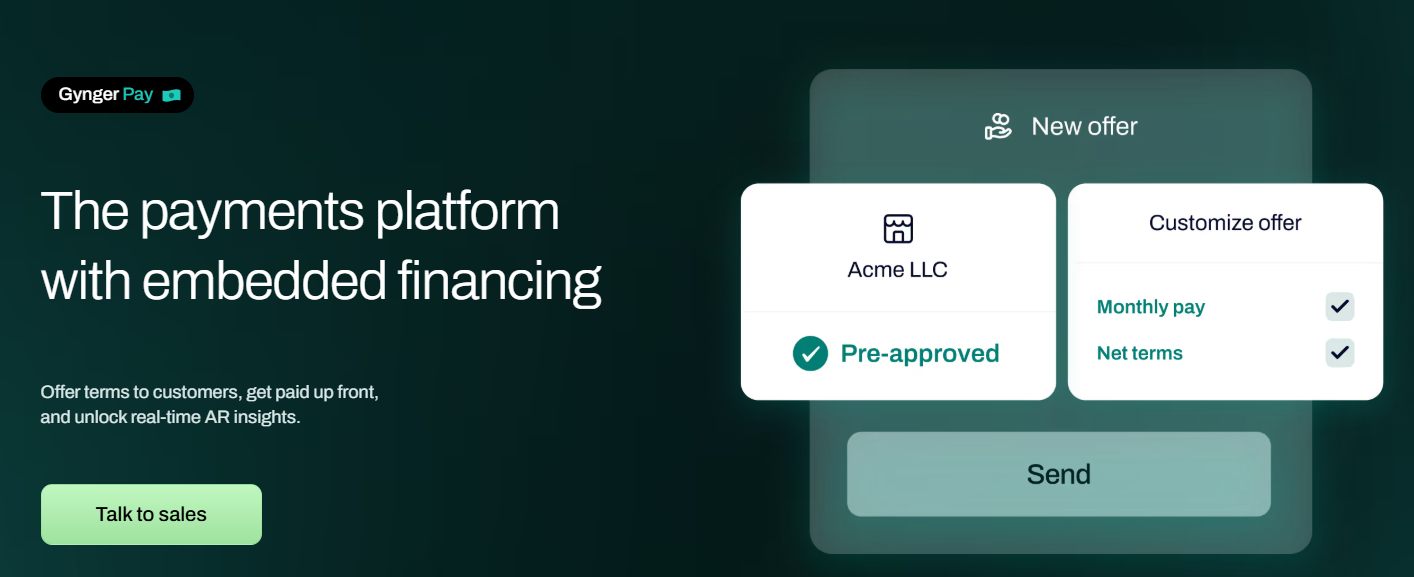
Gynger provides embedded financing that allows technology and hardware vendors to offer pay-over-time options directly within invoices or checkout flows, while receiving payment upfront.
Gynger positions its solution as a way to convert receivables into immediate working capital, helping sellers avoid delayed cash flow when customers request extended payment terms.
Key Features
- Embedded financing widget added to checkout or invoicing
- Upfront payment to the vendor
- Buyer pre-qualification and fast approval process
- No-code integrations with accounting and finance tools
- Centralized dashboard to manage financed transactions
- Designed to work without changing the buyer purchasing experience
Pros
- Simple way to add payment flexibility without rebuilding sales workflows
- Fast setup and buyer approval timelines
- Useful for hardware sellers offering installment-style payments
Cons
- Broad “technology vendor” positioning rather than HaaS-specific
- Does not explicitly address subscription hardware economics or asset lifecycle
- Best suited for pay-over-time purchases rather than HaaS operating models
Pricing
Not publicly disclosed. Access is through a sales conversation.
Demo Availability
Available via sales consultation.
Final Verdict: Best for Transactional or HaaS-Adjacent Use Cases
Gynger fits scenarios where hardware sellers need to offer pay-over-time options at purchase while still collecting cash upfront. It is best suited for simpler, transactional, or shorter-term HaaS use cases. Sellers building deeply integrated, long-term HaaS operating models should evaluate how well it aligns with subscription economics and ongoing lifecycle needs.
Quick Disclaimer: All information in the above section is based on publicly available content from each provider’s official website, reviewed as of September 2026. Conclusions reflect each provider’s current product positioning, public messaging, and stated use cases as of 2026, without assumptions about future capabilities or roadmaps.
So far, we reviewed what makes a great HaaS financing provider. We also looked at how leading options stack up. One pattern is clear: Teams building true HaaS models need Ratio Boost—not just for cash flow relief, but to accelerate growth. In the next section, we will tell you why.
Why Hardware Businesses Choose Ratio Boost as Their HaaS Financing Partner to Scale Without Compromise
“Ratio is helping us transform the purchasing experience. We see many ways to sell more deals faster by speeding up the procurement process for our customers. And we collect upfront no matter how the customer pays.”
— David Keane, Founder & CEO, Bigtincan
If you're too serious about scaling your HaaS model and not just testing the waters, you need more than flexible terms. You need a financing engine that works with your sales motion, doesn’t slow down deals, and frees up cash when you need it most.
Ratio, the Closing Motion Platform, does exactly that.
We’ve already walked through the core benefits earlier—but behind the scenes, Ratio brings even more firepower that makes it the go-to choice for high-growth hardware teams:
- Reliable Capital Pool: Backed by $411M in committed funding, Ratio can support multi-million-dollar deployments without breaking stride. No cap tables. No credit pulls. No delays.
- Dynamic Underwriting: Ratio uses machine learning to evaluate deals in real-time. As a result, speeding up approvals without sacrificing diligence.
- Smart Pricing Logic: Match your payment offers with what customers can afford, without hurting your margins.
These aren’t just nice-to-haves. They’re what separate a financing workaround from a true growth infrastructure.
Want to see how this can work for you?
Let’s talk. Book a quick 20-minute strategy call with our team, and we’ll walk you through how embedded financing could support your model, speed up your sales cycle, and help you scale HaaS without compromise.
Frequently Asked Questions About HaaS Financing
- How Is HaaS Different From Traditional Leasing or Renting?
HaaS is a subscription model where the value delivered is the service, not the hardware itself. Unlike leasing — which is essentially paying for ownership over time — HaaS keeps ownership with the service provider and includes lifecycle services such as maintenance, upgrades, and support.
Traditional loans or leases often require personal or equipment collateral and treat the hardware like an asset to be owned. HaaS financing focuses on contracted recurring revenue as the basis for underwriting.
- Can Financing Cover Both Hardware and Software Costs in a HaaS Deal?
Yes. While some lenders limit financing to the hardware component, true HaaS financing — like embedded contract financing — can cover hardware + bundled software + services as a single economic package. This makes cash flow smoother and aligns funding with how the business recognizes revenue.
- Can HaaS Companies Fuel Cash Flow Without a Financing Partner?
Yes, to some degree. Companies often structure contracts to accelerate cash by offering annual or quarterly prepayments, or by bundling professional services into upfront charges. However, these methods still depend on customer behavior and may not fully bridge the working‑capital gap. Which is why many turn to specialized HaaS financing partners
- Is HaaS Financing Only for IT or Tech Hardware?
No. While IT equipment like laptops, servers, and networking gear is common, HaaS applies across many industries (from industrial machinery to robotics) where subscription economics make sense. Finance partners that underwrite based on contract structure and recurring revenue — not just hardware type — can serve a broad range of hardware sellers.
- What Are the Risks of HaaS Financing?
Risks include:
- Long payback periods stretching cash flows
- Customer churn that reduces expected revenue
- Asset obsolescence requiring hardware refreshes
- Contractual ambiguity delaying billing
These are the reasons strong underwriting and clear contracting are central in HaaS financing. They help mitigate risk for both the seller and the financing partner.
- How Do I Know If HaaS Financing Makes Sense for My Business?
Consider HaaS financing if:
- You’re offering hardware subscriptions with deferred cash flow
- Upfront working capital is a bottleneck to closing deals
- You want to preserve balance sheet and avoid traditional debt
- You need financing scalable with your recurring revenue
A strategy conversation with a financing partner helps benchmark your payback, risk profile, and capital needs.
↗
The Closing Motion Platform
Sellers on Ratio see up to 30% higher close rates and 25% higher ACV.


