The 4 Robotics Equipment Financing Partners Every Hardware Company Should Know
Robotics equipment financing is becoming essential for hardware sellers facing budget objections, slower approvals, and cash flow pressure. This guide explains the main financing models, the seller-side challenges, and partners like Ratio Boost, NFS Capital, North Star Leasing, and KLC Financial so you can choose the right fit.


Table of contents

Robotics equipment financing is becoming essential for hardware sellers facing budget objections, slower approvals, and cash flow pressure. This guide explains the main financing models, the seller-side challenges, and partners like Ratio Boost, NFS Capital, North Star Leasing, and KLC Financial so you can choose the right fit.
The Challenge: A Deal Is Stalling. The Buyer Wants the Robot. The Budget Does Not.
Robotics is a high-cost purchase, so many buyers do not choose to pay the full amount upfront. Instead, eight out of 10 buyers rely on leases, secured loans, or lines of credit to make the investment workable. That creates a clear tension for sellers. Buyers want more manageable payment terms to move forward, but sellers still need cash fast enough to support production, delivery, and growth.
That is why robotics equipment financing is worth exploring from a seller's point of view. It allows sellers to offer payment flexibility to buyers while getting paid sooner through a third-party financing provider.
In this guide, I'll break down what robotics equipment financing means for sellers, why it matters, and which financing partners hardware companies should consider in 2026.
What Is Robotics Equipment Financing (From a Seller's POV)?
At its core, equipment financing is a way for a business to acquire costly machinery without paying the full cost upfront. It includes loans or leases that let companies spread payments over time while using the equipment immediately.
When applied to robotics, this means vendors and buyers no longer have to treat an expensive robotic system as a large cash outlay. Instead, financing enables the buyer to use the equipment now while making predictable payments over a set term, often 12-60 months.
From a seller's point of view, the term expands:
- Reduces friction at the point of sale
- Makes automation affordable to more buyers
- Lets sellers offer terms or embed financing without tying up their own cash flow
In practical terms, robotics equipment financing can take multiple forms:
- Loans that pay the vendor upfront
- Leases that spread cost over time
- Embedded BNPL or vendor financing that integrates payment plans at the point of sale
The key idea is simple: the buyer gets access to the robot now, the seller gets paid, and the cost is spread over time.
It sounds straightforward. Almost obvious.
But here's the real reason it's becoming non-negotiable: the market is shifting fast, and sellers without a financing option are getting left behind. Let's break down why.
What Challenges Made Robotics Equipment Financing a Must-Have for Hardware Sellers?
I consistently hear this from robotics sales leaders I meet at conferences and on LinkedIn:
We know our robots deliver ROI - faster throughput, fewer defects, safer floors. But every time we walk into a buyer meeting, we're up against one brutal reality: budget cycles and capital constraints slow our deals to a crawl. A CFO doesn't decide on value, they decide on cash flow.
This isn't anecdotal. Studies show that capital cost remains the number one barrier to robotics adoption, cited by 71% of industrial companies surveyed, with lack of funding hurting confidence in automation projects.
And that's just one reason. There are several others why robotics equipment financing has become a must-have:
1. Long Sales Cycles
Cost is one of the biggest barriers to adoption. And when your robot's price starts at $100K or more, you're not just selling value - you're navigating bureaucracy.
Even with strong buyer enthusiasm, deals get stuck in layers of internal approvals:
- Capex committees
- Procurement reviews
- Budget meetings
You're chasing alignment across functions that move on different clocks. By the time funding clears, your buyer's priorities might have shifted - or a competitor who offered financing within the deal already closed.
Financing solves that by collapsing the timeline. It gives budget-constrained buyers a "yes" path now, not next quarter.
2. Discounting Eats Into Margins
When a buyer hesitates, reps often reach for the only lever they control: price.
You offer a 10% discount. Then 15%. Now you've shaved $30K off your $200K product just to bridge a cash problem that isn't yours.
But here's the kicker: even at the lower price, the buyer still struggles to afford it. You've lost margin, and the deal may still stall.
This is what financing solves. It shifts the conversation from "How cheap can we get this?" to "How can we afford it on our terms?" You protect value and price integrity while helping the buyer say yes.
3. Budget Objections from SMB and Mid-Market Buyers
Most robotics vendors start by targeting enterprise clients. But the real growth is moving downstream.
SMBs and mid-market manufacturers are hungry for automation, but they're operating with tighter budgets and slower purchasing processes. They ask:
- "Can we split this over 12 months?"
- "Is there a leasing option?"
- "Do you offer deferred terms?"
When the answer is no, they go cold.
The demand is there. The ROI is proven. But when the cash isn't available, the deal doesn't move. Financing changes the math entirely. It gives buyers access - and it gives you reach.
4. In-House Financing Brings Operational Risk You Didn't Plan For
Some vendors try to fill the affordability gap themselves: offering internal payment plans, maybe stretching terms manually. It seems like a quick fix.
But the second a buyer delays or defaults, your team's now handling:
- Credit risk
- Chasing invoices
- Managing collections
- Legal overhead
You're not just delivering robots - now you're running a mini bank. And it's absorbing your time, people, and working capital. When vendors partner with external financing providers, they offload risk and unlock scalability.
5. Cash Flow Gaps Hold Back Growth, Even After You Close
The irony? You finally win a deal, but you don't get paid for 60 to 90 days.
Meanwhile, you're ordering components, paying engineers, shipping units, and onboarding support. In hardware, cash flow timing is everything.
If money flows in slower than it flows out, growth becomes strained. You either slow down delivery or start dipping into reserves.
Financing flips that equation. You get paid upfront (or close to it), while the buyer pays over time. That means faster reinvestment, smoother operations, and more deals on deck.
What Does Robotics Equipment Financing Actually Make Possible for Hardware Vendors?
More than 8 in 10 companies now use financing when they buy equipment, from machinery to robotics systems. As a seller, this shift changes your go-to-market playbook. Financing isn't just a buyer convenience - it's a revenue driver for you.
Here's what it unlocks:
1. Faster Deal Velocity
Large capex expenditures trigger internal budget processes that take time - often weeks, if not quarters. When financing turns a six-figure capex item into a structured payment, it reframes the financial discussion internally and reduces those procedural checkpoints. Industry financing trends show leasing still accounts for a significant share of equipment purchases (about 25% of purchase volume in 2023), highlighting how widely companies prefer spreading cost versus delaying or canceling investments.
2. Wider Market Access
Enterprise buyers may have deep pockets, but the velocity of growth is often in mid-market and small business segments. Their adoption is constrained by capital availability. Robotics communities often echo this reality: beyond capability and ROI, raw cost remains the biggest barrier to deploying even moderately priced automation systems. Financing makes these buyers viable.
3. Embedded, Self-Serve Financing at Point of Sale
Typically, financing meant paperwork, third parties, and separate approval cycles - all adding friction that kills momentum. A modern financing structure provided by partners like Ratio Boost surfaces payment options inside the quote or checkout. It helps buyers decide and commit without losing traction. This also reflects broader market growth: the global equipment financing ecosystem is robust and expanding, projected to grow meaningfully over the next decade.
4. Full Risk Offload
If sellers offer internal extended terms, they carry all the credit risk, collections overhead, and operational complexity. Using a financing structure externalizes that burden. Equipment and vendor financing programs are widely recognized for helping companies maintain pricing integrity while making purchases affordable.
5. Improved Pricing Power and Reduced Discounting
When buyers say the price is too high, the underlying issue is often cash timing, not value. Financing lets sellers solve the cash-flow concern without adjusting list price, reducing the need for discounting just to get budget buy-in.
6. Accelerated CAC Payback and Revenue Recognition
Selling robotics involves effort: demos, pilots, engineering support, and long sales cycles. If you don't get paid until months after a close, your customer acquisition cost (CAC) payback period expands, slowing growth reinvestment. By monetizing deals upfront through financing, sellers recognize revenue sooner, recover CAC faster, and free up working capital. For more on this model, see: Optimizing Robotics-as-a-Service Models for Subscription Economy.
What Robotics Equipment Financing Models Exist Today?
When robotics vendors think about how their buyers pay for six-figure equipment, the default answers tend to be: cash, loans, or leases. But the landscape is evolving fast, and missing the right financing strategy means leaving deals on the table.
Here are the primary models being used in the field today:
1. Equipment Loans
How it Works
The buyer takes a loan from a bank or lender to buy the robotics system. They repay it over time, and the robotics company gets paid upfront.
Real-World Usage
- Common in industrial robotics purchases where buyers want to own the system.
- Often seen in deals with established manufacturing firms with strong credit.
Example Providers
- U.S. Bank Equipment Finance
- Wells Fargo Commercial Capital
- Balboa Capital (robotics-specific lending arm)
Challenges
Slow underwriting. Buyer must qualify. Can delay deals by weeks.
2. Equipment Leasing
How it Works
The buyer rents the equipment - often from a third-party lessor or the vendor - paying monthly. They can buy it later (capital lease) or return it (operating lease).
Real-World Usage
- Used for expensive cobots or warehouse automation systems.
- Appeals to buyers focused on ROI and flexibility over ownership.
Example Providers
Challenges
Lessor owns the asset. May require security deposits or structured terms.
3. In-House Financing or Deferred Payments
How it Works
The vendor (robotics company) directly offers payment terms - often split payments, delayed invoicing, or milestone-based contracts.
Real-World Usage
- Seen in early-stage sales or where external financing isn't viable.
- Also used as a stopgap to win deals.
Challenges
Ties up cash flow. The vendor bears all risk: default, delay, and collections.
4. Government or Green Manufacturing Subsidies
How it Works
Buyers use public grants, low-interest loans, or tax incentives (like Section 179 in the U.S.) to offset the cost of robotics purchases.
Real-World Usage
- Robotics used in energy, clean manufacturing, or workforce automation.
- Subsidy-backed financing makes deals easier to close.
Example Programs
- DOE's Advanced Manufacturing Office grants
- SBA 504 Loans for equipment
- California Competes (local/state automation credits)
Challenges
Not scalable. Paperwork-heavy. The buyer has to navigate the funding bureaucracy.
5. Embedded Financing and Pay-Later Models (The Option Most Sellers Don't Know About)
How it Works
Instead of referring buyers to banks or tying up your own cash, you embed flexible payment options directly into the sales process. This is available through partnering with a financing provider like Ratio Boost, who pays you upfront while giving your buyer the option to pay over time via installment-style BNPL.
Real-World Usage
- Robotics-as-a-Service (RaaS) providers
- High-velocity sales teams in hardware + SaaS
- Hardware vendors trying to accelerate CAC payback and win more SMB deals
What Makes It Different
- Sellers don't carry collection risk
- Seamless CRM and quote tool integrations
- No delays - buyers are approved quickly
- Seller collects the total contract value upfront
Example Providers
- Ratio Boost (designed for robotics, RaaS, and hardware/SaaS combos)
- Others in early stages: Wisetack (limited B2B), Jaris (retail-heavy)
Before You Choose: How the Models Actually Stack Up
You've just seen the five main ways robotics equipment is financed today. But how do they compare when it comes to cash flow, buyer flexibility, and deal speed?
This scorecard breaks it down so you can see why embedded financing isn't just newer - it's better for both sellers and buyers.
| Model | Upfront payment to seller | Buyer flexibility | Seller risk offload | Integrated at point of sale | Speed to close | Best for |
|---|---|---|---|---|---|---|
| Traditional bank loans | Yes | No | No | No | Slow | Enterprise buyers with strong credit |
| Equipment leasing | Yes | Limited | Yes | No | Moderate | Buyers seeking non-ownership options |
| In-house deferred payment | No | Yes | No | Manual | Variable | Early-stage vendors trying to win deals |
| Govt / subsidy programs | Partial | Limited | No | No | Slow | Buyers in targeted industries (clean mfg, DOE, SBA) |
| Embedded financing (e.g., Ratio Boost) | Yes (upfront) | Yes | Yes | Yes | Fast | Robotics vendors scaling across markets |
I've now covered every major financing model from equipment loans and leases to embedded pay-later models. Each has its place. But the key difference lies in how well these solutions support today's B2B sales motion - especially in robotics, where speed, flexibility, and risk offload can make or break a deal.
What sellers really need is a financing partner that:
- Gets buyers approved fast
- Offers flexible payment plans built for hardware + SaaS
- Pays vendors upfront, without collections headaches
- Embeds seamlessly into your CRM or sales tools
Next, let's look at the top providers that are helping robotics vendors close deals faster and expand their market reach.
Top 4 Robotics Equipment Financing Providers Built for Growth-Focused Hardware Teams
Not all financing providers actually help robotics vendors close more deals. Most finance buyers. Very few are designed to support the seller's sales motion, remove budget friction, and keep cash flow healthy while scaling.
Below are four financing providers that genuinely help robotics and hardware teams sell expensive systems without slowing deals or taking on unnecessary risk: Ratio Boost, NFS Capital, North Star Leasing, and KLC Financial.
1. Ratio Boost
Ratio Boost is Ratio's embedded financing product - and the core application of the Closing Motion Platform. The Closing Motion approach connects proposals, embedded BNPL, and collections in a single flow so hardware sellers can offer flexible payment options without managing the back-end complexity themselves.

To understand it in practice: imagine a robotics vendor selling an automation system. The buyer sees clear ROI but can't deploy that much capital upfront due to budget cycles or competing priorities. Traditionally, this deal would stall, get discounted, or require the vendor to extend risky internal payment terms.
With Ratio Boost, the vendor presents multiple payment options directly in the quote or checkout - monthly, deferred, multi-year, or custom - while Ratio purchases the contract via a true sale. The vendor receives cash upfront. Ratio assumes responsibility for billing, collections, and credit risk.
The result:
- Buyers get affordability and flexibility
- Sellers get certainty, speed, and cash
- No one has to act like a bank
This model is particularly effective for robotics-as-a-service, automation deployments, and hardware + software bundles where budget - not product value - is the friction point.
Key Features and Benefits
- Embedded Point-of-Sale Financing: Ratio Boost embeds directly into the sales flow, allowing vendors to present financing options at the exact moment a buyer is deciding. Benefit: fewer stalled deals and less negotiation around payment terms.
- True Sale Structure: Ratio purchases the contract outright instead of advancing a loan. Benefit for sellers: immediate cash realization and off-balance-sheet treatment. Benefit for finance teams: no debt, no personal guarantees, no AR exposure.
- Customizable Financing Economics: Vendors can choose whether financing fees are passed to the buyer, split, or absorbed. Benefit: margin protection without forcing discounts.
- Risk, Billing, and Collections Fully Transferred: Ratio underwrites buyers and manages all post-sale collections. Benefit: sellers avoid credit risk, disputes, and operational overhead.
- Support for X-as-a-Service Models: Hardware, installation, and professional services can be structured as recurring payments. Benefit: higher contract value and smoother expansion into RaaS or subscription-based offerings.
Robotics Customers
These are the robotics companies already using Ratio Boost to remove budget friction and accelerate procurement:
Tuff Robotics
"We're a startup who helps companies with labor challenges. With Ratio, our customers are able to onboard online and get approved almost immediately. Boost was easy to implement and has helped us grow tremendously."
- Kyle Dou, Founder and CEO, Tuff Robotics
Bigtincan (Hardware + Software Sales Motion)
"Ratio is helping us transform the purchasing experience. We see many ways to sell more deals faster - by speeding up the procurement process for our customers. And we collect upfront no matter how the customer pays." - David Keane, Founder and CEO, Bigtincan
Integration
Ratio Boost integrates seamlessly into existing sales infrastructure, including CRM and CPQ systems like Salesforce.
Pricing
- No upfront platform fees
- No personal guarantees
- Sellers receive almost all contract value upfront
- Financing fees can be allocated to buyer, seller, or shared
Ratio also provides a funding calculator and cash-flow simulator to model impact before launch.
Learn More
Want to explore how Ratio Boost works for robotics sales? Visit the Ratio Boost product page.
2. NFS Capital
NFS Capital is a vendor-focused equipment financing provider that enables hardware and robotics sellers to offer financing options directly to their customers as part of the sales process.
Imagine a robotics integrator selling a $120K system to a mid-market manufacturer. The buyer wants the solution but cannot justify a full upfront purchase due to capital allocation constraints. With NFS Capital, the seller can introduce equipment loans or lease structures during the deal, allowing the buyer to move forward while spreading payments over time. Source: NFS Capital industrial automation and robotics equipment financing.
Key Features and Benefits
- Vendor-Focused Equipment Financing: NFS Capital works directly with sellers to support customer purchases. Benefit: financing becomes a sales enablement tool rather than a post-sale hurdle.
- Loans and Lease Structures for Equipment Sales: Supports standard equipment financing structures aligned with hardware purchases.
- Seller Enablement Model: Financing is positioned as part of the vendor's offering to the buyer. Benefit: higher close rates when buyers face capital constraints.
Robotics Customers
NFS Capital supports equipment sellers across industrial and technology categories, including robotics and automation vendors. (Their site positions them as a vendor finance partner; no robotics-specific customer testimonials were available at time of writing.)
Integration
Financing is typically coordinated through vendor-led workflows and financing applications rather than embedded CRM or CPQ tools.
Pricing
Pricing and terms vary based on deal size, equipment type, and buyer credit profile. Rates are not published publicly.
Learn More
Visit NFS Capital's website.
3. North Star Leasing
North Star Leasing is an equipment financing provider offering vendor-supported financing for automation and robotics equipment.
Imagine a manufacturer ready to invest in robotics but unwilling to commit a large upfront payment that could strain cash flow. North Star Leasing enables sellers to offer financing structures that spread the cost of robotics and automation equipment over time, helping buyers proceed without delaying deployment.
The result:
- Sellers remove budget friction from robotics deals
- Buyers adopt automation sooner
- Financing supports growth without draining cash reserves
Key Features and Benefits
- Automation and Robotics Equipment Financing: North Star explicitly supports robotics and automation equipment.
- Flexible Equipment Leasing Structures: Financing tailored to equipment acquisition needs. Payments aligned with operational ROI.
- Relationship-Led Vendor Financing: Emphasis on guided financing support, helpful for sellers managing complex buyer requirements.
Robotics Customers
North Star Leasing supports robotics and automation buyers across manufacturing and operations. (Their robotics financing pages focus on category support rather than named testimonials.)
Integration
Primarily a vendor-finance and procurement-aligned workflow rather than embedded CRM tools.
Pricing
Pricing varies based on equipment, term length, and buyer credit profile. No public rates are listed.
Learn More
Visit North Star Leasing's automation and robotics financing page.
4. KLC Financial
KLC Financial is an equipment financing provider with a dedicated Robotics Equipment Financing offering. It supports robotics manufacturers and integrators by providing third-party financing options that allow buyers to acquire robotic and automation systems without paying the full cost upfront.
In practice, KLC is used when a robotics vendor has a buyer who wants the equipment but prefers to preserve capital or align payments with ROI. Instead of delaying the deal or extending internal payment terms, the vendor introduces KLC's financing or leasing options as part of the purchase, and the buyer repays KLC over time.
Key Features and Benefits
- Equipment Loans: KLC provides fixed-term equipment loans to finance robotics and industrial automation systems. The buyer repays KLC over time while the vendor receives payment at the time of purchase. Benefit: removes upfront budget objections without extending internal payment terms.
- Equipment Leasing Options: KLC offers leasing structures that allow buyers to pay for the use of robotics and automation equipment over a defined period. Benefit: keeps deals moving when capital purchase approvals are a blocker.
- Vendor Financing Programs: KLC runs vendor programs that allow sellers to offer KLC-backed financing to customers, with KLC handling underwriting and repayment. Benefit: financing can be offered without carrying credit risk or managing collections.
- Sale-Leaseback and Working Capital Financing: KLC provides structures that allow buyers to unlock capital from equipment while continuing to operate it. Benefit: helps close deals when buyers need liquidity flexibility to proceed.
Robotics Customers
KLC Financial does not publicly list a broad set of named robotics end-customers, but it does disclose recently funded transactions including:
- Robotic Welding System - $148,000 financing: Funded to automate repetitive welding operations and reallocate skilled labor to higher-value work. (End-customer name not disclosed publicly.)
- Rittal Automation Systems (RAS) Equipment - $391,000 financing: Financing for automated enclosure modification and wire-processing machinery used in industrial automation and robotics-driven manufacturing environments.
Integration
KLC Financial's financing is introduced through vendor-aligned financing workflows. Vendors coordinate financing as part of the sales process, with buyers completing financing applications directly with KLC. KLC does not position its offering as embedded within CRM, CPQ, or checkout systems.
Pricing
KLC Financial does not publish fixed pricing or rate cards. Pricing and terms are determined based on equipment type, financing structure (loan, lease, sale-leaseback), and buyer credit profile. All pricing is provided on a deal-by-deal basis.
Learn More
To learn more about KLC Financial's Robotics Equipment Financing, visit their Robotics Equipment Financing page.
Quick Comparison of Robotics Equipment Financing Providers
Below is a side-by-side view of the four providers, comparing who they're built for, how financing is structured, and when sellers get paid.
| Provider | Financing model | Seller gets paid | Robotics focus | How financing shows up |
|---|---|---|---|---|
| Ratio Boost | Embedded, true-sale financing | Upfront | Explicit (robotics customers + use cases) | Inside quote / checkout / CRM |
| NFS Capital | Traditional vendor finance | At funding | General equipment (incl. robotics) | Parallel financing workflow |
| North Star Leasing | Leasing and equipment finance | At funding | Explicit (automation and robotics) | Vendor-led financing process |
| KLC Financial | Loans, leases, sale-leaseback | At funding | Explicit (robotics financing page) | Vendor programs + applications |
While all four providers support robotics purchases, only one is designed to operate inside the sales moment - making it the most strategic choice for growth-focused robotics sellers. To understand why, let's take a closer look at Ratio Boost.
Why Ratio Boost Is the Best Fit Robotics Equipment Financing Partner for Sellers
The Sorting Robotics founder said it best:
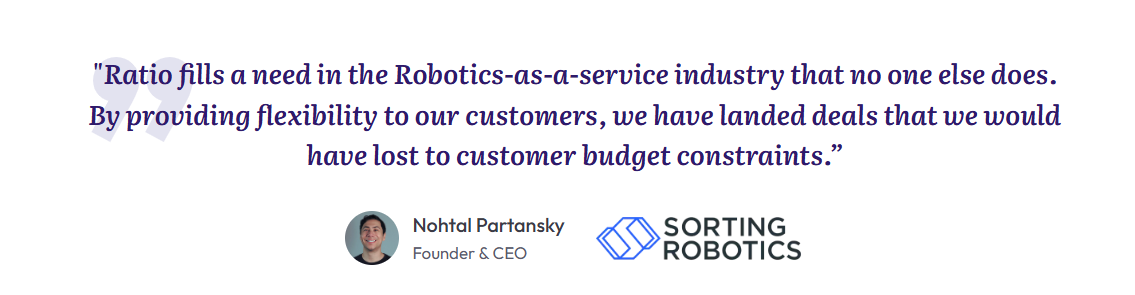
That quote captured something deeper than financing. It captured momentum.
Modern robotics companies are not just selling machines. They are building recurring, service-driven businesses that look and scale like SaaS. The Closing Motion Platform is how Ratio supports that shift. It connects three things that sellers usually manage in silos: proposals (so buyers see their options at the right moment), Boost (so buyers can pay over time while sellers get paid upfront), and collections (so handoffs don't fall apart after the close). That end-to-end architecture is what makes Ratio different from a standalone financing tool.
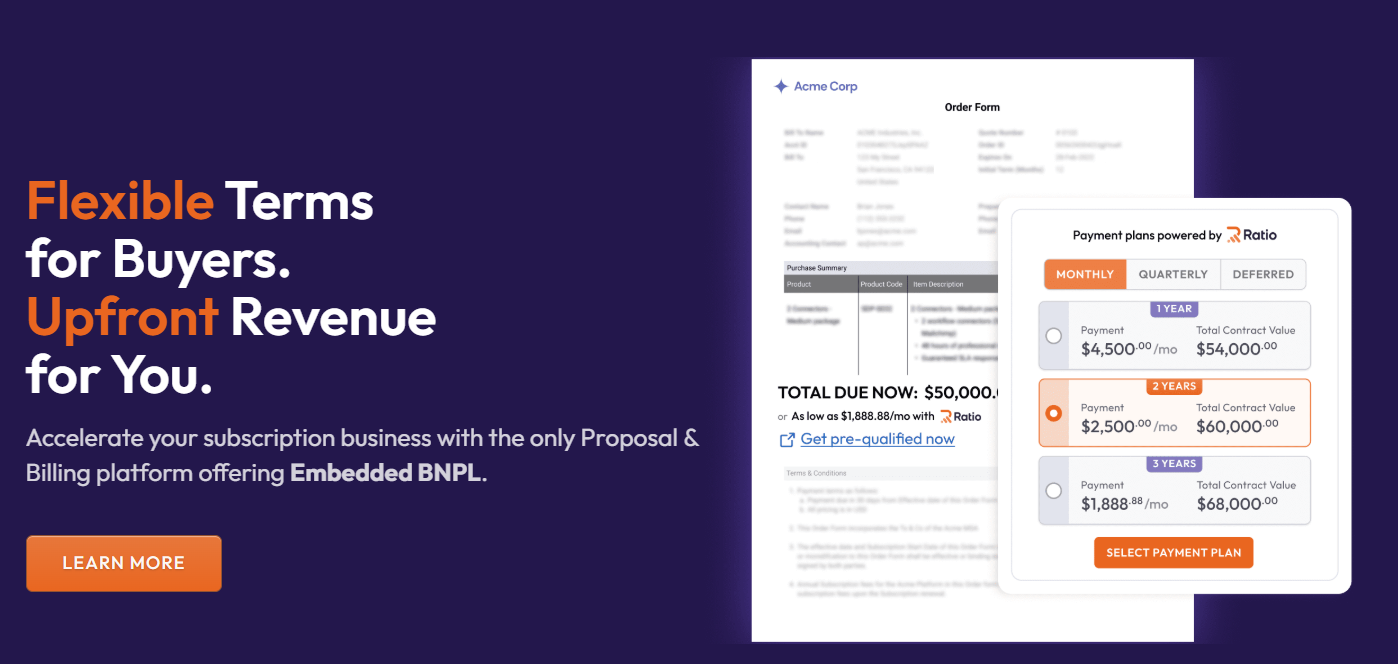
Specifically, Ratio Boost stands out because it is:
- Backed by a $411M dedicated funding pool built to support repeat and high-volume deals [VERIFY: confirm current funding figure before publishing]
- Built on dynamic underwriting that adapts to real business signals, not rigid rules
- Designed to scale with your sales velocity, not slow it down
- Built for Robotics-as-a-Service and recurring revenue models
If you want to understand how this could work for your robotics business, you can book a 20-to-25-minute strategy call. I'll walk through your use case in a practical, no-pressure conversation.
Frequently Asked Questions About Robotics Equipment Financing
1. Who Owns the Robotics Equipment During the Financing Period?
Ownership depends on the financing model. With equipment loans, ownership typically transfers to the buyer at purchase. With leases, the financing provider usually retains ownership until the end of the term, at which point a buyout option may apply. In subscription or usage-based models, ownership and usage rights are defined contractually rather than through asset transfer.
2. What Happens at the End of a Robotics Equipment Financing Term?
End-of-term options vary by structure and provider. Buyers may be able to purchase the equipment, renew the agreement, upgrade to newer systems, or return the equipment. This flexibility is especially important in robotics, where technology evolves quickly and upgrade paths matter.
3. Can Startups and Small Businesses Qualify for Robotics Equipment Financing?
Yes. Robotics equipment financing is not limited to large enterprises. Many providers evaluate buyers based on cash flow, business stability, and the economic value of the deployment rather than company size alone. Early-stage and mid-market companies often qualify when the use case is well defined.
↗
The Closing Motion Platform
Sellers on Ratio see up to 30% higher close rates and 25% higher ACV.


